Do I Have to Report Income Without a 1099? (2026)
This is education, not tax advice. I'm not a CPA or EA. State taxes are not covered.
Schedule C cited below is IRS draft as of 2026-10-07 — DRAFT, NOT FOR FILING. If a line changes, this page is updated in place with a dated note at the foot of the article.
- Last checked
- Tax year
- 2026
- Core line
- Schedule C, line 1 — gross receipts or sales
- Changes
- Update log (1)
§1One job, one tax year, one line
One job, one tax year, one line. The job is real estate agent. The year is 2026. The line is Schedule C, line 1 — gross receipts or sales, the first line of Part I, the income part of the form.
Article 2 read Schedule SE, the short form that turns net profit into self-employment tax. This article starts one form earlier, with the question that arrives every January in a first-year agent's mailbox — or doesn't. Two brokerages paid this agent in 2026. A third payment came straight from a client. Only one envelope ever showed up. The question of the article is narrow: does the missing paperwork change the number on line 1? We read the line, and the two tests that decide whether a form gets printed at all.
§2Where the income lands: line 1 reads the records
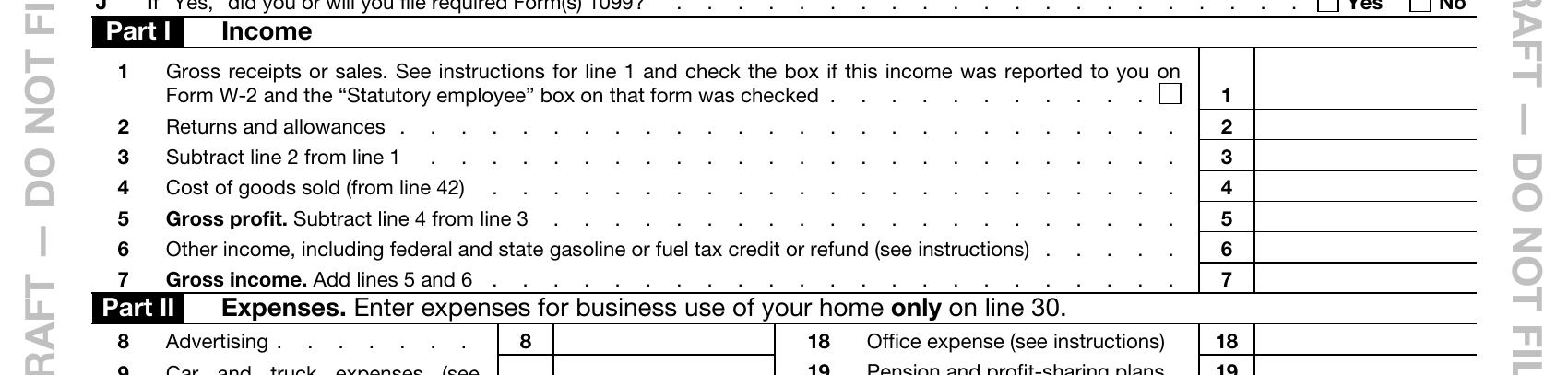
Schedule C, Part I is titled Income, and its first line is the whole subject: gross receipts or sales.
Read what that line is built from. Publication 334, the IRS tax guide for small business — the 2025 edition, the latest posted — states the general rule for business income in Chapter 5, its chapter on kinds of income: report all of it — including income that was not reported to you on a Form 1099 filed by the payor — unless the income is excluded by law. The IRS's own page on Form 1099-K states the same rule from the other side: a filer reports all income on the return, including amounts that never appeared on any form at all — cash, property, goods, digital assets — and income of this self-employed kind is reported on Schedule C.
So line 1 is not a sum of envelopes. It is a total from the filer's own records: every commission statement, every closing record, every check. The lines beneath it adjust that total — returns and allowances come off at line 2, and Part I runs down to gross income at line 7 — but they adjust the records figure; none of them replaces it with a pile of forms. The forms that arrive in January are the payers' paperwork. Line 1 is the filer's. Whether those two piles match is a different question from what the line asks — and the line asks for the records total.
§3Worked example: three streams, one envelope
One worked example, with numbers used only in this article.
A real estate agent — hypothetical, not a prediction, not your numbers — finishes a first self-employed year, 2026, with three payment streams.
First: commissions from Brokerage A, $12,400. A Form 1099-NEC arrived for this one; Box 1 shows the $12,400.
Second: commissions from Brokerage B, $1,700. No form arrived — and, as the next section reads, no form was required to be issued for this payment in 2026.
Third: a fee of $850, paid directly by a client, by check. No form in hand for that one either.
Now line 1. $12,400 plus $1,700 is $14,100. Plus $850 is $14,950. That is the gross receipts figure on line 1 — the records total, all three streams. Not $12,400, which is only the stream that came with an envelope.
And this example stops here, at line 1, on purpose. Expenses, net profit on line 31, the Schedule SE calculation from Article 2 — none of that is recomputed in this article. One line, read completely: $14,950.
| Stream | Amount | Form in hand? | Why |
|---|---|---|---|
| Brokerage A commissions | $12,400 | Yes — Form 1099-NEC, Box 1 | At/over the payer's $2,000 threshold (Instructions for Forms 1099-MISC and 1099-NEC, 12/2026) |
| Brokerage B commissions | $1,700 | No | Under $2,000 for that payer in 2026 — no Form 1099-NEC required to be issued |
| Direct client fee, paid by check | $850 | No | No information return in hand; still business income under Publication 334, Ch. 5 |
| Schedule C line 1, gross receipts | $14,950 | — | $12,400 + $1,700 + $850 — the line reads the records total, not $12,400 |
§4The Fork: the payer's test is not the filer's test
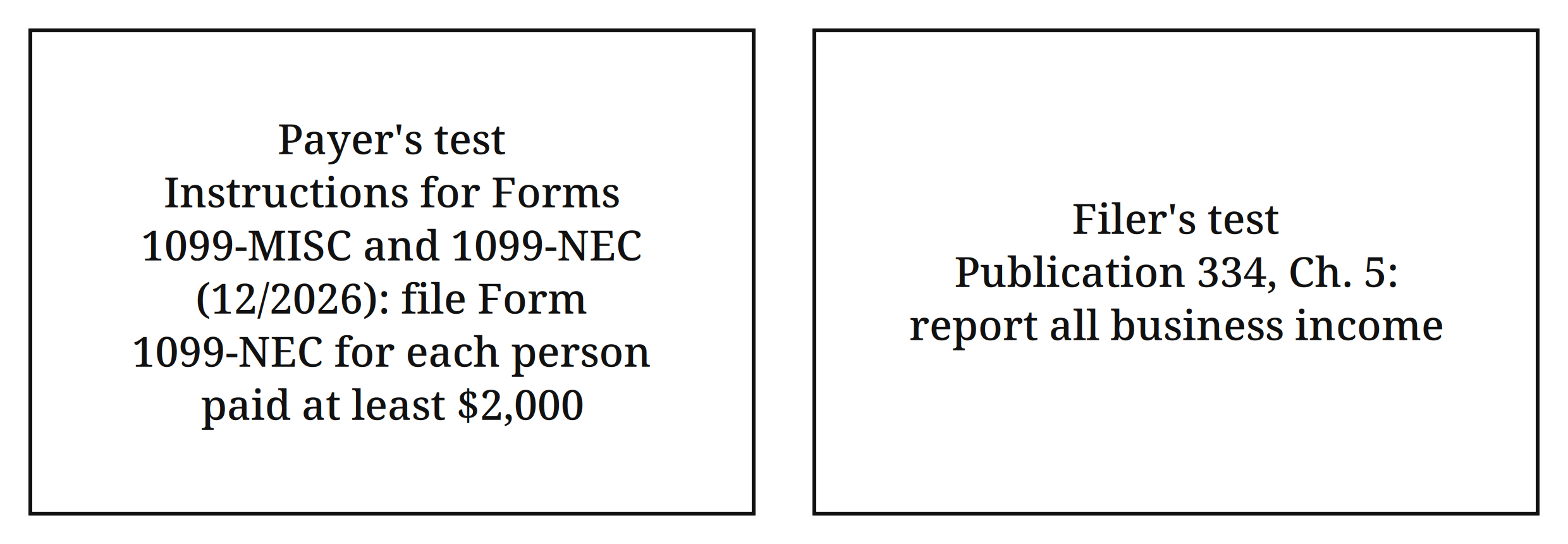
Split card — Payer's test: file Form 1099-NEC for each person paid at least $2,000 (Instructions for Forms 1099-MISC and 1099-NEC, 12/2026); Filer's test: report all business income (Publication 334, Ch. 5).
Here is the fork, and it is a fork between two people's paperwork.
The instructions for Forms 1099-MISC and 1099-NEC, in the December 2026 edition, open the Form 1099-NEC instructions this way: a payer files the form for each person the payer has paid at least $2,000 for services. Read the direction of that sentence. It is written to the payer. It is the payer's filing test, and its threshold decides whether a piece of paper gets printed and mailed. For payments before 2026, that payer threshold was $600 — a $1,700 payment in an earlier year would have come with an envelope.
Publication 334 marks the change itself. For reportable payments made after 2025, the information-reporting threshold rises to $2,000, and the publication files that under What's New for 2026 as an information-reporting item. A reporting change. It changes which envelopes exist — nothing else. Brokerage B paid $1,700 in the example, under the $2,000 line for that payer, so no Form 1099-NEC was required from Brokerage B, and none arrived. That is the threshold working exactly as printed.
What the threshold never does is appear in the recipient's test. The recipient's rule, from the same publication's income chapter, carries no dollar floor: report all business income. Two tests, two forms, two people. The payer's test sorts payers into who must file a form. The filer's test puts every dollar of business income on Schedule C, line 1. Mistaking the first test for the second is the entire error this article exists to read out loud.
§5The neighbouring form: Form 1099-K runs a third test
One neighbouring form, briefly — because its name sounds like it answers the same question, and it runs a different test again.
Form 1099-K is filed by third-party settlement organizations — payment platforms — and under Fact Sheet 2025-08, such an organization is not required to file one unless the gross reportable payments to a payee exceed $20,000 and the number of transactions exceeds 200. Both conditions, together. And one guardrail, stated plainly so the tests never merge: payments made by payment card are a separate category with no threshold at all — a Form 1099-K can be issued for card payments of any size. The $20,000-and-200 test belongs to the platforms. It is never attached to card payments, or to the payer's $2,000 test.
The fact sheet draws the same bottom line this article started from: a payment that is not reported on a Form 1099-K is not, by that fact alone, outside the return. Income is reported whether or not a form arrives — whichever form is the one that didn't arrive.
§6The case: issued, mailed, never received
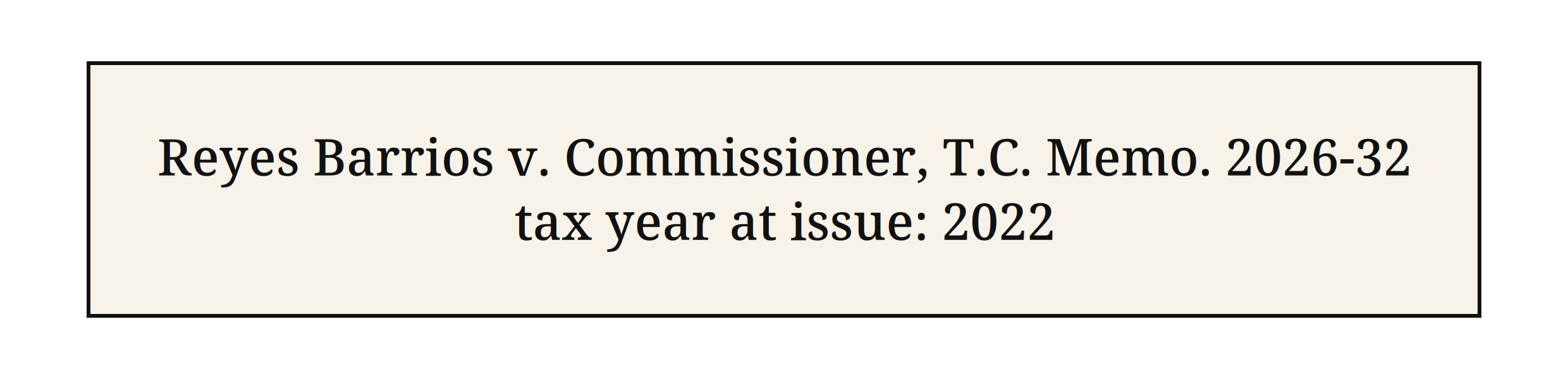
Case card — Reyes Barrios v. Commissioner, T.C. Memo. 2026-32 — tax year at issue: 2022.
One case, stated as fact, because it is the issued-form version of this article's question.
In Reyes Barrios v. Commissioner, a Tax Court memorandum decision, the filer omitted $15,206 of Form 1099-NEC nonemployee compensation from his return for 2022 — the tax year at issue, not 2026 — and the payer had issued the form: it had been mailed to a previous address and reached him only after he filed. The Tax Court granted summary judgment for the IRS — failing to receive an information form does not excuse a taxpayer from the obligation to report the income it would have shown.
Hold the two situations apart, because the article has now shown both. Situation one: a form was required, was issued, and never reached the filer — that is the case. Situation two: no form was ever required, because the payer sat under the $2,000 threshold — that is the example. Different paperwork, different reasons. Both end at the same place: the income is counted in the records total on Schedule C, line 1.
§7What line 1 does not cover
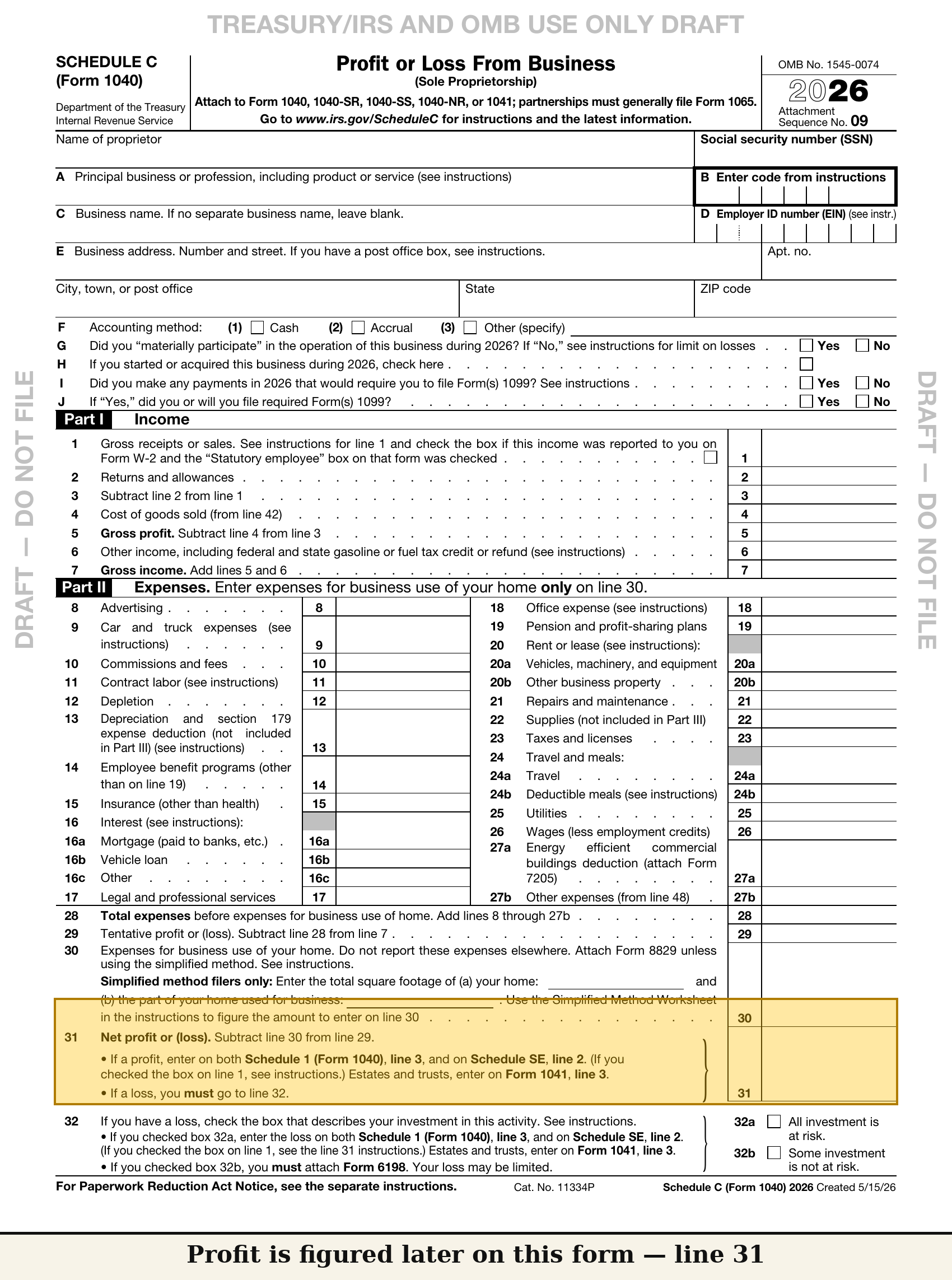
Schedule C full-page draft, greyed, with three callouts: "Profit is figured later on this form — line 31" / "The payer's own filing test is the payer's paperwork" / "State taxes: not covered".
What line 1 does not do, to close the reading.
It does not figure profit. Line 1 is gross receipts; the expense section and line 31's net profit are later lines of this same form, and the self-employment tax on that profit was Article 2's reading. It does not judge the payer: whether Brokerage B, or any payer, met its own filing test is the payer's paperwork question; this article reads only the filer's line. It does not cover state taxes — this site does not cover state taxes, in this article or any other. And it does not settle what counts as business income in an unusual fact pattern: a payment that mixes personal and business purposes, an exchange of services instead of cash, a commission from a prior year paid back. The general rule is printed above. Its edges are not.
§8Software numbers vs ask-a-human numbers
The arithmetic software can carry on this line: adding the streams your records already list, and holding the total on line 1 — provided the records themselves are complete, the input everything else depends on.
Numbers and questions to take to a human before acting on them: whether a stream that arrived with no form is business income in your specific facts; what happens when a form that did arrive shows an amount your records dispute — the return still has to reconcile the two piles, and that reconciliation is a question of facts; and whether a payer who never issued a form was required to issue one in the first place.
That is Schedule C, line 1, as the 2026 draft prints it: gross receipts, figured from the filer's own records — $14,950 in this article's example, of which exactly one stream came with an envelope. IRS draft as of October 7, 2026.
Next article: a different calendar problem — the filer whose first income of the year arrived in October, three due dates into the year — and the worksheet that recomputes each period from the income actually in it: Form 2210 and its Schedule AI. Article 4
Sources
8 claimsEvery claim above traces to a document, a tax year, a line, and the date it was checked.
-
1
Report all business income, including income not reported on a Form 1099 filed by the payor, unless excluded by law
- DOC
- Publication 334, Tax Guide for Small Business
- YEAR
- 2025 edition ("for use in preparing 2025 returns") — latest posted at check date
- LINE
- Ch. 5, "Kinds of Income," opening paragraph
- CHECKED
- 2026-10-06
-
2
A filer reports all income on the return, including amounts not reported on any form (cash, property, goods, digital assets); self-employed / gig / freelancer income of this kind is reported on Schedule C
- DOC
- IRS page "What to do with Form 1099-K" (irs.gov/businesses/what-to-do-with-form-1099-k)
- YEAR
- Current IRS.gov page at check date
- LINE
- "Report Form 1099-K payments and other income on your tax return" section
- CHECKED
- 2026-10-06
-
3
For reportable payments made after 2025, the information-reporting threshold rises to $2,000 (§6041(a)) — printed as a reporting change, not a taxability change
- DOC
- Publication 334
- YEAR
- 2025 edition, "What's New for 2026"
- LINE
- "Information reporting threshold for certain payees" item
- CHECKED
- 2026-10-06
-
4
A payer files Form 1099-NEC for each person paid at least $2,000 for services (Box 1); the prior payer threshold was $600 for payments before December 31, 2025
- DOC
- Instructions for Forms 1099-MISC and 1099-NEC; Publication 1099 (2026) threshold table
- YEAR
- Rev. 12/2026
- LINE
- "Specific Instructions for Form 1099-NEC," opening; Pub. 1099 table (1099-NEC "$2,000 or more," due Jan 31)
- CHECKED
- 2026-10-06
-
5
A third-party settlement organization files Form 1099-K only if gross reportable payments to a payee exceed $20,000 AND transactions exceed 200; a payment not reported on a 1099-K is not, by that fact, outside the return
- DOC
- IRS Form 1099-K FAQs, Fact Sheet 2025-08
- YEAR
- FS-2025-08 (Oct. 23, 2025)
- LINE
- Intro paragraph; A2; A5
- CHECKED
- 2026-10-06
-
6
Payment-card transactions have no 1099-K threshold at all — a 1099-K can be issued for card payments of any size; the card category is separate from the TPSO test
- DOC
- Instructions for Form 1099-K; IRS 1099-K pages
- YEAR
- 12/2026
- LINE
- Reporting requirements for payment card vs. third-party network transactions
- CHECKED
- 2026-10-06
-
7
Line 1 is "Gross receipts or sales," Part I (Income); line 2 is returns and allowances; line 7 is gross income; line 31 is net profit and points to Schedule 1 line 3 and Schedule SE line 2
- DOC
- Schedule C (Form 1040) (2026 draft, posted 05/28/2026), full line map read from the IRS draft PDF
- YEAR
- 2026 draft
- LINE
- Part I, lines 1, 2, 7, 31
- CHECKED
- 2026-10-07 — IRS draft as of 2026-10-07
-
8
Case (one factual passage only): the payer had issued the Form 1099-NEC; it was mailed to a previous address and arrived after filing; $15,206 of 1099-NEC nonemployee compensation was omitted from the 2022 return; failure to receive information forms does not excuse the duty to report income; the $3,842 deficiency was sustained and summary judgment granted for the IRS
- DOC
- Reyes Barrios v. Commissioner, T.C. Memo. 2026-32, Dkt. No. 14691-24 (Urda, C.J.), filed Apr. 16, 2026 — tax year at issue is 2022, stated on screen
- YEAR
- Opinion filed 2026
- LINE
- Background; Discussion §II closing; §III
- CHECKED
- 2026-10-06
Update log
Changes are dated and kept. Old figures are never silently overwritten.