Form 2553 Deadline 2026: The 2 Months and 15 Days Rule, Read From the Instructions
This is education, not tax advice. I'm not a CPA or EA. State taxes are not covered.
No 2026 draft form is read in this article. The documents cited below are the printed Form 2553 and the Instructions for Form 2553 (Rev. December 2020 — the latest edition posted). No "IRS draft" label applies to them. If a line changes, this page is updated in place with a dated note at the foot of the article.
- Last checked
- Tax year
- 2026
- Core line
- Form 2553, line E
- Changes
- Update log (1)
§1One job, one tax year, one form
The job is real estate agent — the job this season opened with. The year is 2026. The form is Form 2553, the election by a small business corporation, and the line this article locks to is line E: the effective date entered on that form.
Every article so far read a form or worksheet that income runs through. This one reads a form that changes what kind of taxpayer files — and the season ends here deliberately, because Form 2553 is where this site's method reaches its edge. The form's deadline is exact and printable. Almost everything that decides whether the form should exist at all is not on it.
This article does not recommend electing or not electing; it reads the paperwork.
§2What this form is, and what line E carries
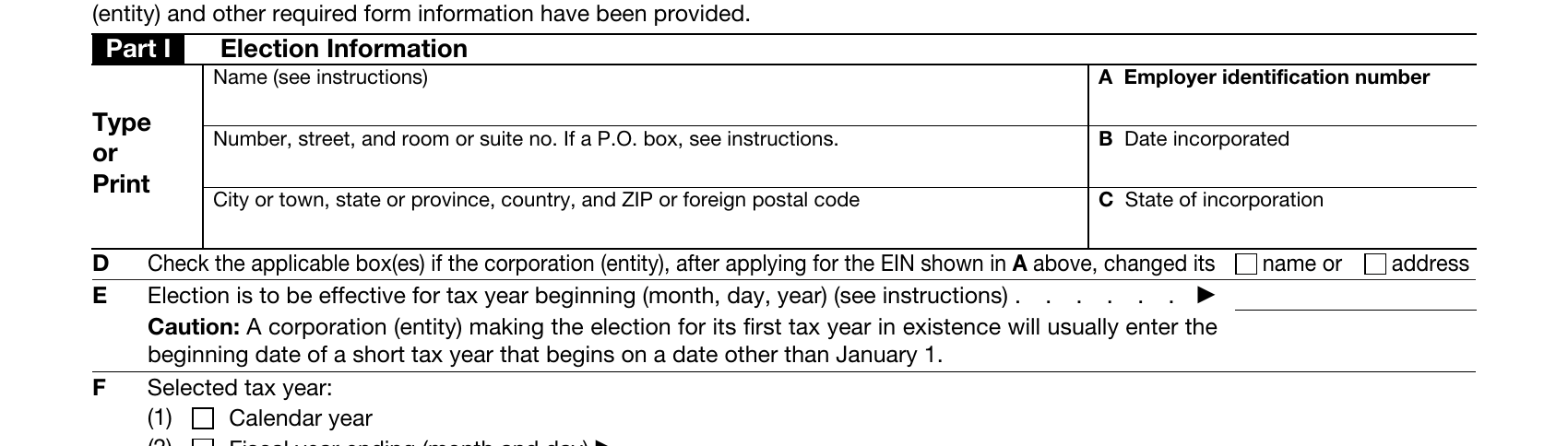
Form 2553, page 1 — the identification and election lines, with line E highlighted: the effective date of the election.
Form 2553 is short — an election form, not a return. A corporation files it to be treated as an S corporation, and everything on it is identification, dates, and agreement: the corporation's information, the tax year the election is for, the shareholders, and their consent.
Line E is the line that asks for the effective date of the election — the date the S corporation treatment is to begin. Read that line's weight carefully, because two different clocks hang off the dates around it. The filing deadline is measured from the beginning of the tax year the election is to take effect. And if the filing is late, the relief windows the instructions print are measured from the date entered on line E. One entered date, and the form's entire calendar is built around it.
The document read alongside the form in this article is its instructions — Instructions for Form 2553, revision December 2020, the latest edition posted. What this article states about deadlines and relief is what those instructions print.
§3The deadline rule, as the instructions print it
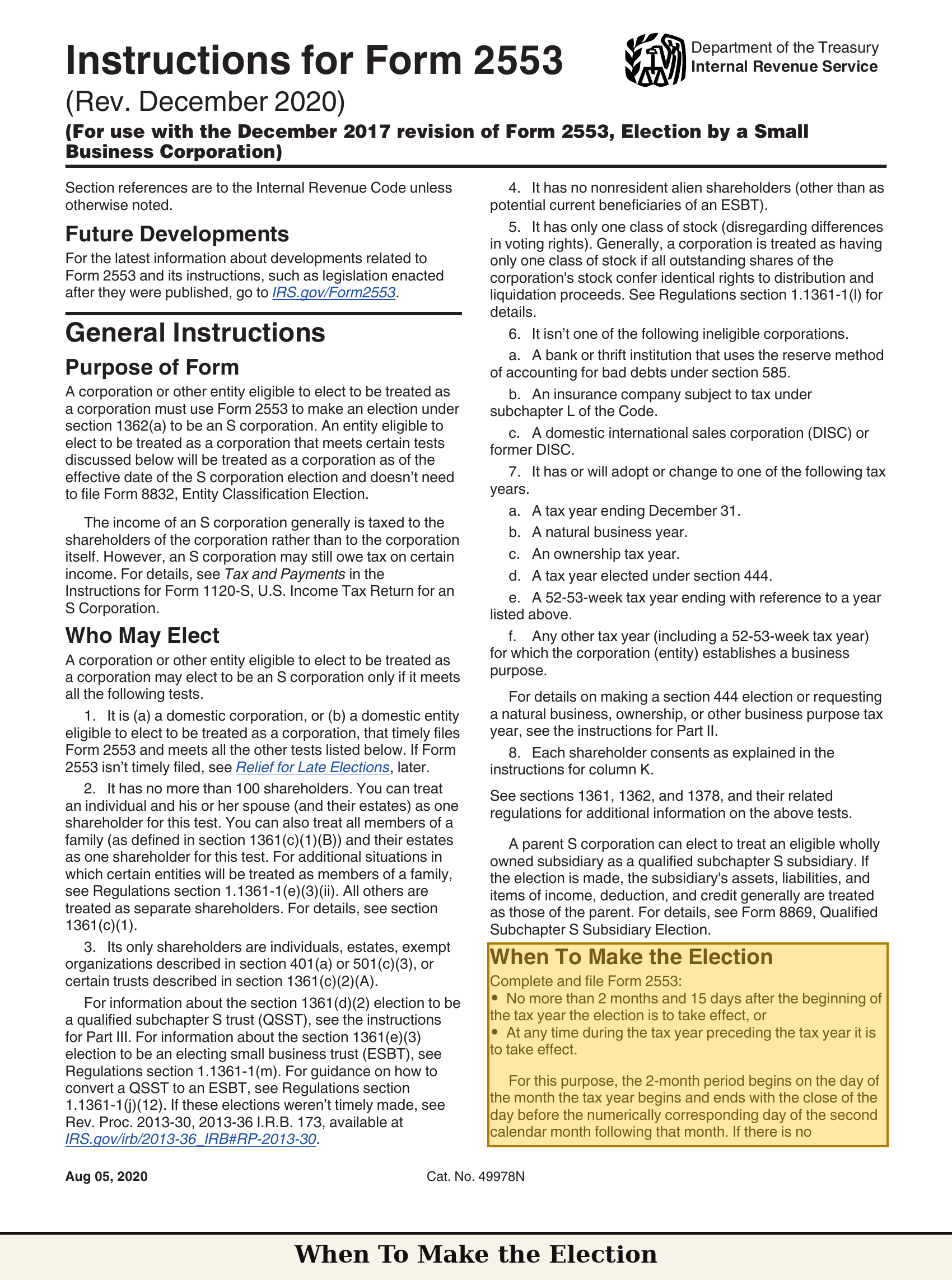
Instructions for Form 2553, "When To Make the Election" (p. 1) — the rule sentence highlighted.
The instructions state the rule in their section "When To Make the Election," and it has two doors.
File Form 2553 no more than 2 months and 15 days after the beginning of the tax year the election is to take effect — or file it at any time during the tax year before that year. That is the printed structure: a short window after the year begins, and the whole preceding year standing in front of it.
For a calendar-year corporation, a tax year beginning January 1, the instructions print the result themselves: the window runs to March 15. March 15 is not a separate deadline added later. It is what 2 months and 15 days counts out to from January 1, and the next section counts it on the instructions' own terms.
Two mechanics are printed alongside the rule. The form is signed by an officer of the corporation, and the instructions state the consequence plainly: if Form 2553 is not signed, it will not be considered timely filed. And the shareholders consent — their agreement is entered in the form's consent column, column K, or on a separate consent statement attached to the form. A deadline met with an unsigned form, or without the consents, is not the filing the instructions describe.
§4Worked example: the deadline computation
This article's worked example is not a taxpayer. It is a calendar computation — the instructions' own three examples, counted the way the instructions count them.
The instructions' second example explains the count for a January 1 year: the 2-month period ends February 28 — February 29 in a leap year — and 15 days after that is March 15.
Apply that same printed count to all three printed examples.
Tax year begins January 1: two months end February 28, plus 15 days. The election is due March 15.
Tax year begins January 7: two months end March 6, plus 15 days. The election is due March 21 — the first example the instructions print.
Tax year begins November 8: two months end January 7, plus 15 days. The election is due January 22 — their third example.
Three beginning dates, one printed rule. Notice what the count is anchored to. Not the filing season. Not the due date of a return. Not the day anyone decides to elect. The beginning of the tax year the election is to take effect. Everything in this article's relief section is measured against missing this count — and the relief section's own clock starts from line E.
| Tax year begins | 2 months end | + 15 days | Election due (as printed) |
|---|---|---|---|
| January 1 | February 28 (February 29 in a leap year) | March 15 | March 15 (Example 2) |
| January 7 | March 6 | March 21 | March 21 (Example 1) |
| November 8 | January 7 | January 22 | January 22 (Example 3) |
Rule behind the table (Instructions for Form 2553, "When To Make the Election," p. 1): file no more than 2 months and 15 days after the beginning of the tax year the election is to take effect, or at any time during the preceding tax year.
§5The Fork: inside the window, or past it
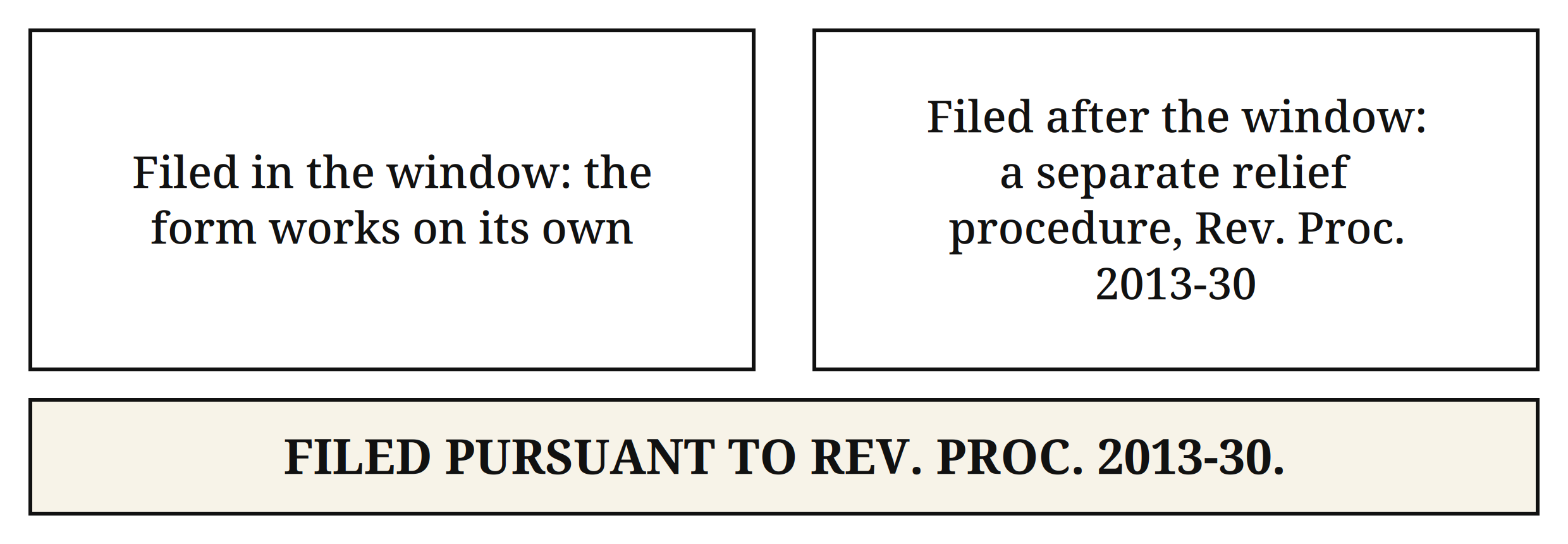
Split card — Filed in the window: the form works on its own; Filed after the window: a separate relief procedure, Rev. Proc. 2013-30. Below: the legend text FILED PURSUANT TO REV. PROC. 2013-30.
The fork in this article is procedural, and it is the same form on both sides of it.
Filed inside the window — during the preceding year, or within 2 months and 15 days after the year begins — the form does its work on its own. The election is timely, and the date on line E stands as entered.
Filed after the window, the form by itself does not cure the lateness. The instructions print a separate relief procedure, with its own paperwork and its own clock. The relief is presented in the instructions entirely through Revenue Procedure 2013-30. The filer writes "FILED PURSUANT TO REV. PROC. 2013-30." across the top margin of the form's first page. And for a corporation, the printed requirements include that the election was intended from the start, that the failure was only the late filing, that there was reasonable cause and the failure was corrected diligently, that the shareholders reported consistently with the election — and that the form is filed within 3 years and 75 days of the date entered on line E.
One absence in these instructions is worth reading out loud. Relief for a late election is often discussed under a section number — 1362(b)(5). That citation never appears in these instructions. The relief they print runs through the revenue procedure, and on this site, the instructions are the document being read.
Past that 3-years-and-75-days window, the instructions still print one more route before any ruling is requested: relief where every shareholder reported consistently with the election for the intended year, where six months have passed since the first return for that intended year was filed, and where the IRS sent no notice about the election within that window. Only when the printed requirements — that fallback included — are not met do the instructions name the remaining route: a private letter ruling, requested from the IRS, with a user fee — granted or not by the IRS, not a filing the filer controls.
§6What missing paperwork looks like, on paper
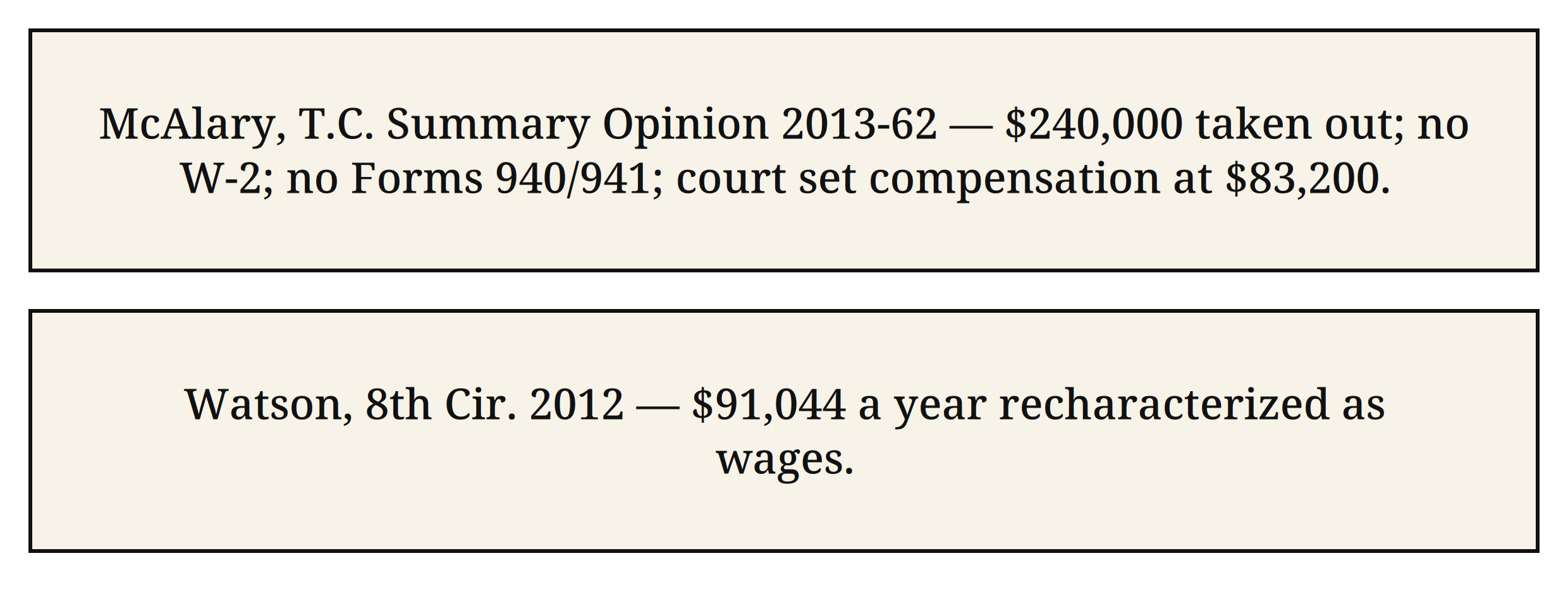
Two case cards — McAlary, T.C. Summary Opinion 2013-62: $240,000 taken out; no W-2; no Forms 940/941; court set compensation at $83,200. Watson, 8th Cir. 2012: $91,044 a year recharacterized as wages.
What does missing paperwork look like, on paper? Two court documents, one factual line each — stated as facts, not as lessons.
In a 2013 Tax Court summary opinion, the McAlary case, the factual record fits in one sentence: a real estate broker's S corporation paid him $240,000 with no W-2 and no Forms 940/941 filed, and the court set his reasonable compensation at $83,200. Two flags travel with that case on this site: a summary opinion is not precedent for any other case under §7463(b), and that proceeding was an employment-tax case under §7436. What it shows, factually, is a corporation whose payroll paperwork was not there.
And one line from a court of appeals case, Watson, decided in 2012: an S corporation owner's distributions were recharacterized, in part, as wages — $91,044 a year treated as pay for his services. The taxpayer there was an accountant, not one of this site's four jobs. The line is here only for the general fact it establishes: amounts labeled distributions can be re-read as wages.
The IRS has also, on paper, granted late-election relief to a filer who requested it by letter ruling. That is all a letter ruling can show — it binds only the taxpayer who requested it, and may not be used or cited as precedent. The procedure to point at is the one the instructions print: Revenue Procedure 2013-30.
§7What this form does not cover
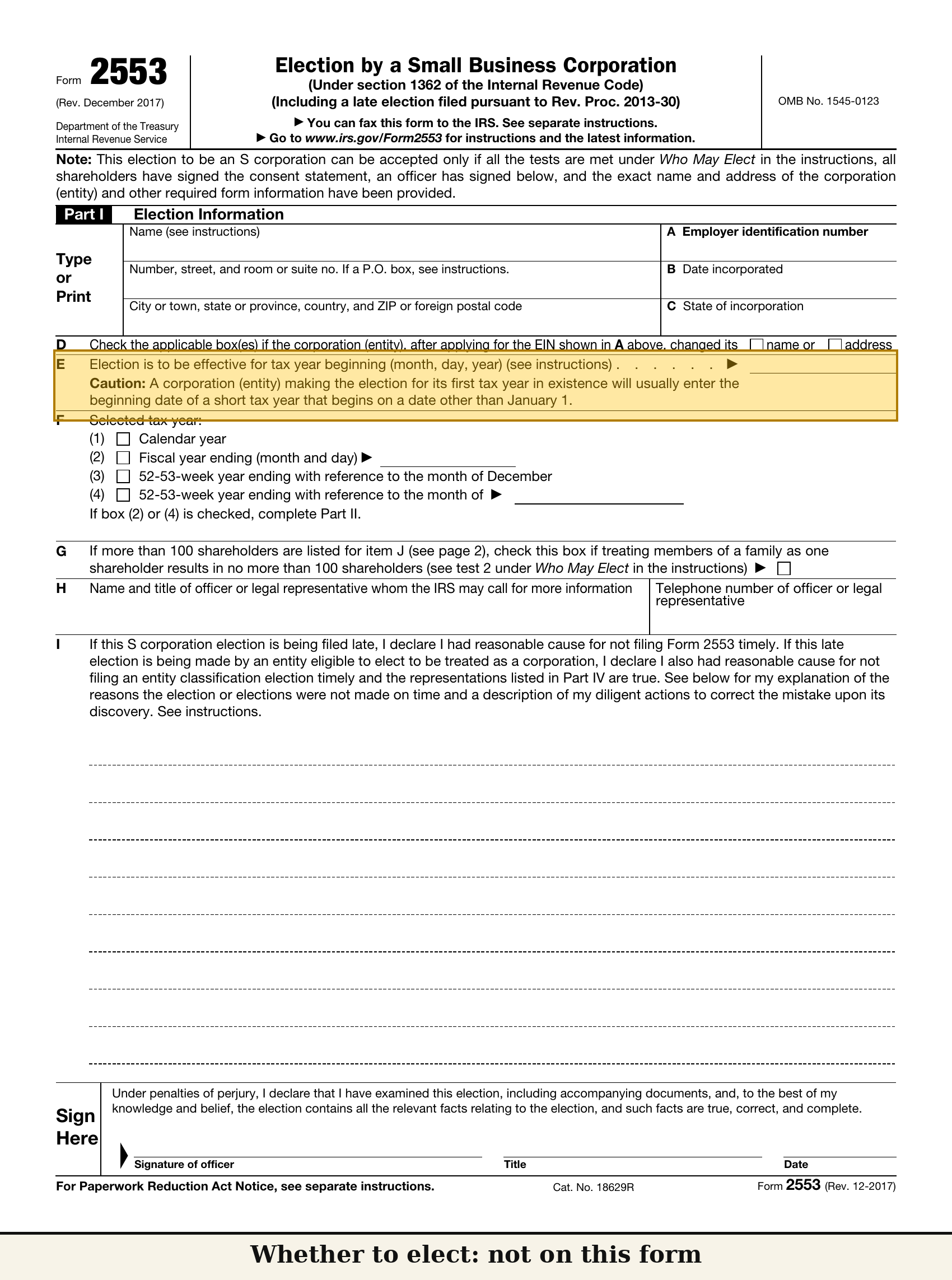
Form 2553 full page, greyed, with three callouts: "Whether to elect: not on this form" / "Reasonable compensation: no line computes it" / "State treatment: not covered".
What Form 2553 and its instructions do not do, to close the reading.
They do not say whether an election fits a given business. The form takes an effective date and consents; it does not weigh a corporation's income, its owner, or its payroll against anything. They do not compute reasonable compensation — the figure the McAlary case turned on is not a line on this form, or on any form read this season; no worksheet in these instructions produces it. They do not set up payroll: an S corporation that pays its owner meets employment-tax filings of its own, and Forms 940 and 941 exist in that world as filings — named here as paperwork, the way they appear in the McAlary facts. And nothing in this form touches how a state treats the election. State taxes are not covered.
The IRS prints no S-corp break-even threshold anywhere in the documents read here, and this article does not invent one.
Software numbers vs ask-a-human numbers — the hand-off split. Software carries the mechanics: the calendar count from the tax year's first day, the dates a filed form shows, the arithmetic on every form already read this season. Printed, countable things.
A human carries the rest — and on this form, the rest is nearly everything that matters. Whether an election fits the business at all. What reasonable compensation is for the person doing the work — a number this site has never computed, and does not compute. How payroll is set up, so the filings an owner-paid corporation meets actually exist. And anything at the state level, which this site does not cover.
That closes the season's twelve: one tax year, four jobs — every number read off the form or publication that prints it. One article follows — the retirement fork, the article that did not fit the twelve. The standing rule, stated once, on the record: if a document read here is revised, or a line this season read moves, this page is updated in place with a dated note at the foot of the article.
Next article: Solo 401k vs SEP IRA 2026 — a freelance designer's two builds to one line. Article 13
Sources
9 claimsEvery claim above traces to a document, a tax year, a line, and the date it was checked.
-
1
Filing deadline: no more than 2 months and 15 days after the beginning of the tax year the election is to take effect, or at any time during the preceding tax year
- DOC
- Instructions for Form 2553
- YEAR
- Rev. December 2020 (latest posted)
- LINE
- "When To Make the Election," p. 1
- CHECKED
- 2026-10-06
-
2
Printed examples: calendar-year election window runs to March 15 (Example 2 explains the count: the 2-month period ends Feb 28, Feb 29 in a leap year, and 15 days after that is March 15); tax year beginning Jan 7 → due March 21 (Example 1); beginning Nov 8 → due January 22 (Example 3)
- DOC
- Instructions for Form 2553
- YEAR
- Rev. December 2020
- LINE
- Examples 1–3, p. 2
- CHECKED
- 2026-10-06
-
3
Late relief is presented entirely through Rev. Proc. 2013-30: write "FILED PURSUANT TO REV. PROC. 2013-30." in the top margin of Form 2553 page 1; corporation route requires intended S status, failure solely from the late filing, reasonable cause and diligent correction, consistent shareholder reporting, and filing within 3 years and 75 days of the date entered on line E; if the requirements are not met, the route is a private letter ruling with a user fee (Rev. Proc. 2021-1)
- DOC
- Instructions for Form 2553
- YEAR
- Rev. December 2020
- LINE
- "Relief for Late Elections," pp. 2–3
- CHECKED
- 2026-10-06
-
4
The instructions never cite §1362(b)(5) by number (full-text check of the instructions PDF) — the relief they print runs through Rev. Proc. 2013-30
- DOC
- Instructions for Form 2553
- YEAR
- Rev. December 2020
- LINE
- Full text
- CHECKED
- 2026-10-06
-
5
If Form 2553 is not signed, it will not be considered timely filed; shareholder consent is given in column K of the form or on a separate consent statement attached to it
- DOC
- Instructions for Form 2553
- YEAR
- Rev. December 2020
- LINE
- Signature and consent discussion, pp. 4–5
- CHECKED
- 2026-10-06
-
6
Where To File: the original goes to the service center shown in the instructions' table, and the table itself warns it is subject to change (the two centers' addresses are deliberately not read in this article — see conversion notes)
- DOC
- Instructions for Form 2553
- YEAR
- Rev. December 2020
- LINE
- "Where To File," p. 3
- CHECKED
- 2026-10-06
-
7
McAlary: a real estate broker's S corporation took out $240,000 with no W-2 and no Forms 940/941 filed; the court set reasonable compensation at $83,200 and sustained employment-tax penalties. The broker was the corporation's sole shareholder, its only licensed broker, and its only manager (registry Section K7 — source table only, not narrated in the script). Summary Opinion — §7463(b), not precedent; the posture was a §7436 employment-tax proceeding
- DOC
- Sean McAlary Ltd, Inc. v. Commissioner, T.C. Summary Opinion 2013-62
- YEAR
- 2013
- LINE
- Case bank, registry §G1
- CHECKED
- 2026-10-06
-
8
Watson: S corporation shareholder-employee's distributions recharacterized in part as wages — $91,044 per year treated as wages (taxpayer was a CPA; general principle only)
- DOC
- David E. Watson, P.C. v. United States, 668 F.3d 1008 (8th Cir. 2012)
- YEAR
- 2012
- LINE
- Case bank, registry §G1
- CHECKED
- 2026-10-06
-
9
PLR 200350013: the IRS granted late-election relief to the taxpayer who requested it; a private letter ruling binds only that taxpayer and may not be used or cited as precedent (§6110(k)(3)) — used only to show a relief procedure exists on paper; the procedure pointed to in this article is Rev. Proc. 2013-30
- DOC
- PLR 200350013 (IRS letter ruling — not a court case)
- YEAR
- 2003
- LINE
- Case bank, registry §G1
- CHECKED
- 2026-10-06
Update log
Changes are dated and kept. Old figures are never silently overwritten.