Solo 401k vs SEP IRA 2026: A Freelance Designer's Two Builds to One Line
This is education, not tax advice. I'm not a CPA or EA. State taxes are not covered.
Schedule 1 and Schedule C cited below are IRS draft as of 2026-10-07 — DRAFT, NOT FOR FILING. Publication 560's latest posted edition is the 2025 edition ("for use in preparing 2025 returns"); its What's New section prints the 2026 limits used here. If a line changes, this page is updated in place with a dated note at the foot of the article.
- Last checked
- Tax year
- 2026
- Core line
- Schedule 1, line 16
- Changes
- Update log (1)
§1One job, one tax year, one line
The job is freelance designer and consultant — a sole proprietor with no employees; hold onto that last fact, because one of this article's deadlines turns on it. The year is 2026. The line is Schedule 1, line 16: "Self-employed SEP, SIMPLE, and qualified plans."
Two different retirement plans send their deduction to that one line — a SEP, and a one-participant 401(k), the solo 401(k). This article reads how each plan's number is built before it arrives there, and the calendar each plan's paperwork runs on. It does not pick one.
§2The landing line, and where the build actually lives
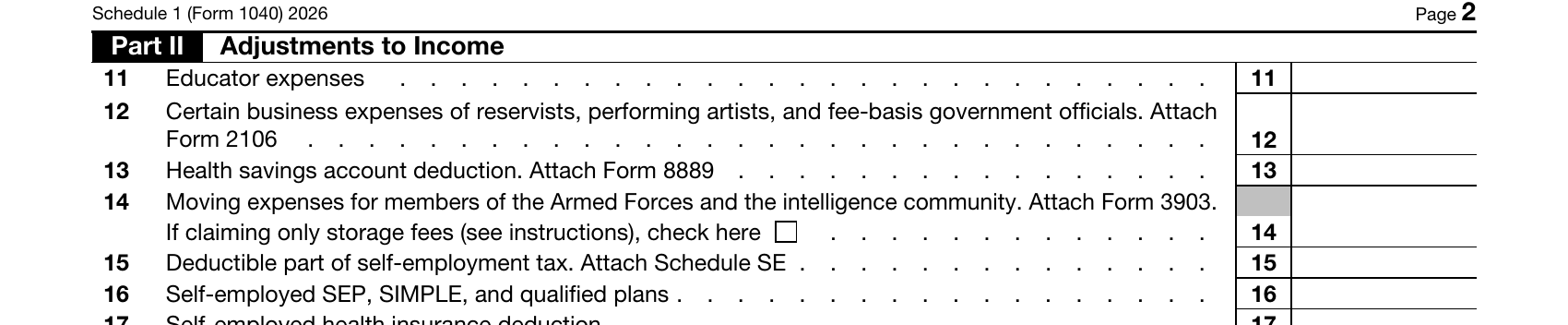
Schedule 1 is the return's adjustments schedule, and line 16 sits in Part II, among the adjustments to income. Whatever number is built for a self-employed filer's own retirement plan is entered here, and Part II totals at line 26, into Form 1040, line 10.
But line 16 builds nothing. It is a landing line. The arithmetic that produces the number lives in a different document entirely: Publication 560, the IRS publication for small-business and self-employed retirement plans.
Edition note, because this site reads editions. The latest Publication 560 posted is the 2025 edition — its cover says "for use in preparing 2025 returns." Its What's New section, however, prints the 2026 dollar limits, and those are the limits this article uses. Where the publication's own worksheet still prints 2025 figures, this article says so out loud.
§3The shared base: net earnings, built once
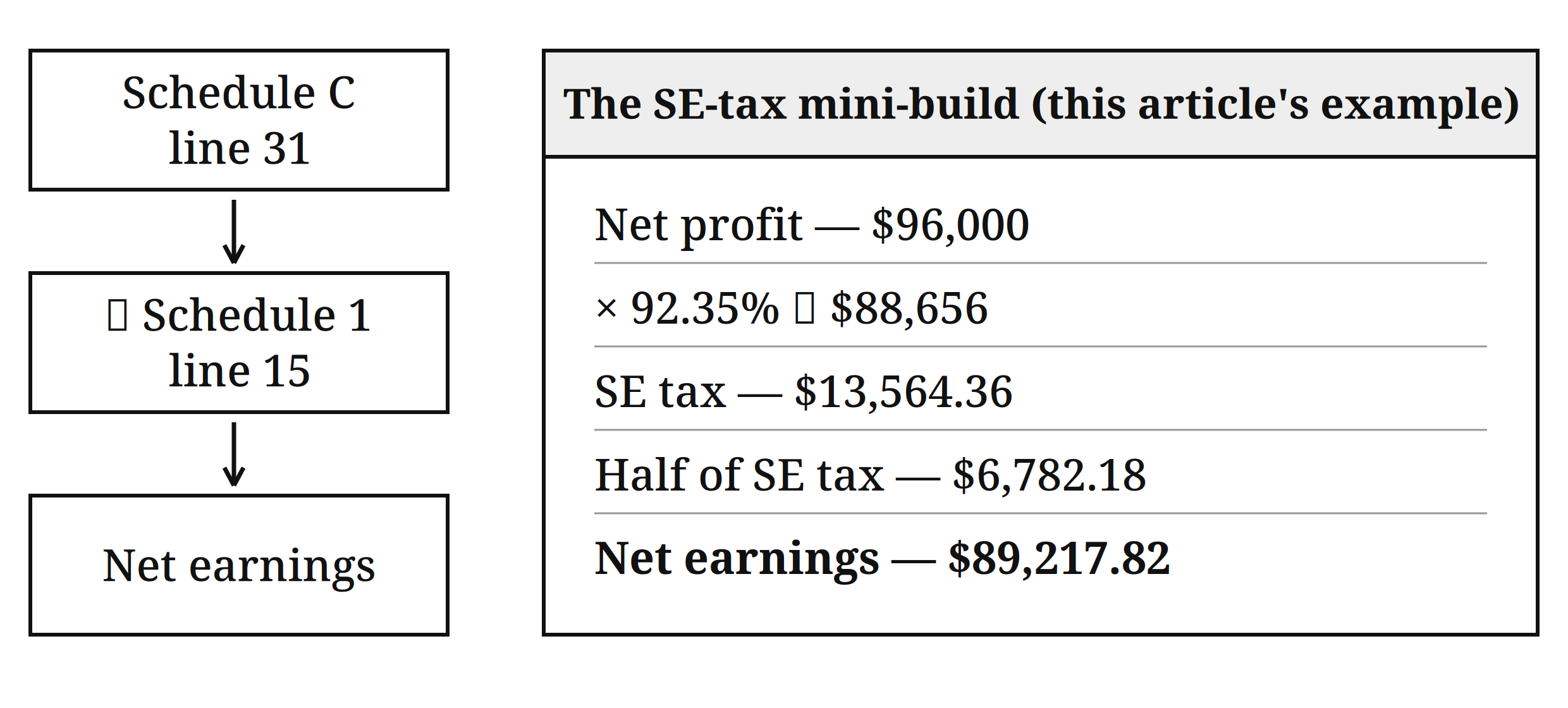
Both plans start from the same base, and the base is not the Schedule C bottom line by itself.
Publication 560 defines a self-employed filer's compensation for their own plan as net earnings from self-employment — and it defines that figure taking into account two deductions: the deduction for one-half of self-employment tax, and the deduction for the plan contribution itself. The second of those is what makes the arithmetic circular, and the publication solves the circle with a reduced rate. That arrives in a moment.
First, the base, in this article's one worked example. A designer-consultant — hypothetical, a sole proprietor, no employees, no W-2 wages — finishes 2026 with net profit of $96,000 on Schedule C, line 31.
The self-employment tax on that profit, figured the way Article 2 read Schedule SE: $96,000 times 92.35 percent is $88,656. The Social Security part, at 12.4 percent, is $10,993.34. The Medicare part, at 2.9 percent, is $2,571.02. The total is $13,564.36. One-half of it — the amount that lands on Schedule 1, line 15 — is $6,782.18.
So the plan base: $96,000 minus $6,782.18 is $89,217.82. Net earnings, in Publication 560's sense. Both branches of the fork start from this same $89,217.82.
| Step | Where | Operation | Amount |
|---|---|---|---|
| Net profit | Schedule C, line 31 | Hypothetical input | $96,000 |
| SE earnings base | Schedule SE, line 4a | $96,000 × 92.35% (0.9235) | $88,656 |
| Social Security part | Schedule SE, line 10 | $88,656 × 12.4% (base under the 2026 wage base, $184,500 — no cap interaction) | $10,993.34 |
| Medicare part | Schedule SE, line 11 | $88,656 × 2.9% — no cap | $2,571.02 |
| Self-employment tax | Schedule SE, line 12 | $10,993.34 + $2,571.02 | $13,564.36 |
| Deductible half of SE tax | Schedule SE line 13 → Schedule 1, line 15 | $13,564.36 ÷ 2 | $6,782.18 |
| Net earnings (Pub. 560 plan base) | Pub. 560, Ch. 1/2 definition | $96,000 − $6,782.18 (before the plan-contribution deduction, which the reduced rate handles) | $89,217.82 |
§4Branch one: the SEP build
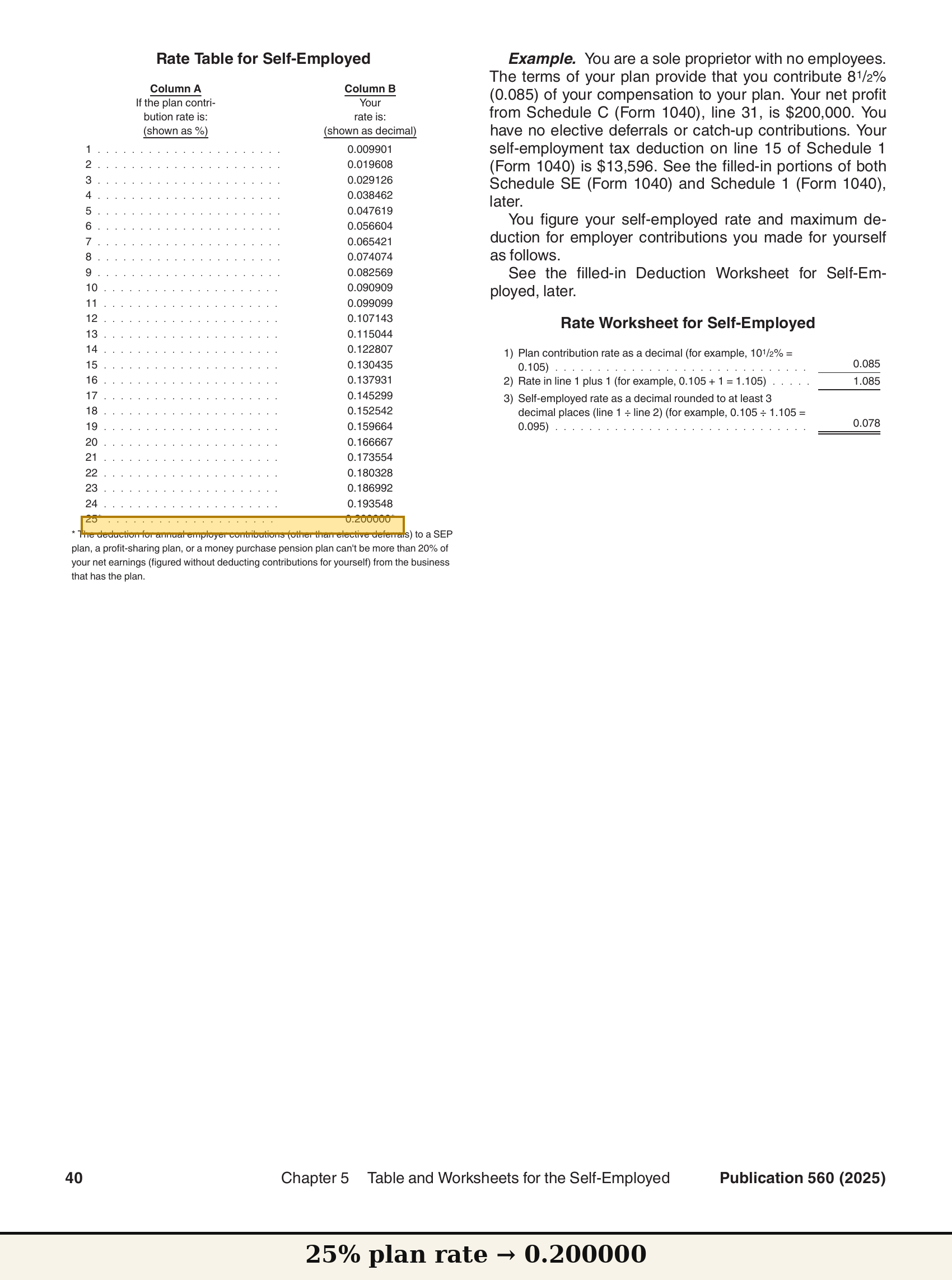
Publication 560, Ch. 5 Rate Table — the 25% row (0.200000) highlighted; worked-example table, SEP rows.
The publication's Chapter 5 worksheet runs the chain in one printed order: Schedule C, line 31, minus the Schedule 1, line 15 amount, times a reduced rate, through the caps, and out to Schedule 1, line 16. And the edition note from the top of this article, kept as promised: that worksheet's printed steps still carry the 2025 caps — every limit this article actually uses is the 2026 figure, from the publication's What's New.
A SEP contribution for the owner is built at the plan's stated rate — and because the contribution itself shrinks the base it is figured on, Publication 560 converts the stated rate before applying it. Chapter 5 prints a Rate Table for exactly this: the reduced rate is the plan rate divided by one plus the plan rate. The table prints a row for each whole-percentage plan rate.
This example's SEP is written at a 25 percent plan rate — that rate is the example's input, not a figure the form supplies. The 25 percent row converts to 0.200000. Twenty percent.
$89,217.82 times 20 percent is $17,843.56. That is the maximum SEP contribution in this example, and it is the amount entered on Schedule 1, line 16.
The publication states the same ceiling in words: at a 25 percent plan rate, the deduction cannot exceed 20 percent of net earnings. Two caps also stand behind the figure, and neither is reached here: the 2026 dollar cap on annual contributions is $72,000, and compensation taken into account stops at $360,000 — this example's base is $89,217.82.
§5Branch two: the solo 401(k) build
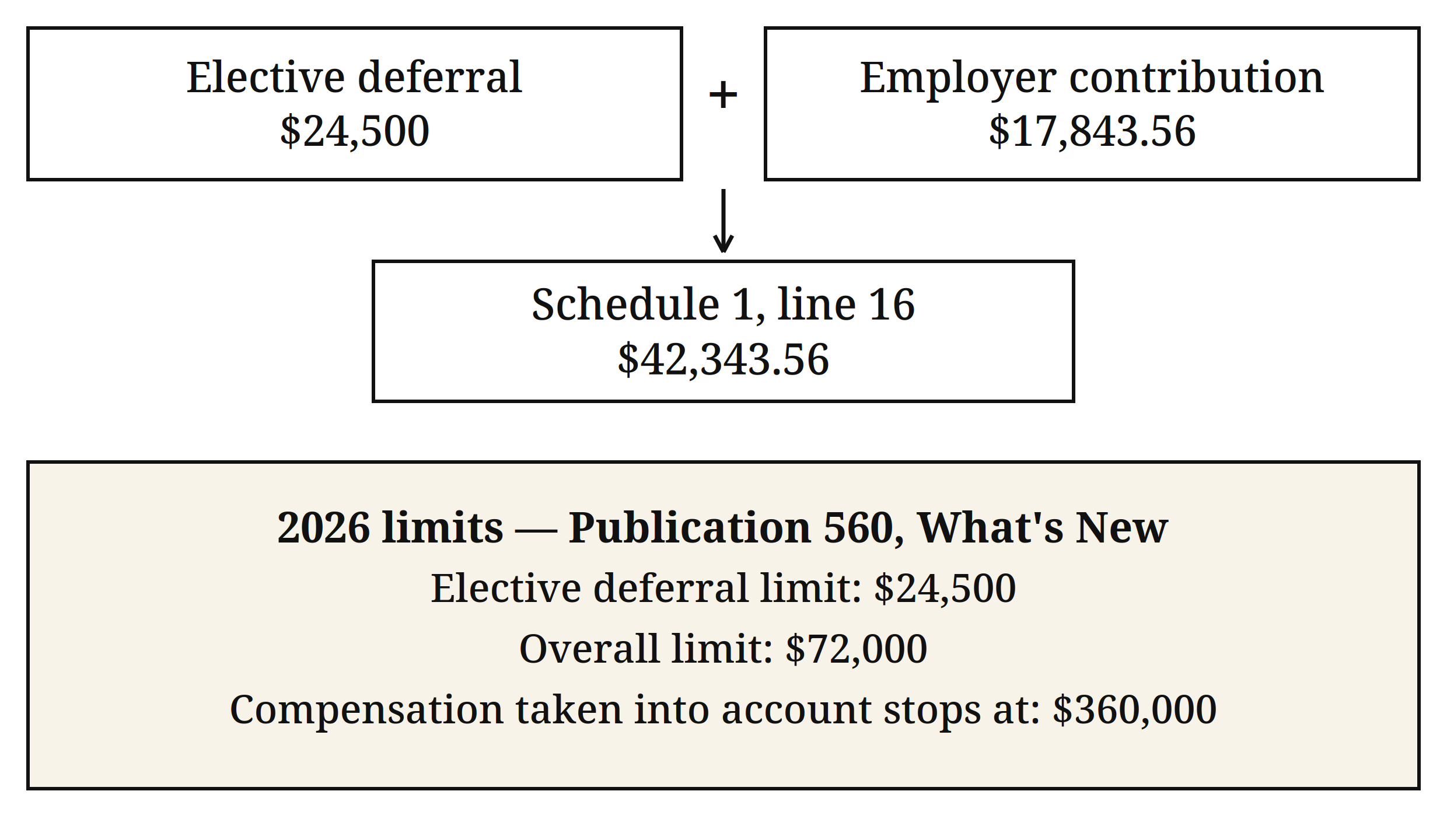
Two-component build diagram — elective deferral + employer contribution → Schedule 1 line 16; limits card with the 2026 What's New figures.
Branch two: the one-participant 401(k).
Where the SEP build has one component, the 401(k) build has two, and Publication 560 prints them separately.
Component one is the elective deferral — the amount deferred out of the business's earnings into the plan. Its 2026 limit, from the publication's What's New, is $24,500. The deferral is a separate printed component with its own limit; it is not run through the reduced-rate conversion. This example's filer is under 50, so no catch-up amount is figured here. The publication does print catch-ups — $8,000 at age 50 and over, and $11,250 for ages 60 to 63 — and this article does not compute them.
Component two is the employer contribution, and it is built by the same reduced-rate mechanics as the SEP: at the same 25 percent plan rate, on the same $89,217.82 base, it comes to the same $17,843.56.
Add the components: $24,500 plus $17,843.56 is $42,343.56 — and the total stands under the same $72,000 overall limit for 2026. That limit is shared, not separate: the Chapter 5 Deduction Worksheet subtracts the elective deferrals from the same contribution dollar limit, so the deferral consumes part of the one limit the employer contribution is also measured against — the two components do not each get a $72,000 of their own. That total, deferral plus employer contribution, is what this branch sends to Schedule 1, line 16.
Same base, same landing line. One build has a single component; the other has two. That is the arithmetic half of the fork. The other half is the calendar.
| Branch | Build | Result → Schedule 1, line 16 |
|---|---|---|
| SEP (plan rate 25%, example input) | Reduced rate = 25% ÷ (1 + 25%) = 20% (Rate Table row: 0.200000). $89,217.82 × 20% = $17,843.56. Caps: under the $72,000 dollar cap; base under the $360,000 compensation cap | $17,843.56 |
| Solo 401(k) — elective deferral | 2026 limit (Pub. 560, What's New); no catch-up (filer under 50 in this example) | $24,500 |
| Solo 401(k) — employer contribution | Same reduced-rate build as the SEP branch: $89,217.82 × 20% | $17,843.56 |
| Solo 401(k) — components total | $24,500 + $17,843.56 — under the $72,000 overall 2026 limit | $42,343.56 |
§6The Fork: two clocks
Here is where the two plans genuinely part, in print: their deadlines do not run on the same clock.
The SEP runs on the return's own clock. Publication 560, Chapter 2: a SEP can be set up as late as the due date of the return, including extensions — and contributions for the year are due by that same date, extensions included. One clock, and it is the longest one on this page.
The 401(k) runs on an earlier clock, with one printed exception. Chapter 4's general rule: to deduct contributions for a tax year, the plan must be adopted by the last day of that year — December 31.
The exception is written for exactly this article's filer. A sole proprietor with no employees — the only participant — may adopt a 401(k) after the year ends, as late as the filing deadline for the return, without regard to extensions. But under that after-year-end adoption, the elective deferrals must be paid into the plan before that same unextended filing time. The employer contribution keeps the longer clock: the due date of the return, plus extensions.
That split calendar is also why this article runs in January. For 2026 plans, the SEP clock — and, for a no-employee sole proprietor, the 401(k) adoption clock — is tied to the filing deadline in the documents themselves. The article is reading these deadlines while they are still the printed ones for the year just ended.
| SEP (Ch. 2) | Solo 401(k) (Ch. 4) | |
|---|---|---|
| Set up / adopt | As late as the return due date, including extensions | General rule: by the last day of the tax year. Sole proprietor with no employees: may adopt after year-end, by the filing deadline without regard to extensions |
| Money in | Contributions by the return due date, including extensions | Elective deferrals under a retroactive adoption: paid before that same unextended filing time. Employer contributions: by the return due date plus extensions |
§7What these documents do not cover

What this reading does not cover.
Line 16's label names a third plan type — SIMPLE plans. This article does not read them; the label is the only place they appear.
The example's no-employees fact is load-bearing. The after-year-end adoption rule is printed for a sole proprietor with no employees, and plans that cover employees run under different printed rules, which this article does not open.
Nothing here computes a catch-up, a year that mixes W-2 wages with the business, or a plan rate other than the example's 25 percent. And Publication 560's arithmetic does not answer which plan fits a given designer's business — that question is not printed on these pages, and this site does not fill the gap. State taxes: not covered, in this article or any other.
Software numbers vs ask-a-human numbers. The numbers a piece of software can carry on this one: the 92.35 percent shrink and the two rate multiplications in the base build, the Rate Table conversion, the multiplication at the reduced rate, and the cap comparisons — provided the inputs it is handed are the inputs the publication asks for.
Questions to take to a human before acting on them: what rate a plan document states; whether a plan document exists, and when it was adopted; whether anyone besides the owner was paid by the business in 2026; and which plan fits the business at all.
This is the season's extension article, so it closes the way the season closes. Every figure in it was read from documents as they stand: a draft Schedule 1, and a Publication 560 whose latest posted edition is the 2025 edition, printing 2026 limits. When the 2026 edition of that publication posts, or the final Schedule 1 moves a line, this page is updated in place with a dated note at the foot of the article — the old wording is never silently overwritten.
Sources
10 claimsEvery claim above traces to a document, a tax year, a line, and the date it was checked.
-
1
Line 16 reads "Self-employed SEP, SIMPLE, and qualified plans" and sits in Part II (adjustments); Part II totals at line 26 into Form 1040, line 10
- DOC
- Schedule 1 (Form 1040) (2026 draft, posted 06/08/2026); Schedule 1 line 16 confirmed from the draft PDF
- YEAR
- 2026 draft
- LINE
- Lines 16, 26
- CHECKED
- 2026-10-07 — IRS draft as of 2026-10-07
-
2
Worksheet chain: Schedule C line 31 − Schedule 1 line 15 → × reduced rate → caps → Schedule 1 line 16
- DOC
- Publication 560, Ch. 5, Deduction Worksheet for Self-Employed (2025-form references in the edition read)
- YEAR
- Pub. 560 (2025), latest posted
- LINE
- Ch. 5
- CHECKED
- 2026-10-06
-
3
The worksheet's step mechanics: Step 1 = Schedule C line 31; Step 2 = Schedule 1 line 15; Step 3 = net earnings; Step 4 = reduced rate (Rate Table); Step 5 = Step 3 × Step 4 (the EMPLOYER contribution figure — the reduced rate touches only this component); Step 8 = contribution dollar limit; Step 9 = elective deferrals entered as a dollar amount, never run through the reduced rate; Step 10 = Step 8 − Step 9 (the dollar limit is SHARED — deferrals consume it); Step 13 = the controlling smallest figure; Step 19 = maximum deductible contribution → Schedule 1 line 16
- DOC
- Publication 560, Ch. 5, Deduction Worksheet for Self-Employed — steps read directly (registry Section K9); the steps as printed carry the 2025 caps
- YEAR
- Pub. 560 (2025), latest posted
- LINE
- Ch. 5, Steps 1–5, 8–10, 13, 19
- CHECKED
- 2026-10-07
-
4
A self-employed filer's own-plan "compensation" is net earnings from self-employment, taking into account BOTH the deduction for one-half of self-employment tax AND the deduction for contributions to the plan on the filer's own behalf — the circularity the reduced rate resolves
- DOC
- Publication 560, Ch. 1 (definitions) and Ch. 2, "Deduction Limit for Self-Employed Individuals"
- YEAR
- Pub. 560 (2025)
- LINE
- Ch. 1; Ch. 2
- CHECKED
- 2026-10-06
-
5
Reduced rate = plan rate ÷ (1 + plan rate); Rate Table row: 25% plan rate → 0.200000; stated in words — at a 25% plan rate the deduction cannot exceed 20% of net earnings; the table prints a row for each whole-percentage plan rate
- DOC
- Publication 560, Ch. 5, Rate Table / Rate Worksheet for Self-Employed
- YEAR
- Pub. 560 (2025)
- LINE
- Ch. 5
- CHECKED
- 2026-10-06
-
6
SEP deadlines: a SEP can be set up as late as the due date (including extensions) of the return for the year, and contributions for the year must be made by that same due date (including extensions)
- DOC
- Publication 560, Ch. 2 — "Deadline for setting up a SEP"; "Time limit for making contributions"
- YEAR
- Pub. 560 (2025)
- LINE
- Ch. 2
- CHECKED
- 2026-10-06
-
7
Solo / one-participant 401(k) deadlines: general rule — plan must be set up (adopted) by the last day of the tax year to deduct contributions for that year; a sole proprietor with NO employees may adopt after year-end by the tax filing deadline without regard to extensions, and under such a retroactive adoption elective deferrals must be PAID before that same unextended time; employer contributions by the due date of the return plus extensions
- DOC
- Publication 560, Ch. 4 — "Set-up deadline"; "Contributions deadline"; Reminders ("Plans established after the end of tax year")
- YEAR
- Pub. 560 (2025)
- LINE
- Ch. 4
- CHECKED
- 2026-10-06
-
8
2026 limits: elective deferrals $24,500; catch-up 50+ $8,000; catch-up ages 60–63 $11,250; defined-contribution / SEP annual dollar cap $72,000; compensation cap $360,000
- DOC
- Publication 560 (2025), What's New; Notice 2025-67
- YEAR
- 2026 limits as printed in the 2025 edition
- LINE
- What's New
- CHECKED
- 2026-10-06
-
9
Caveat: the Ch. 5 worksheet's printed steps still carry the 2025 caps ($350,000 compensation / $70,000 dollar limit / $23,500 deferrals); the 2026 values live in What's New and chapter text until the next edition
- DOC
- Publication 560, Ch. 5, Deduction Worksheet steps
- YEAR
- Pub. 560 (2025)
- LINE
- Ch. 5
- CHECKED
- 2026-10-06
-
10
The base build's SE-tax mechanics: net profit × 92.35%; Social Security part 12.4% (base under the 2026 wage base of $184,500, so no cap interaction in this example); Medicare part 2.9%; one-half of the SE tax is the Schedule 1, line 15 amount
- DOC
- Schedule SE form text, cross-checked on the 2026 draft (preprinted line 7: $184,500); Schedule 1 (2026 draft), line 15
- YEAR
- 2025 form text; 2026 draft
- LINE
- Schedule SE lines 4a, 10, 11, 12, 13; Schedule 1 line 15
- CHECKED
- 2026-10-06 / 2026-10-07 — draft items as labeled
Update log
Changes are dated and kept. Old figures are never silently overwritten.