You May Owe Your Salon Owner a 1099-MISC
This is education, not tax advice. I'm not a CPA or EA. State taxes are not covered.
The Form 1099-MISC and 1099-NEC instructions cited below are the current (12/2026) instructions. Revenue Procedure 2026-35, section 3.52, sets the 2027 § 6041(a) threshold at $2,100. Schedule C (Form 1040) 2026 is final (Cat. No. 11334P); its instructions still serve the 2025 edition.
- Last checked
- Tax year
- 2026
- Core line
- Form 1099-MISC, box 1
- Changes
- Update log (7)
The booth rent a renter deducts can also make the renter a filer: rent paid in the course of your business is reported in box 1 of Form 1099-MISC, and for payments made in 2026 the printed threshold is at least $2,000 — not the $600 figure in the 2011 industry publication. Payments to a corporation are generally excepted, and rent paid through a real-estate agent or property manager follows a different printed rule. In this article's example, $375 a month crosses the threshold in June and totals $4,500 for the year.
This article is for you if you rent a booth or suite and pay the rent to an individual salon owner.
§1One job, one tax year, one box
The job is a hairstylist or barber who rents a booth or suite and runs an independent business from that chair. The year is 2026. The box is Form 1099-MISC, box 1 — rents.
Most first-time renters look for a 1099 with their own name on it. This article follows the payment in the other direction. The same booth rent that belongs on the renter's Schedule C, line 20b, can also make the renter a filer: whether the renter has to send Form 1099-MISC to the salon owner who received the rent.
Schedule C points at the issue itself. Line I asks whether the filer made payments that require Form 1099, and whether the filer filed the required forms. The rent therefore does two jobs on paper: it is an expense in the renter's business, and it may be a reportable payment to the owner of the salon space.
§2Box 1 is for rents
The instructions for Forms 1099-MISC and 1099-NEC place rents in box 1 of Form 1099-MISC. The box covers all types of rents, including real estate rentals paid for office space. A booth or suite payment is not reported as though the salon owner had worked as the renter's contractor. Amounts more appropriately described as rent belong in box 1 of Form 1099-MISC, not in the nonemployee-compensation box of Form 1099-NEC. Check whether you must send the form with the 1099 checker.
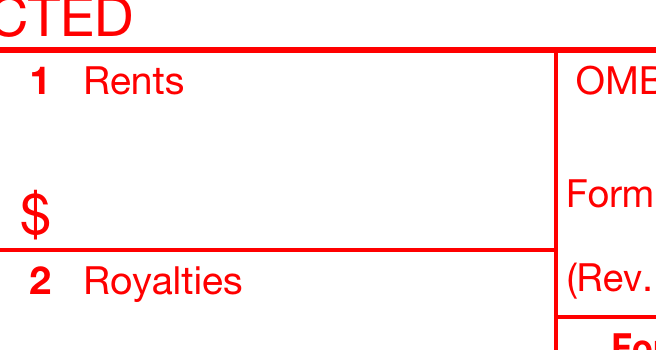
The question is narrow: did the renter, in the course of the renter's own trade or business, pay rent to the salon owner? The instructions draw that boundary directly. Reporting applies only when payments are made in the course of a trade or business; personal payments are not reportable. Being engaged in a trade or business is described as operating for gain or profit.
The payer in this article is therefore not anyone who paid for a chair. It is a self-employed stylist or barber paying for space used by that person's business.
§3For 2026 payments, the printed threshold is $2,000
The current (12/2026) instructions print the reporting threshold for rents as at least $2,000 for payments made in 2026. Read the figure with its year attached.
§4What happens in 2027: $2,100
The $2,000 figure in this article is the threshold for payments made in 2026. For payments made in calendar year 2027, the reporting threshold for payments described in section 6041(a) is $2,100 (Revenue Procedure 2026-35, section 3.52). Rent paid for a booth or suite is a section 6041(a) payment reported in box 1 of Form 1099-MISC, so the $2,100 figure governs 2027 booth rent. The threshold is adjusted for inflation every year; the current-year inflation-adjusted amount is published at IRS.gov/InflationAdjustment. Nothing in the 2026 example changes: the $2,000 threshold still applies to every payment made in 2026, including the rent in the worked example above, and the forms for those payments are filed in early 2027.
The older figure is still easy to find. Publication 4902, Tax Tips for the Cosmetology and Barber Industry, told booth renters to issue Form 1099-MISC for business rent of “$600 or more.” But that publication is dated February 2011 and points readers to forms and publications that are no longer current. Forum answers preserve the same stale $600 figure.
Those older pages explain the confusion; they are not the current instruction. Publication 1099 (2026), “What's New,” likewise states that the threshold increased to $2,000 for tax years beginning after 2025 and identifies $600 as the previous figure.
The threshold is not a deduction limit, and it does not move the rent on Schedule C. Line 20b records the expense. The $2,000 figure answers the separate reporting question.
§5Two exceptions are printed with the rule
First is the corporation exception. Generally, payments to a corporation do not have to be reported, subject to exceptions listed elsewhere in the instructions. The instructions include an LLC taxed as a C corporation or an S corporation in that corporation treatment. Rent paid to an incorporated salon owner therefore generally does not produce a Form 1099-MISC from the renter under this rule.
Second is the real-estate-agent or property-manager exception. Payments of rent to real estate agents or property managers are not reported by the payer. Instead, the agent or manager must report the rent paid over to the property owner, under Regulations section 1.6041-3(d).
“Salon owner” can therefore mean a person paid directly, a corporation, or a manager standing between renter and owner. The instructions treat those payment paths differently, so the exceptions are part of the mechanic, not footnotes to skip.
§6The three payment paths, side by side
The two exceptions sort every booth-rent payment into one of three paths. The table states the filer for each path; the example below prices the second one.
| Payment path | Who files Form 1099-MISC, box 1? | Amount in box 1 |
|---|---|---|
| Rent paid directly to an individual salon owner | The renter files, if the year's rent reaches at least $2,000 | The year's total rent |
| Rent paid to an incorporated salon owner (including an LLC taxed as a C or S corporation) | Generally no one files for the rent | $0 — the corporation exception |
| Rent paid to a real-estate agent or property manager | The agent or manager files for the rent paid over to the owner, not the renter | The rent paid over to the owner |
Worked example: the corporation exception, priced. A second suite renter pays $900 in booth rent each month of 2026 to a salon owner who operates as a corporation. The year's rent is $900 × 12 = $10,800 — well above the $2,000 threshold — but the threshold is not the only test. Under the corporation exception, the rent generally produces no Form 1099-MISC from the renter: $10,800 paid, $0 in box 1. The rent itself is still the renter's Schedule C expense on line 20b, the way Article 17 walks it; the exception removes the reporting form, not the expense.
One more number travels with the TIN step. Publication 1099 (2026), Part N, prints backup withholding at a 24% rate on rents among other reportable payments, applying when the payee fails to furnish a TIN. If no TIN was on file for the whole year, 24% of this article's first example — $4,500 of rent — is $1,080 withheld across the payments. And the form follows the withholding: Publication 1099's introductory material states that if you backup withhold on a payment, you file the form to report the payment and the amount withheld even when the payment is below the normal filing threshold. Any tax withheld under backup withholding goes in box 4 of Form 1099-MISC, "Federal income tax withheld." The instructions list box 1 rent among the boxes subject to withholding when the payee has not furnished a Taxpayer Identification Number, and a return must be filed for each person from whom tax was withheld under the backup withholding rules regardless of the amount of the payment. For the January bundle as a whole — which forms arrive, and when — see Article 44; for the payer's own paper behind any amount claimed, see Article 21. How each figure above was checked is described on the site's How we verify page.
§7How you pay changes the form: card and app rent
The form depends on how the rent was paid, not only on how much was paid. Payments made with a credit card or payment card and certain other types of payments, including third-party network transactions, must be reported on Form 1099-K by the payment settlement entity under section 6050W and are not subject to reporting on Form 1099-MISC or Form 1099-NEC (Instructions for Forms 1099-MISC and 1099-NEC, "What's New — Form 1099-K"). So if the booth rent was paid by credit card, or through a third-party network such as a payment app, the renter does not report that rent on Form 1099-MISC; the payment settlement entity reports it on Form 1099-K. Rent paid by check, ACH, wire, or cash stays on Form 1099-MISC, box 1, when the threshold is met. The payment method changes only the reporting form. The rent is still the renter's business expense on Schedule C, line 20b, whichever form reports it.
§8Worked example: crossing $2,000 in June
One worked example, with numbers used only in this article. A suite renter pays $375 in booth rent for each month of 2026. The payments go directly to an individual salon owner for space used in the renter's business. In this hypothetical, the owner is not a corporation and is not acting as a real-estate agent or property manager.
| Period | Calculation | Rent paid so far |
|---|---|---|
| January–May | $375 × 5 | $1,875 |
| June | $1,875 + $375 | $2,250 |
| July–December | $375 × 6 | $2,250 more |
| All of 2026 | $375 × 12 | $4,500 |
Check the crossing. Five payments total $1,875, still below $2,000. The June payment brings the year to $2,250, so June is when the rent paid to this owner crosses the printed threshold. By December 31, the total is $4,500. On the stated facts — business rent, paid directly to a non-corporate owner, with no agent or manager in the payment path — $4,500 is the amount that belongs in box 1 of Form 1099-MISC for that owner.
The June crossing does not create a separate June form. The form reports the calendar year's payments. Under Publication 1099 (2026), the Guide to Information Returns gives Form 1099-MISC for rent two dates: the statement is furnished to the recipient by January 31, and the form is filed with the IRS by February 28 — March 31 if filed electronically. Dates that fall on a Saturday, Sunday, or legal holiday move to the next business day; for 2026 payments, both January 31 and February 28, 2027 fall on a Sunday, so the recipient statement and the paper filing are timely on Monday, February 1 and Monday, March 1, 2027, respectively, and the electronic filing date stays March 31, 2027.
The box 1 amount is reported under the salon owner's name and taxpayer identification number. Publication 1099's TIN section describes the collection step: where the recipient is a U.S. person, the requester asks the recipient to complete Form W-9, Request for Taxpayer Identification Number and Certification. The publication prints no separate deadline for that request, and this article prints none. It does print the consequences around the number: an incorrect or missing TIN on an information return can draw a penalty, W-9 identity information is to be kept confidential and used only to comply with the tax laws, and if no TIN is provided the TIN box is left blank, with backup withholding addressed in Part N of the same publication. The TIN step has a second half on the form itself. If the IRS notified you twice within 3 calendar years that the payee provided an incorrect TIN, you may enter an "X" in the "2nd TIN Not." box; if you mark this box, the IRS will not send you any further notices about this account (Instructions for Forms 1099-MISC and 1099-NEC, "2nd TIN Not. Box"). A filer may truncate a recipient's TIN on payee statements, but truncation is not allowed on documents filed with the IRS, and a payer's TIN may not be truncated on any form (same instructions, "Truncating recipient's TIN on payee statements"). Show the owner's individual name on the first name line; a "doing business as" name goes on the second name line, never alone — for a sole proprietor, you may not enter only the DBA name (Publication 1099 (2026), Part J). If the owner does not provide a TIN, leave the box for the recipient's TIN blank on the form; backup withholding may apply (same, Part J).
The outbound side of a salon — money paid out to the people who work in it — has been tested once on the records question. One case, stated as fact:
John F. Moran of Williamstown, New Jersey, ran a beauty salon as a proprietor, first under the name Media Hair and later under the name Gian Franco Faces. On his 1989 and 1990 returns he claimed deductions for beauty-salon wages of $86,580 and $90,101. The notice of deficiency disallowed only portions of those deductions — $3,210 for 1989 and $14,951 for 1990 — the portions for which substantiation had not been provided.
Those disallowed portions were the ones litigated, and the Tax Court allowed none of them. He introduced no documentary evidence to support the claimed deductions, and the court, not convinced he had actually paid the amounts, held that he was not entitled to deductions for wages of $3,210 for 1989 and $14,951 for 1990. The portions the notice took away stayed at $0.
— Moran v. Commissioner, T.C. Memo. 2005-66 · Tax years at issue: 1989 and 1990
Hold the shape of it apart from this article's form: the case decides nothing about Form 1099-MISC, box 1, and nothing about whether any salon worker was an employee or an independent contractor. What it measures is the payer's own paper — wage amounts claimed as paid out of a salon business, with no records behind the portions in dispute, were worth $0.
§9The mirror image: no form flows back for the rent itself
Does the salon owner owe the renter a Form 1099 because the renter paid booth rent?
The research behind this article searched Publication 4902 and the current instructions for Forms 1099-MISC, 1099-NEC, and 1099-K. It found no IRS text stating that a salon owner issues a booth renter any Form 1099 for the rental arrangement itself. That is a finding about the documents searched, stated plainly — not a loophole, and not a claim about every arrangement that could exist.
In the pure rental arrangement, the reportable payment identified by the instructions runs from renter to owner: rent out, then Form 1099-MISC box 1 if the threshold and other conditions are met. No matching form for the rent itself runs from owner to renter.
A different arrangement should not be folded into that sentence. If a salon pays a stylist compensation for services, that payment is treated under the generic Form 1099-NEC rules. It does not turn rent into compensation, or a service payment into rent.
§10Getting the form to the IRS: paper, Form 1096, or IRIS
Filing the form means two steps: a copy to the salon owner and a copy to the IRS. If you file on paper, you must send a Form 1096 with each type of form as the transmittal document, and you must group the forms by form number and submit each group with a separate Form 1096 (Publication 1099 (2026), Part E). If you e-file, do not file the same returns on paper. If you are required to file 10 or more information returns during the year, you must e-file; the 10-or-more requirement does not apply separately to each type of form — for example, four Forms 1098 and six Forms 1099-A together require e-filing (Publication 1099 (2026), Part F). A renter who files a single Form 1099-MISC is below that count and may file on paper with Form 1096. A hardship waiver is available on Form 8508, filed at least 45 days before the due date, one tax year at a time. Beginning with tax year 2026 (filing season 2027), the Information Returns Intake System (IRIS) is the only intake system for information returns; the FIRE system will not be available for submissions once it shuts down in 2026 (Publication 1099 (2026), "What's New"). The IRIS Taxpayer Portal is no-cost and accepts up to 100 forms per submission; a Transmitter Control Code (TCC) is required, and the application process may take up to 45 days, so a first-time e-filer should apply well before the filing date. Keep copies of information returns you filed with the IRS, or have the ability to reconstruct the data, for at least 3 years from the due date of the returns — 4 years if federal withholding, including backup withholding, was imposed (Publication 1099 (2026), Part E).
§11What a late or missing form costs: the 2027 penalty tiers
The penalties for information returns are set by statute and adjusted each year. For returns required to be filed in 2027, the penalty under section 6721 is $340 per return; $60 per return if the correct return is filed on or before 30 days after the required filing date; and $130 per return if corrected after the 30th day but on or before August 1 of that year (Revenue Procedure 2025-32, section 3.57). For failure due to intentional disregard of the filing requirement, the penalty is the greater of $690 or 10 percent of the aggregate amount required to be reported correctly, with no calendar-year limit (same, section 3.57(3)). The penalty for failing to furnish a correct payee statement to the salon owner is separate and uses the same tiers — $340, $60, and $130 per statement under section 6722, with the same $690-or-10-percent intentional-disregard tier (Revenue Procedure 2025-32, section 3.58). A filer whose average annual gross receipts for the most recent three taxable years are $5,000,000 or less is subject to lower calendar-year maximums — $1,397,000 for the general rule, $244,500 for corrections within 30 days, and $698,500 for corrections after 30 days through August 1 (same, sections 3.57(2) and 3.58(2)).
§12If the filed form was wrong: correct it, do not void it
If you filed a paper return with the IRS and later discover an error, correct it as soon as possible: file Copy A of the corrected return with Form 1096 at the IRS Submission Processing Center, and furnish corrected statements to the recipient (Publication 1099 (2026), Part H). An "X" in the "VOID" box at the top of the form will not correct a previously filed return (same, Part I). A wrong money amount uses one corrected return with the "CORRECTED" box checked; a missing or incorrect TIN, an incorrect payee name, or the wrong type of return uses two returns — the first repeating the original information with zero money amounts, the second reporting the correct information as an original (same, Error Charts for Filing Corrected Returns on Paper Forms). For a missing or incorrect TIN, a corrected return is not required if the reasonable-cause criteria are met, though the IRS encourages filing one so the payee's records can be updated. Article 41 walks through the correction from the recipient's side.
§13What Form 1099-MISC does not decide
Form 1099-MISC does not decide whether a stylist is an independent contractor or an employee. Classification turns on facts and circumstances under the three categories printed in Publication 15-A: behavioral control, financial control, and the type of relationship between the parties. Publication 4902 lists trade-specific booth-renter indicators — a key to the establishment, setting their own hours, purchasing their own products, having their own phone number and business name, and determining their prices — but the 2011 publication is used here for industry structure, not current filing mechanics.
The form also does not report the salon owner's income for the owner; the owner's return is a different posture. It does not cover the renter's tips, retail product, estimated tax, or self-employment tax. Those mechanics live on other forms and in other articles.
Read as the current instructions print it, the outbound line is short: business rent goes in Form 1099-MISC, box 1; for payments made in 2026, the printed threshold is at least $2,000; payments to a corporation are generally excepted; rent paid through a real-estate agent or property manager follows the agent/manager rule; and, for the rent itself, the research found no IRS text sending a form back from salon owner to renter.
Frequently asked questions
4 questionsReal questions first-time filers asked in public forums — answered only from the lines read in this article.
My spouse is a hairstylist who pays booth rent to work in a salon — which type of 1099 form must she use or file?
For the rent itself, Form 1099-MISC: the instructions place rents in box 1 of that form, not in the nonemployee-compensation box of Form 1099-NEC. For payments made in 2026, the current (12/2026) instructions print the threshold as at least $2,000 — not the $600 figure in the 2011 industry publication — and reporting applies only when the rent is paid in the course of the renter's own trade or business.
I'm a self-employed hairstylist — do I need to file a 1099, or just a Schedule C?
The two forms run in opposite directions, and both can apply. Your own return is the Schedule C, where the booth rent is the expense on line 20b. The same rent, paid in the course of your business, can also make you a filer: Form 1099-MISC to the salon owner who received it. And no matching form flows back for the rent itself — the research behind this article found no IRS text stating that a salon owner issues a booth renter any Form 1099 for the rental arrangement.
My stylists insist I have to give them a 1099, but I pay them nothing — they pay me booth rent. Do I owe them a form?
For the rent itself, no form flows back from owner to renter: the research behind this article found no IRS text stating that a salon owner issues a booth renter any Form 1099 for the rental arrangement. The reportable payment runs the other way — renter to owner, on Form 1099-MISC, box 1, when the year's rent reaches at least $2,000. And if the salon is a corporation, the corporation exception generally means the renter files no 1099-MISC for the rent either.
I'm a booth renter and paid the salon owner $10,400 — I gave her a 1099. Where does that go?
The form you issue is Form 1099-MISC, box 1 — rents — and $10,400 clears the $2,000 threshold for 2026 payments. On your own return, the same rent is your Schedule C expense on line 20b. The two entries are separate: issuing the form does not change the expense, and deducting the expense does not replace the form.
Sources
42 claimsEvery claim above traces to a document, a tax year, a line, and the date it was checked.
-
1
Booth/suite rent is placed on Schedule C line 20b; Schedule C Line I asks about required Forms 1099 and whether they were filed
- YEAR
- 2025
- LINE
- “Line 20b”; General instructions / Line I
- CHECKED
- 2026-10-08
-
2
Rents are reported in Form 1099-MISC box 1; rent does not belong in Form 1099-NEC box 1a
- YEAR
- Current (12/2026)
- LINE
- Box 1; box 1a sections
- CHECKED
- 2026-10-08
-
3
Reporting applies only to payments made in the course of a trade or business; personal payments are not reportable
- YEAR
- Current (12/2026)
- LINE
- “Who must file”
- CHECKED
- 2026-10-08
-
4
Rent threshold is at least $2,000 for payments made in 2026
- YEAR
- Current (12/2026)
- LINE
- Box 1 / threshold
- CHECKED
- 2026-10-08
-
5
Threshold increased to $2,000 after 2025; previous figure was $600
- DOC
- Publication 1099
- YEAR
- 2026
- LINE
- “What's New”
- CHECKED
- 2026-10-08
-
6
Publication 4902 used $600 for a booth renter's business rent and lists booth-renter indicators
- DOC
- Publication 4902, Tax Tips for the Cosmetology and Barber Industry
- YEAR
- (2-2011), Cat. No. 56037B
- LINE
- Booth Renters, pp. 6–7
- CHECKED
- 2026-10-08
-
7
Payments to a corporation are generally excepted, including an LLC taxed as a C or S corporation, subject to listed exceptions
- YEAR
- Current (12/2026)
- LINE
- Exceptions
- CHECKED
- 2026-10-08
-
8
Rent paid to a real-estate agent or property manager is not reported by the payer; the agent/manager reports rent paid over to the owner
- YEAR
- Current (12/2026), citing Regs. §1.6041-3(d)
- LINE
- Rent-payment exception
- CHECKED
- 2026-10-08
-
9
No IRS text was found stating that a salon owner issues a booth renter a Form 1099 for the rental itself
- DOC
- Research finding across Pub. 4902 and the current 1099-MISC/NEC and 1099-K instructions
- YEAR
- Current editions
- LINE
- No issuing line found
- CHECKED
- 2026-10-08
-
10
Classification facts fall into behavioral control, financial control, and type of relationship
- DOC
- Publication 15-A
- YEAR
- 2026
- LINE
- §2
- CHECKED
- 2026-10-08
-
11
1099-MISC rent: to IRS Feb. 28 (Mar. 31 if electronic), to recipient Jan. 31; the Feb. 15 recipient date applies only to substitute-dividend / attorney rows
- DOC
- Publication 1099, General Instructions for Certain Information Returns
- YEAR
- 2026
- LINE
- Guide to Information Returns, 1099-MISC rent row + footnote *
- CHECKED
- 2026-10-08
-
12
Due date on Sat./Sun./legal holiday is timely the next business day; Feb. 28 does not shift in leap years
- DOC
- Publication 1099
- YEAR
- 2026
- LINE
- Introductory Material; repeated in Types of Payments note
- CHECKED
- 2026-10-08
-
13
Requester asks a U.S.-person recipient to complete Form W-9; penalty for incorrect/missing TIN; W-9 confidentiality; blank TIN box + backup withholding if no TIN
- DOC
- Publication 1099
- YEAR
- 2026
- LINE
- Part J, "TINs / Requesting a recipient's TIN"
- CHECKED
- 2026-10-08
-
14
Form W-9 provides a correct TIN to the person required to file an information return
- DOC
- IRS "About Form W-9" page
- YEAR
- Page last reviewed 2026-06-27
- LINE
- Whole page
- CHECKED
- 2026-10-08
-
15
Rents may be subject to backup withholding at a 24% rate; withholding applies if the payee fails to furnish a TIN
- DOC
- Publication 1099
- YEAR
- 2026
- LINE
- Part N, "Backup Withholding"
- CHECKED
- 2026-10-26
-
16
Threshold for requiring filing of certain information returns and backup withholding increased to $2,000 for tax years beginning after 2025; previously $600
- DOC
- Publication 1099
- YEAR
- 2026
- LINE
- "What's New"
- CHECKED
- 2026-10-26
-
17
Case (one factual passage only): a salon proprietor claimed beauty-salon wage deductions of $86,580 (1989) and $90,101 (1990); the portions the notice of deficiency had disallowed — $3,210 for 1989 and $14,951 for 1990 — were allowed at $0, the court finding no documentary evidence and the payments unsubstantiated
- DOC
- Moran v. Commissioner, T.C. Memo. 2005-66 — full text read at DAWSON (U.S. Tax Court)
- YEAR
- Opinion filed 2005 (tax years at issue: 1989 and 1990)
- LINE
- "Beauty Shop Salaries" section and footnote 6
- CHECKED
- 2026-10-13
-
18
For payments made in calendar year 2027, the reporting threshold for payments described in § 6041(a) is $2,100.
- DOC
- Revenue Procedure 2026-35
- YEAR
- 2027 inflation adjustments
- LINE
- § 3.52
- CHECKED
- 2026-11-13
-
19
IR-2026-133 announces the 2027 inflation adjustments; Rev. Proc. 2026-35 provides the details; 2027 adjustments generally apply to returns filed in 2028.
- DOC
- IR-2026-133
- YEAR
- Nov. 5, 2026
- LINE
- News release
- CHECKED
- 2026-11-13
-
20
The $2,000 amounts in the Guide to Information Returns are adjusted for inflation every year; the current-year inflation-adjusted amount is at IRS.gov/InflationAdjustment.
- DOC
- Publication 1099 (2026), Guide to Information Returns
- YEAR
- 2026
- LINE
- Footnote ****
- CHECKED
- 2026-11-13
-
21
Payments made with a credit card or payment card and certain other types of payments, including third-party network transactions, must be reported on Form 1099-K by the payment settlement entity under section 6050W and are not subject to reporting on Form 1099-MISC or Form 1099-NEC.
- YEAR
- Rev. December 2026
- LINE
- "What's New — Form 1099-K"
- CHECKED
- 2026-11-13
-
22
Enter backup withholding in box 4; persons who have not furnished their TINs are subject to withholding on payments required to be reported in boxes 1, 2, 3, 5, 6, 8, 9, and 10.
- YEAR
- Rev. December 2026
- LINE
- Box 4. Federal Income Tax Withheld
- CHECKED
- 2026-11-13
-
23
You must also file Form 1099-MISC for each person from whom you have withheld any federal income tax under the backup withholding rules regardless of the amount of the payment.
- YEAR
- Rev. December 2026
- LINE
- Who Must File — Form 1099-MISC
- CHECKED
- 2026-11-13
-
24
You may enter an "X" in the "2nd TIN Not." box if you were notified by the IRS twice within 3 calendar years that the payee provided an incorrect TIN; the IRS will not send further notices about the account.
- YEAR
- Rev. December 2026
- LINE
- 2nd TIN Not. Box
- CHECKED
- 2026-11-13
-
25
Filers may truncate a recipient's TIN on payee statements; truncation is not allowed on documents filed with the IRS; a payer's TIN may not be truncated on any form.
- YEAR
- Rev. December 2026
- LINE
- Truncating recipient's TIN on payee statements
- CHECKED
- 2026-11-13
-
26
If you must file any Form 1097, 1098, 1099, 3921, 3922, 5498, or W-2G with the IRS and you are filing paper forms, you must send a Form 1096 with each type of form; group by form number, separate Form 1096 per type.
- DOC
- Publication 1099 (2026)
- YEAR
- 2026
- LINE
- Part E. Filing Returns With the IRS
- CHECKED
- 2026-11-13
-
27
Keep copies of information returns filed with the IRS, or have the ability to reconstruct the data, for at least 3 years from the due date (4 years if federal withholding, including backup withholding, was imposed).
- DOC
- Publication 1099 (2026)
- YEAR
- 2026
- LINE
- Part E. Filing Returns With the IRS
- CHECKED
- 2026-11-13
-
28
If you are required to file 10 or more information returns during the year, you must e-file; the count is aggregated across all types of form.
- DOC
- Publication 1099 (2026)
- YEAR
- 2026
- LINE
- Part F. Electronic Reporting
- CHECKED
- 2026-11-13
-
29
A hardship waiver is available on Form 8508, filed at least 45 days before the due date, one tax year at a time.
- DOC
- Publication 1099 (2026)
- YEAR
- 2026
- LINE
- Part F. Electronic Reporting
- CHECKED
- 2026-11-13
-
30
Beginning tax year 2026 / filing season 2027, IRIS will be the only intake system for information returns; FIRE will not be available for submissions once it shuts down in 2026.
- DOC
- Publication 1099 (2026)
- YEAR
- 2026
- LINE
- "What's New"
- CHECKED
- 2026-11-13
-
31
The IRIS Taxpayer Portal is no-cost and accepts up to 100 forms per submission; a TCC is required and the application process may take up to 45 days.
- DOC
- Publication 1099 (2026)
- YEAR
- 2026
- LINE
- Part F. Electronic Reporting
- CHECKED
- 2026-11-13
-
32
Schedule C line 20b is "Other business property" under "Rent or lease"; Line I asks whether any payments were made in 2026 that would require filing Form(s) 1099; Line J asks whether the required Form(s) 1099 were or will be filed.
- YEAR
- 2026 (final)
- LINE
- Line 20b; Lines I–J
- CHECKED
- 2026-11-13
-
33
The payments that must be reported to a corporation are only: cash payments for fish for resale; medical and health care payments; substitute payments in lieu of dividends or tax-exempt interest; and gross proceeds paid to an attorney. Rent (box 1) is not in the list.
- YEAR
- Rev. December 2026
- LINE
- Reportable payments to corporations
- CHECKED
- 2026-11-13
-
34
Generally, payments to corporations are not reportable; the must-report list (medical and health care payments; withheld federal income tax; barter exchange transactions) does not include rent.
- DOC
- Publication 1099 (2026)
- YEAR
- 2026
- LINE
- Part P. Payments to Corporations
- CHECKED
- 2026-11-13
-
35
For returns required to be filed in 2027, the § 6721 penalty is $340 per return; $60 if corrected on or before 30 days after the required filing date; $130 if corrected after the 30th day but on or before August 1.
- YEAR
- 2026 inflation adjustments (returns required to be filed in 2027)
- LINE
- § 3.57
- CHECKED
- 2026-11-13
-
36
For failure to file due to intentional disregard, the § 6721 penalty is the greater of $690 or 10% of the aggregate amount required to be reported correctly, with no calendar-year limit.
- YEAR
- 2026 inflation adjustments (returns required to be filed in 2027)
- LINE
- § 3.57(3)
- CHECKED
- 2026-11-13
-
37
For statements required to be furnished in 2027, the § 6722 penalty is $340 per statement; $60 if corrected within 30 days; $130 if corrected after 30 days but on or before August 1; intentional disregard is the greater of $690 or 10%.
- YEAR
- 2026 inflation adjustments (statements required to be furnished in 2027)
- LINE
- § 3.58
- CHECKED
- 2026-11-13
-
38
If you filed a paper return and later discover an error, correct it as soon as possible and file Copy A and Form 1096 with the IRS Submission Processing Center, and furnish corrected statements to recipients.
- DOC
- Publication 1099 (2026)
- YEAR
- 2026
- LINE
- Part H. Corrected Returns on Paper Forms
- CHECKED
- 2026-11-13
-
39
An "X" in the "VOID" box at the top of the form will not correct a previously filed return.
- DOC
- Publication 1099 (2026)
- YEAR
- 2026
- LINE
- Part I. Void Returns
- CHECKED
- 2026-11-13
-
40
For a sole proprietor, show the individual's name on the first name line and the "doing business as" name on the second; you may not enter only the DBA name. If the recipient does not provide a TIN, leave the TIN box blank; backup withholding may apply.
- DOC
- Publication 1099 (2026)
- YEAR
- 2026
- LINE
- Part J. Recipient Names and Taxpayer Identification Numbers (TINs)
- CHECKED
- 2026-11-13
-
41
The $2,000 threshold "may be adjusted for inflation beginning in calendar year 2027"; use the December 2026 revision to file 2026 information returns in early 2027 and continue to use it for subsequent years until a superseding revision is issued.
- YEAR
- Rev. December 2026
- LINE
- "What's New"
- CHECKED
- 2026-11-13
-
42
Error Type 1 (incorrect money amount, code, or checkbox): one new return with the "CORRECTED" box checked. Error Type 2 (no or incorrect TIN, incorrect payee name, wrong type of return): two returns — the first with -0- money amounts, the second as a fresh original.
- DOC
- Publication 1099 (2026)
- YEAR
- 2026
- LINE
- Error Charts for Filing Corrected Returns on Paper Forms (Part H)
- CHECKED
- 2026-11-13
Update log
Changes are dated and kept. Old figures are never silently overwritten.
- Same form Form 1099-MISC
- Next form Form 1099-K
- Tool Do I Need to Send a 1099?
Free one-page sheet: The $1,000 Line reads the $1,000 test on the 2026 Estimated Tax Worksheet.