Daycare Home Use 2026: Where Form 8829 Breaks the Home-Office Rules
This is education, not tax advice. I'm not a CPA or EA. State taxes are not covered.
Form 8829 and its instructions are read in their 2025 editions, and Publication 587 in its 2025 edition — the latest posted when checked; the 2026 editions had not posted. The simplified-method facts Article 9 relies on are read there; the daycare adjustments are read in Publication 587 (2025). If a line changes, this page is updated in place with a dated note at the foot of the article.
- Last checked
- Tax year
- 2026
- Core line
- Form 8829, line 7 — and the simplified method's daycare reduction
- Changes
- Update log (4)
Daycare breaks the home-office pattern in three printed places: exclusive use is not required — regular use qualifies; the simplified method survives but its $5 rate is reduced by the time percentage on a Daycare Facility Worksheet, unless 300 square feet are used regularly and exclusively; and a house mixing exclusive and regular space leaves Part I for an attached computation. In this article's example the attached computation gives 20 percent at line 7, against $375 through the reduced simplified door.
This article is for you if you're a family daycare provider who read the home-office fork and found its gate — exclusive use — standing in front of your living room.
§1One job, one tax year, one broken pattern
The job is family daycare, and the year is 2026. Article 9 read Schedule C, line 30 for a designer: two printed doors — the simplified method, $5 a square foot up to 300 square feet, or the regular method on Form 8829 — standing behind a gate of tests, exclusive use first among them. A daycare provider walks up to the same line 30 and finds that nearly every part of that description has been amended for her job. The gate's first test is waived. One of the doors is quietly reduced. And the form's own percentage, which in Article 9 was a single measurement of space, is in her hands a product of space and time. This article is the fork: it reads Article 9's rules only far enough to mark where daycare departs from them, and it answers the cluster of space questions providers actually ask — bathrooms, backyards, sheds — from the daycare text, not from the home-office text.
Nothing here re-decides Article 9. Its analysis — the tests, the two doors, its own worked example — stands for the filers it was written for. And its one piece of case law, the 2011 decision that measured a home office room by room, decides nothing on this page: daycare space is not measured by that logic, because daycare never had to pass the test that case applied. The departures below are printed in the daycare texts themselves.
§2Departure one: exclusive use is not required
Article 9's gate begins with exclusive use: a part of the home used only for the business, with the room-by-room consequences that follow. The daycare texts print the exception in the doorway. The Instructions for Form 8829, under "Daycare Facilities," allow the deduction for space used on a regular basis in the business of providing daycare even though the provider uses the same space for nonbusiness purposes — behind the one condition that paragraph prints, the license posture (applied for and not rejected, granted and in effect, or exempt, under state law).
Form 8829's own line 1 caption carries the amendment: the area line reads "regularly and exclusively for business, regularly for daycare, or for storage of inventory or product samples." Regular use is a complete qualification on this form. The playroom that becomes the family's room at night, the kitchen that feeds the provider's own children after hours — none of that mixing is a defect to be cured. It is the expected fact pattern, and the form answers it not by denying the space but by discounting it: the time percentage of Part I, lines 4–6, which Article 23 walks line by line. Where the home office pays for its single-purpose space with a purity test, the daycare pays for its mixed space with a second measurement.
§3Departure two: the simplified method survives — reduced
Article 9's first door exists for daycare too, but Publication 587 rebuilds it before a provider may walk through. The publication's simplified-method passage states the adjustment in its first step: multiply the allowable area by $5 — or less than $5 if the qualified business use is for a daycare that uses space in the home on a regular, but not exclusive, basis. The rate itself shrinks, and the amount of the shrink is the provider's time percentage, figured on a worksheet printed for exactly this: the Daycare Facility Worksheet (for simplified method). Its three lines are Part I's time computation lifted out of the form — line 1, days used for daycare times hours used per day; line 2, total hours available for the year; line 3, the division, entered as a decimal. That decimal enters the simplified build at its line 3b, the prescribed $5 is multiplied by it, and the reduced rate is what the allowable square footage — still capped at 300 — is priced at.
Beside the worksheet, the publication prints a tip that restores the unreduced door for one posture: where at least *300 square feet are used regularly and exclusively* for the daycare, there is no reduction and the worksheet is not needed — the space was never mixed, so time has nothing to discount. The exclusive nap rooms of a larger program can carry a provider through that door; a provider whose whole daycare is mixed-use space cannot, and for her the simplified method is the $5 rate after the worksheet has had its say.
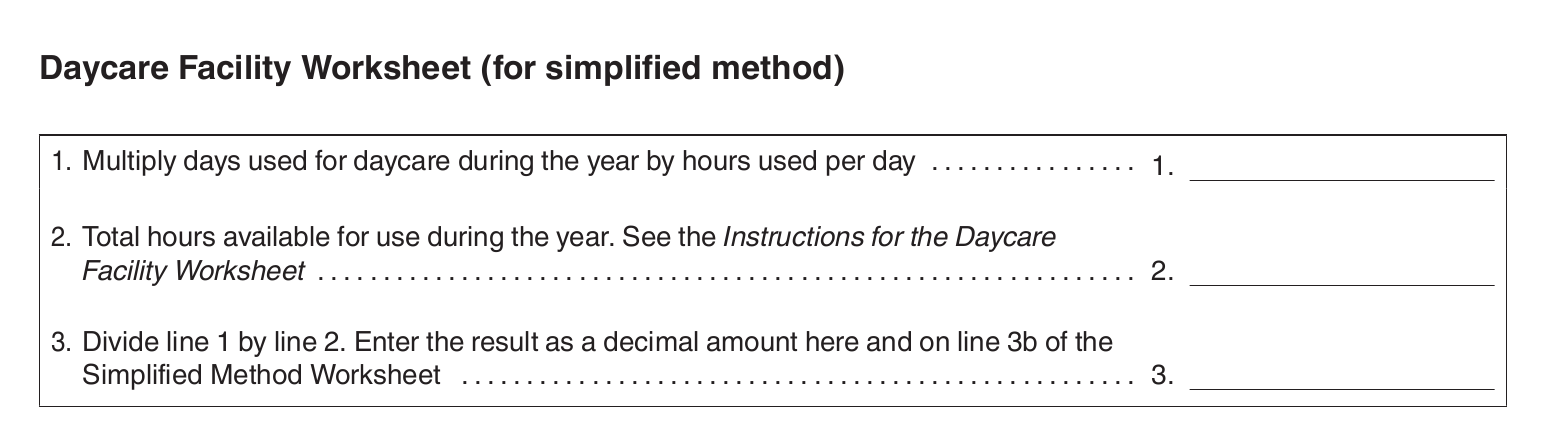
Publication 587 (2025) — the Daycare Facility Worksheet (for simplified method): days × hours, total hours available, the decimal that reduces the $5 rate. Per Publication 587 (2025), checked 2026-10-10.
§4Departure three: mixed space leaves Part I entirely
Article 9's regular method never faces the layout a family daycare commonly has: one room that is the daycare's alone, and the rest of the care space shared with the family. For that layout the instructions withdraw Part I itself. The Special Computation for Certain Daycare Facilities prints that a provider whose daycare facility includes areas used exclusively for business as well as areas used only partly for business cannot figure the business percentage using Part I — and substitutes a three-step computation of its own: the exclusive part's percentage figured on area alone; the partly used part's percentage figured by the Part I method, space times time; the two added together on line 7, with the computation attached as a statement and "See attached computation" entered directly above the line 7 percentage. The home office has no such branch — its rooms are exclusive or they are nothing. The daycare form expects a house that is both, and computes for exactly that house.
§5The space questions, answered from the daycare text
The questions below are the ones providers ask about the space percentage, and each is answered from the two measurements the form actually takes — area of the home used regularly for daycare (line 1) against total area of the home (line 2) — not from the exclusive-use case law of Article 9's world.
Bathrooms. On this form the question answers itself once the test is named: line 1 counts area used regularly for daycare, and the daycare texts print no room list and no exclusivity condition. A bathroom the children use through every care day is area used regularly for daycare, and it enters line 1 on that ground — the family's use of the same bathroom in the evening is the ordinary nonbusiness use the exception was printed for. The home-office question "but is it exclusively the business's?" is never asked here.
The backyard. Lines 1 and 2 measure the home — its total area, and the part of that area used for daycare. A yard is not area of the home on either line: it does not enter line 2's total, and so it cannot enter line 1's part, however exclusively the children use it. The outdoor play space is real daycare space in every sense but the form's; the form's sense is a measured area of the house.
Garages and detached sheds. The same two lines decide these, and the decision runs on what the area is. Line 2 takes the total area of the home; line 1 takes the part of that home used regularly for daycare. An attached garage is part of the home whose area stands on line 2, and it enters line 1 to the extent it is itself used regularly for daycare — the bay where the children are signed in and out and their outdoor equipment is kept is used for the daycare in the course of every care day. A detached structure is not area of the home on line 2, and the daycare texts print no rule that adds it to either line. The instructions print no separate garage rule and no shed rule; the two lines, and the regular-use test, are the whole text — and this article adds nothing to them.
The walk-through room. A room the provider crosses to reach the furnace, used for daycare in between crossings: in Article 9's world, passage is a fact argued about under exclusive use. On the daycare form there is nothing to argue. The room is used regularly for daycare; the crossings are nonbusiness use of exactly the kind the exception contemplates; the time percentage — not a purity ruling — is how the form prices the sharing.
Which areas count has been litigated once, provider by provider and room by room. One case, stated as fact:
Two Minnesota couples, each wife a state-licensed home daycare provider, filed for 1989 with the same question open. Their expenses, their square footage, and their hours were not in dispute — the only issue was which areas of each home counted in the space fraction as used on a regular basis for the daycare, under section 280A(c)(4). The IRS had kept both garages out, and the basement laundry and storage areas out as well; it determined deficiencies of $321 for Brian and Pamela Uphus and $715 for Roger and Lois Walker.
The Tax Court read "regular basis" as continuous, ongoing, or recurring business use, judged on all the facts — and the use that counts is the provider's, not the children's presence in the room. Pamela Uphus took all three areas: the laundry area, where the daycare's laundry was done daily; the storage area; and the garage, each in constant use for the daycare's play items, outdoor toys, and equipment. Lois Walker took her basement — its bathroom was used at least once a day, with its laundry and storage — but lost her garage: her use of it was walking through to reach the car, incidental and predominantly personal, and that did not make it an area used on a regular basis.
— Uphus and Walker v. Commissioner, T.C. Memo. 1994-71 · Tax year at issue: 1989
The decisions were entered under Rule 155, so the opinion prints no final tax for either couple; the deficiencies the IRS determined are the only dollar figures in it. What it decides is the measurement: an area enters the space fraction on the provider's regular use of it, room by room — and the same garage can be in on one return and out on the other.
§6Worked example: one mixed house, both doors
One worked example, with numbers used only in this article. Our provider's home is 2,000 square feet. She has one nap room of 200 square feet that is the daycare's alone, all year — used regularly and exclusively. The rest of her care space — 800 square feet of living and dining area — is used regularly for daycare and by her family after hours. She provided care for 2,190 hours in the year. These are hypothetical figures, not a prediction and not your numbers.
Her regular method leaves Part I. Exclusive part: 200 divided by 2,000 — 10 percent, on area alone. Regular part: its space share is 800 divided by 2,000 — 40 percent; her time percentage is 2,190 divided by 8,760 — 25 percent; the part's business percentage is 40 percent times 25 percent — 10 percent. The attached computation adds them: 20 percent on line 7, with "See attached computation" entered above it. Priced against a year of the home's indirect expenses — mortgage interest, real estate taxes, insurance, and utilities totaling $14,600 — that percentage carries $2,920 of them into Part II's columns before the limitation Article 23 reads. (The full Part II walk — tiers, limitation, carryover — is Article 23's; this example prices the percentage only.)
Her simplified door, same house. The allowable area is capped at 300 square feet. Her exclusively used space is 200 square feet — short of the publication's 300-square-foot tip — so the reduction applies: the Daycare Facility Worksheet takes her 2,190 hours over 8,760 and returns the decimal 0.25; the $5 rate becomes $5 times 0.25 — $1.25 a square foot; and 300 square feet at $1.25 is $375. Had her exclusive space reached 300 square feet, the same door would have paid the unreduced $5 — $1,500 — and the worksheet would never have been opened.
| Door | Build | Result |
|---|---|---|
| Regular method — exclusive part | 200 sq ft ÷ 2,000 sq ft | 10% |
| Regular method — regular part | (800 ÷ 2,000) × (2,190 ÷ 8,760) | 40% × 25% = 10% |
| Regular method — line 7 | Attached computation: 10% + 10% | 20% |
| Regular method — priced | $14,600 of indirect expenses × 20% | $2,920 |
| Simplified — worksheet decimal | 2,190 ÷ 8,760 | 0.25 |
| Simplified — reduced rate | $5 × 0.25 | $1.25 / sq ft |
| Simplified — amount | 300 sq ft × $1.25 | $375 |
| Simplified — if 300 sq ft were exclusively used | 300 sq ft × $5, no worksheet | $1,500 |
§7The worksheet, filled: a part-time provider's reduced rate
The worked example above runs the worksheet once, on a full-time-feeling year. The worksheet itself deserves one clean filling, because its three lines are where providers most often misread the reduction — as a penalty on the rate, rather than as the time the space was actually the daycare's. A second provider, hypothetical figures used only in this article, as of 2026-10-26: she provided care on 146 days of the year, 6 hours a day, on a part-time schedule that ran the whole year, so the worksheet's total-hours line stays the full-year figure.
| Daycare Facility Worksheet (for simplified method) | Entry |
|---|---|
| Line 1 — days used for daycare × hours used per day | 146 × 6 = 876 hours |
| Line 2 — total hours available for the year | 8,760 hours |
| Line 3 — the decimal (line 1 ÷ line 2) | 876 ÷ 8,760 = 0.10 |
The decimal enters the simplified build, where the prescribed $5 rate is multiplied by it: $5 × 0.10 = $0.50 a square foot. Her regularly used mixed space measures 287 square feet — under the 300-square-foot cap, so the cap does not bind and the full 287 is allowable. The simplified amount is 287 × $0.50 = $143.50.
Read the worksheet against the main example's. The main provider's decimal was 0.25 and her rate $1.25; this provider's decimal is 0.10 and her rate $0.50 — the same three lines, the same multiplication, a different year of care. Nothing about the space changed between the two providers except how much of the year it was the daycare's, and the worksheet is exactly that measurement: it prices time, not worth. And the tip from Departure two still stands over both: had this provider's exclusive space reached 300 square feet, the worksheet would never have been opened and the door would have paid the unreduced $5. The regular method's time-space percentage is Article 23's walk; the home-office door this one discounts is Article 9's fork; and the Schedule C the simplified amount feeds is Article 24. How each figure above was checked is described on How we verify.
The fork in one view: the home office's simplified door pays the full $5 rate against its gate-kept space; the daycare's pays a time-discounted rate unless a full 300 square feet stand exclusive. And the regular method she actually files never asked her nap room to be pure or her living room to be one thing — it asked how much of the house the daycare used, and for how much of the year, and multiplied. That is the whole departure, and it is printed in the daycare texts themselves: the exception in the instructions' doorway paragraph, the reduced rate and its worksheet in the publication, and a computation that leaves the form when the house is mixed. Article 9's rules are not wrong. They are simply not hers.
Article 9's fork, for the filers it governs — the simplified method and Form 8829 behind the exclusive-use gate. Article 9
The spine of this hub — Form 8829's time-space percentage, line by line. Article 23
Frequently asked questions
5 questionsReal questions first-time filers asked in public forums — answered only from the lines read in this article.
Can we count bathrooms in the Space Percent?
On Form 8829, yes — on the ground the daycare text prints. Line 1 counts area used regularly for daycare, and the daycare exception asks for regular use, not exclusive use: a bathroom the children use through every care day is area used regularly for daycare, and the family's use of the same bathroom in the evening is the ordinary nonbusiness use the exception was printed for. The home-office question — is it exclusively the business's? — is never asked on this form.
Does the backyard count as space, whether it's used exclusively for business or not?
No — because the two lines measure the home. Line 2 is the total area of the home and line 1 is the part of that area used for daycare; a yard is not area of the home on either line, so it cannot enter the percentage however exclusively the children use it. Exclusivity makes no difference on this form in any case: regular use is the test, and the space measured is the house.
If I have a basement that I use for daycare only except if I host a holiday for family, then may we use that area exclusively for business?
Daycare does not need the area to be exclusively anything. The Instructions for Form 8829 allow the deduction for space used on a regular basis in the business of providing daycare even though the provider uses the same space for nonbusiness purposes — one family holiday is the expected fact pattern, not a defect. The sharing is priced instead of punished: the time percentage at lines 4 through 6 discounts the space percentage by the share of the year's hours the space spent as a daycare.
Do I not qualify for an exclusive daycare room if I have to walk through it to get to my furnace?
There is no exclusive daycare room to qualify for — that test belongs to the home-office rules Article 9 reads. On the daycare form, a room counts by being used regularly for daycare; walking through it to reach the furnace is nonbusiness use of exactly the kind the daycare exception contemplates, and it does not remove the room from line 1.
For home square footage, do you count your garage square footage if you plan to claim it for regular use? How about a detached shed?
By the two lines the form prints: line 2 takes the total area of the home, and line 1 takes the part of that home used regularly for daycare. An attached garage is part of the home whose area stands on line 2, and it enters line 1 to the extent it is itself used regularly for daycare. A detached structure is not area of the home on line 2 — and the daycare instructions print no rule that adds one to either line.
Sources
10 claimsEvery claim above traces to a document, a tax year, a line, and the date it was checked.
-
1
Daycare space used on a regular basis may be deducted even though the same space is used for nonbusiness purposes, behind the license condition (applied for and not rejected, granted and in effect, or exempt, under state law)
- YEAR
- 2025
- LINE
- "Daycare Facilities"
- CHECKED
- 2026-10-10
-
2
Line 1's caption reaches area used regularly and exclusively for business, regularly for daycare, or for storage of inventory or product samples; line 2 is the total area of the home
- DOC
- Form 8829
- YEAR
- 2025
- LINE
- Part I, lines 1–2
- CHECKED
- 2026-10-10
-
3
Mixed exclusive and regular use cannot be figured in Part I: figure each part's percentage, add on line 7, attach the computation, enter "See attached computation" directly above the line 7 percentage
- YEAR
- 2025
- LINE
- "Special Computation for Certain Daycare Facilities"
- CHECKED
- 2026-10-10
-
4
The simplified method's first step: multiply the allowable area by $5, or less than $5 if the use is a daycare using space on a regular but not exclusive basis; the time percentage for such a facility is needed to figure the reduction
- YEAR
- 2025
- LINE
- "Using the Simplified Method," steps and information list
- CHECKED
- 2026-10-10
-
5
Daycare Facility Worksheet (for simplified method): line 1 days used for daycare × hours per day; line 2 total hours available; line 3 the decimal, carried to line 3b of the simplified build, where the $5 rate is multiplied by it
- YEAR
- 2025
- LINE
- "Daycare Facility Worksheet (for simplified method)"; Simplified Method Worksheet lines 3a–3c
- CHECKED
- 2026-10-10
-
6
Where space is used regularly but not exclusively for daycare, the prescribed rate (maximum $5 per square foot) is reduced by comparing business-use time to total time the space can be used (8,760 hours in a full year; prorated if the provider started or stopped)
- YEAR
- 2025
- LINE
- "Space used regularly for daycare"
- CHECKED
- 2026-10-10
-
7
The simplified method's daycare exception as the pack verified it: at least 300 square feet used regularly and exclusively → the prescribed rate is not reduced and the Daycare Facility Worksheet is not needed
- YEAR
- 2025
- LINE
- "Figuring the Deduction" (simplified method), daycare tip
- CHECKED
- 2026-10-10
-
8
The simplified method's general shape — $5 per square foot, allowable area capped at 300 square feet and a $1,500 maximum — as read in Article 9
- YEAR
- 2025
- LINE
- Simplified method
- CHECKED
- 2026-10-10
-
9
Case (one factual passage only): two state-licensed daycare providers' only dispute was which areas counted in the space fraction as used on a regular basis under section 280A(c)(4) — expenses, area, and hours were not in dispute; the IRS had excluded both garages and the basement laundry and storage areas, determining deficiencies of $321 (Uphus) and $715 (Walker) for 1989; the Tax Court held that "regular basis" means continuous, ongoing, or recurring business use judged on all the facts, and that the provider's regular use counts, not the children's presence in the area — Uphus's laundry area, storage area, and garage all counted; Walker's basement counted and her garage did not, her use of it being incidental and predominantly personal; the decisions were entered under Rule 155 and no final tax is printed in the opinion
- DOC
- Uphus and Walker v. Commissioner, T.C. Memo. 1994-71 — full text (CCH memorandum) read via Bradford Tax Institute PDF; docket and filing date per DAWSON docket records
- YEAR
- Opinion filed 1994 (tax year at issue: 1989)
- LINE
- Whole opinion
- CHECKED
- 2026-10-13
-
10
Second-worksheet arithmetic (computed 2026-10-26): 146 days × 6 hours = 876 hours; 876 ÷ 8,760 = 0.10; $5 × 0.10 = $0.50 per square foot; 287 square feet (under the 300 cap) × $0.50 = $143.50
- YEAR
- 2025
- LINE
- —
- CHECKED
- 2026-10-26
Update log
Changes are dated and kept. Old figures are never silently overwritten.
- Same form Form 8829
- Next form Client Mileage Reimbursement 2026: The Actual-Expense Contractor's Two Questions
- Tool Form Finder
Free one-page sheet: The $1,000 Line reads the $1,000 test on the 2026 Estimated Tax Worksheet.