Freelance Designer Home Office 2026: Simplified Method vs Form 8829 — Schedule C Line 30
This is education, not tax advice. I'm not a CPA or EA. State taxes are not covered.
Schedule C cited below is IRS draft as of 2026-10-07 — DRAFT, NOT FOR FILING. If a line changes, this page is updated in place with a dated note at the foot of the article.
- Last checked
- Tax year
- 2026
- Core line
- Schedule C, line 30 — expenses for business use of your home
- Changes
- Update log (8)
Schedule C, line 30 has two printed doors. The simplified method is one multiplication — $5 per square foot, up to 300 square feet and a $1,500 maximum, worked on a worksheet in the Schedule C instructions — and the regular method is figured on Form 8829 from the home's actual expenses. Either way, the amount subtracts at line 31 from tentative profit. In this article's example, a 240-square-foot home office produces $1,200 on line 30 by the simplified method.
This article is for you if you're a freelance designer or consultant working from a dedicated room at home and facing the two ways of figuring line 30.
§1One job, one tax year, one line
One job, one tax year, one line. The job is freelance designer and consultant — solo, billing clients directly, filing Schedule C. The year is 2026. The line is Schedule C, line 30: expenses for business use of your home.
Line 30 is where this site's Fork pillar lives in its purest form. Two printed routes lead into the same line — one is a single multiplication worked out in the instructions, the other is an entire second form — and this article reads both doors without walking through either one for you.
§2Where line 30 sits
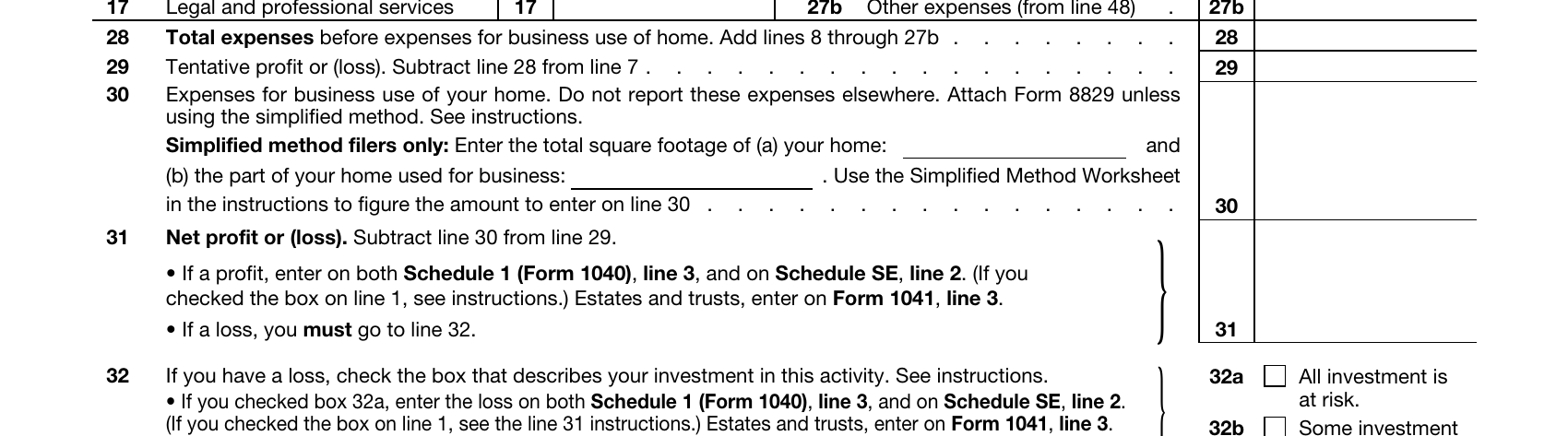
Read line 30 in its neighborhood, because Schedule C saves this expense for nearly last.
Part II of Schedule C totals the year's expenses at line 28 — and line 28 is the total taken before expenses for business use of your home. Line 29 is tentative profit or loss: gross income minus that line 28 total. The home expense has not been touched yet.
Then line 30: expenses for business use of your home. Its printed text names its own two sources — attach Form 8829, unless the simplified method is being used, in which case the worksheet is in the Schedule C instructions.
Line 31 subtracts line 30 from line 29 and produces net profit or loss, and line 31's destinations are printed on the form: Schedule 1, line 3, and Schedule SE, line 2. So whatever amount lands on line 30 does not sit off to the side — it moves the net profit figure that both the income tax side and the self-employment tax side of the return read next.
§3The tests standing in front of the line
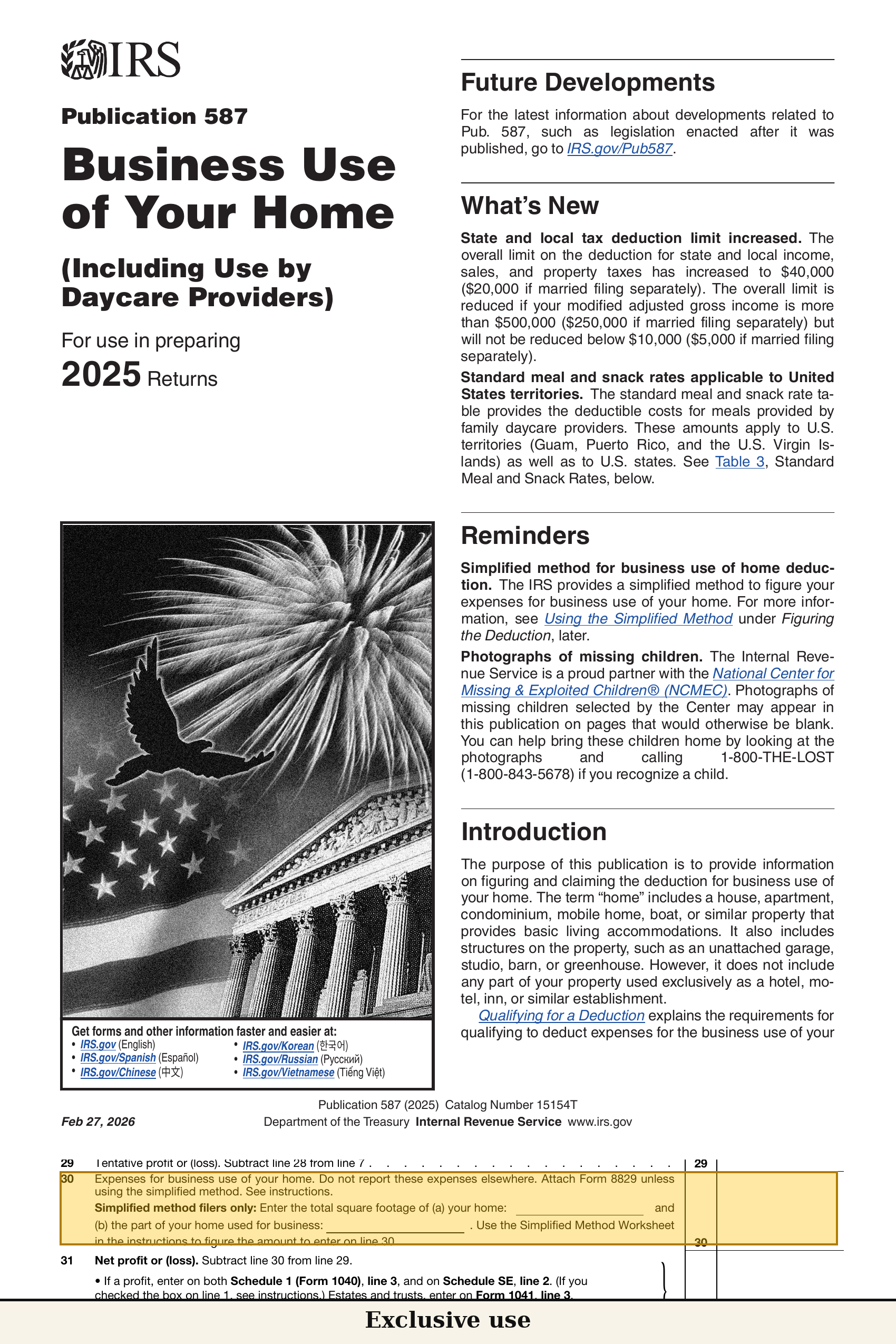
Publication 587 cover/title card beside the Schedule C line 30 zoom. Callouts: "Exclusive use" / "Regular use" / "Principal place of business". No rule text beyond the test names.
Before either route produces a number, there are gates, and they are not on Schedule C. Publication 587 is where the IRS keeps them: tests with names — exclusive use, regular use, and the principal place of business test. Schedule C line 30 assumes those questions; it does not ask them. This article names the tests and where they live, and reads the two cases this site keeps for what the principal-place test is — because that test was built in a courtroom.
In Soliman, decided by the Supreme Court in 1993, the principal place of business was decided by comparison: weigh the relative importance of the activities at each place, and the time spent at each place. That is the comparative test the Supreme Court used in Soliman. One flag travels with it, stated here because it changes what the case can mean: Soliman is pre-1999 law, and a 1997 Act rule for administrative and management activities — effective 1999 — can produce a different result for a solo filer today.
The same comparison cut the other way in Popov, in the Ninth Circuit in 2001: a violinist who practiced four to five hours a day in a living room used for nothing else. Its flags travel with it too: the taxpayer was a W-2 employee, the law was pre-1999, and it binds one circuit. It is used here for the shape of the analysis, and for nothing else.
Exclusive use has its own decided example, under current law: Bulas v. Commissioner, T.C. Memo. 2011-201 (tax year at issue: 2007). The case is named here only, without its room-by-room figures: no official full text (Tax Court / govinfo) was located on re-check 2026-10-27, so no figure from it is printed.
One exception to exclusive use: storage of inventory or product samples. The exclusive-use test has a printed exception that matters to a seller, not a designer. Form 8829's Part I, line 1, captions the area as used "regularly and exclusively for business, regularly for daycare, or for storage of inventory or product samples" — and the Instructions for Form 8829 (2025), "Who Can Deduct," list storage of inventory or product samples among the exceptions to exclusive use. A seller who stores stock or samples at home need not meet the exclusive-use requirement for that storage space. This article's designer example — a dedicated room, used exclusively and regularly — does not use the exception; it is printed here because the same line 30 serves sellers whose home holds inventory, and the exception is theirs.
§4Door one: the simplified method, and the worked example
Door one: the simplified method, printed in Revenue Procedure 2013-13 and carried in the IRS's own summaries.
The build is one multiplication. Five dollars per square foot of the part of the home used for business. Two printed limits ride on it: the area counted stops at 300 square feet — so the multiplication tops out at $5 × 300 sq ft = $1,500 by arithmetic. No IRS original prints $1,500 as a separate dollar cap: Publication 587 and Topic 509 print the $5 rate and the 300-square-foot limit, and $1,500 is their product. The worksheet that walks it sits in the Schedule C instructions — line 30's own text points there. And notice what is not attached on this route: no Form 8829. The instructions' worksheet stands in its place.
One worked example, with numbers used only in this article. A freelance designer — hypothetical, not a prediction, not your numbers — works from a dedicated room of 240 square feet, used exclusively and regularly for the design business.
240 square feet times $5 is $1,200. Check it against both printed limits: 240 is under the 300-square-foot limit, and $1,200 is under the $1,500 arithmetic maximum ($5 × 300 sq ft), so neither limit trims it. Line 30 takes $1,200.
Now read the cap doing its work, once, at the limit itself. At 300 square feet the multiplication reaches $1,500 — $5 × 300 sq ft, where the square-foot limit and the arithmetic meet — and any area beyond 300 adds nothing on this route, because the multiplication cannot pass the area limit. That is the whole arithmetic of door one: one multiplication, two limits, and an answer that never asks what the home actually cost to run.
| Step | Source line | Operation | Amount |
|---|---|---|---|
| Dedicated home office area, used exclusively and regularly for the design business | Hypothetical input | Invented for this article | 240 sq ft |
| Simplified-method rate | Rev. Proc. 2013-13 | Printed rate per square foot | $5 |
| Multiplication | Simplified method | 240 × $5 | $1,200 |
| Square-foot limit check | Printed limit | 240 sq ft is under the 300 sq ft limit — no trim | — |
| Dollar cap check | Printed limit | $1,200 is under the $1,500 maximum — no trim | — |
| Amount entered on Schedule C | Line 30 | Simplified method result | $1,200 |
| Printed-limit read (not a second example) | Rev. Proc. 2013-13 | At 300 sq ft: 300 × $5 = $1,500 — the square-foot limit and the dollar cap meet; area beyond 300 adds nothing on this route | $1,500 |
§5Door two: Form 8829
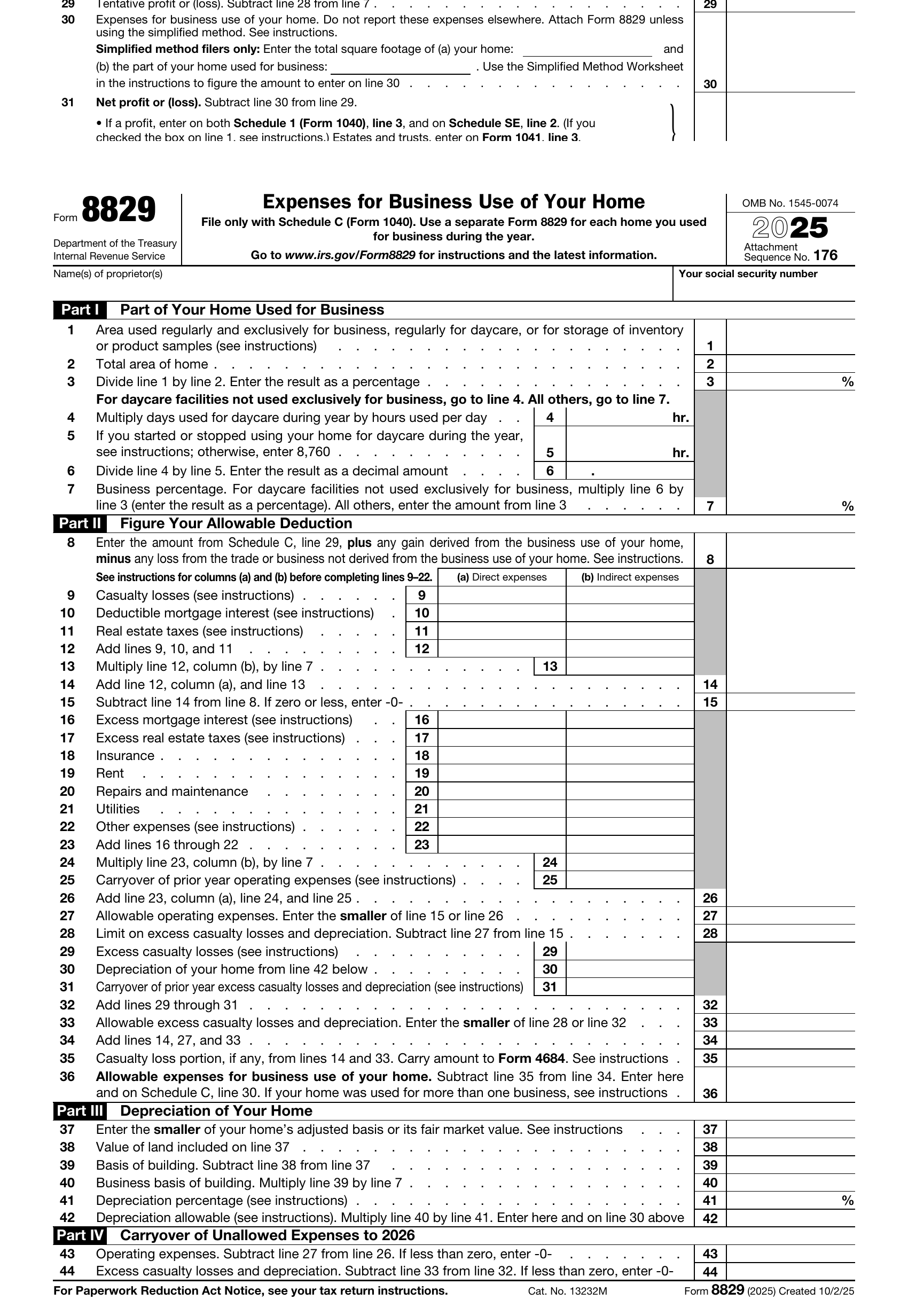
Schedule C line 30 text zoomed on the words "Attach Form 8829 unless using the simplified method", then a closed Form 8829 cover — the form is shown, its lines are not opened.
Door two: the regular method, and its address is a different form entirely — Form 8829, Expenses for Business Use of Your Home.
Line 30's text is the map: attach Form 8829 unless the simplified method is being used. Read it from the other direction and it says the regular route is the default printed path, and the form behind it is where that route's amount is figured — from the home's actual expenses, worked through Form 8829's own structure.
This article does not read Form 8829's lines. They have not been opened for this site, and a number read from memory is a number this site does not say. What can be read from Schedule C itself is the fork's shape. Behind door one, the amount is built from area alone — square feet times five dollars, inside two printed limits. Behind door two, the amount is built inside a second form and carried back to the same line.
Two builds, one destination. Both doors are printed, and both are read here as doors — and which door fits a given designer's year is not a question Schedule C answers.
§6The plumbing does not change
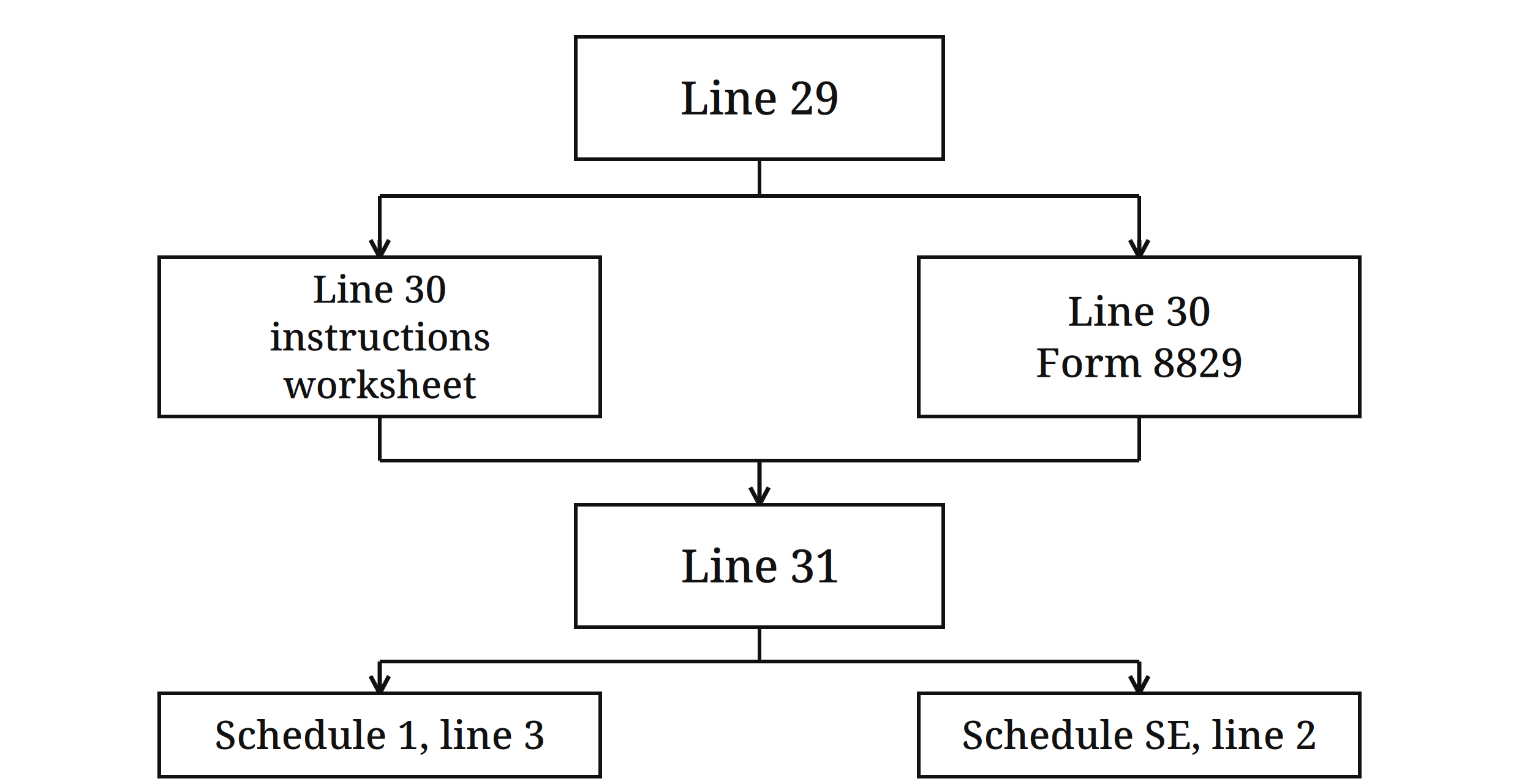
Whichever door produced it, the amount lands in the same place and does the same work.
Line 31 subtracts line 30 from line 29. Net profit falls by exactly the line 30 amount — no more, no less — and the mechanics do not change with the route that built the number.
From line 31 the figure splits toward the two places already read: Schedule 1, line 3, where business income enters the individual return, and Schedule SE, line 2, where the self-employment tax computation starts. That is why a home-office amount is never only a home-office amount on this return: it is an input to the profit figure two other schedules read.
And one boundary worth stating plainly: line 30 sits after line 28's expense total. The expenses of the business itself — the software, the supplies, the contract labor — are figured above it, on their own lines. The home enters at line 30, alone, through one of its two doors.
§7What changed for tax year 2026
Nothing in the simplified method's printed figures moved. The rate, the area limit, and the dollar cap read the same for 2026 as they read for 2025 — which is why this article's worked example, $1,200 on 240 square feet, stands without adjustment. The choice between the two doors is likewise unchanged: the simplified method's worksheet still sits in the Schedule C instructions, and the regular method still runs through Form 8829.
| Item | TY2025 | TY2026 | Source | As of |
|---|---|---|---|---|
| Simplified-method rate | $5 per square foot | $5 — No change | Rev. Proc. 2013-13; IRS Topic 509 | 2026-10-26 |
| Area counted | Up to 300 square feet | Up to 300 square feet — No change | Rev. Proc. 2013-13; IRS Topic 509 | 2026-10-26 |
| Arithmetic maximum | $5 × 300 sq ft = $1,500 | $5 × 300 sq ft = $1,500 — No change (no separate $1,500 figure printed) | Rev. Proc. 2013-13; IRS Topic 509 | 2026-10-27 |
| The two doors (simplified worksheet vs Form 8829) | Both printed, no ranking | Both printed, no ranking — No change | Schedule C instructions; Form 8829 | 2026-10-26 |
§8What line 30 does to line 31
The worked example stops at line 30: $1,200 on 240 square feet. The subtraction that follows is a second illustration, as of 2026-10-26, built to show what that $1,200 does next — because line 30 is not the end of the form, and the amount it holds is subtracted once, in full, before anything else reads the profit.
| Schedule C line | Figure |
|---|---|
| Line 29 — tentative profit or loss (hypothetical input for this illustration) | $58,360 |
| Line 30 — expenses for business use of your home (the simplified method's $1,200 from the worked example) | −$1,200 |
| Line 31 — net profit or loss | $57,160 |
$58,360 minus $1,200 is $57,160, and $57,160 is the figure both downstream lines read: Schedule 1, line 3, where business income enters the individual return, and Schedule SE, line 2, where the self-employment tax computation starts. The home amount does not get subtracted twice — once for income tax and once for self-employment tax — and it does not get subtracted at a discount on either side. One subtraction at line 31, and the same reduced profit feeds both. Had line 30 been $0, both downstream lines would have read $58,360; the $1,200 room is worth exactly $1,200 of profit on each side, no more and no less.
The self-employment side of that split is Article 2; the other expense that moves line 31 before the home ever enters is Article 10's car; and the Form 8829 route this article names but does not open is walked line by line in Article 23. How each figure above was checked is described on How we verify.
§9What this form does not cover
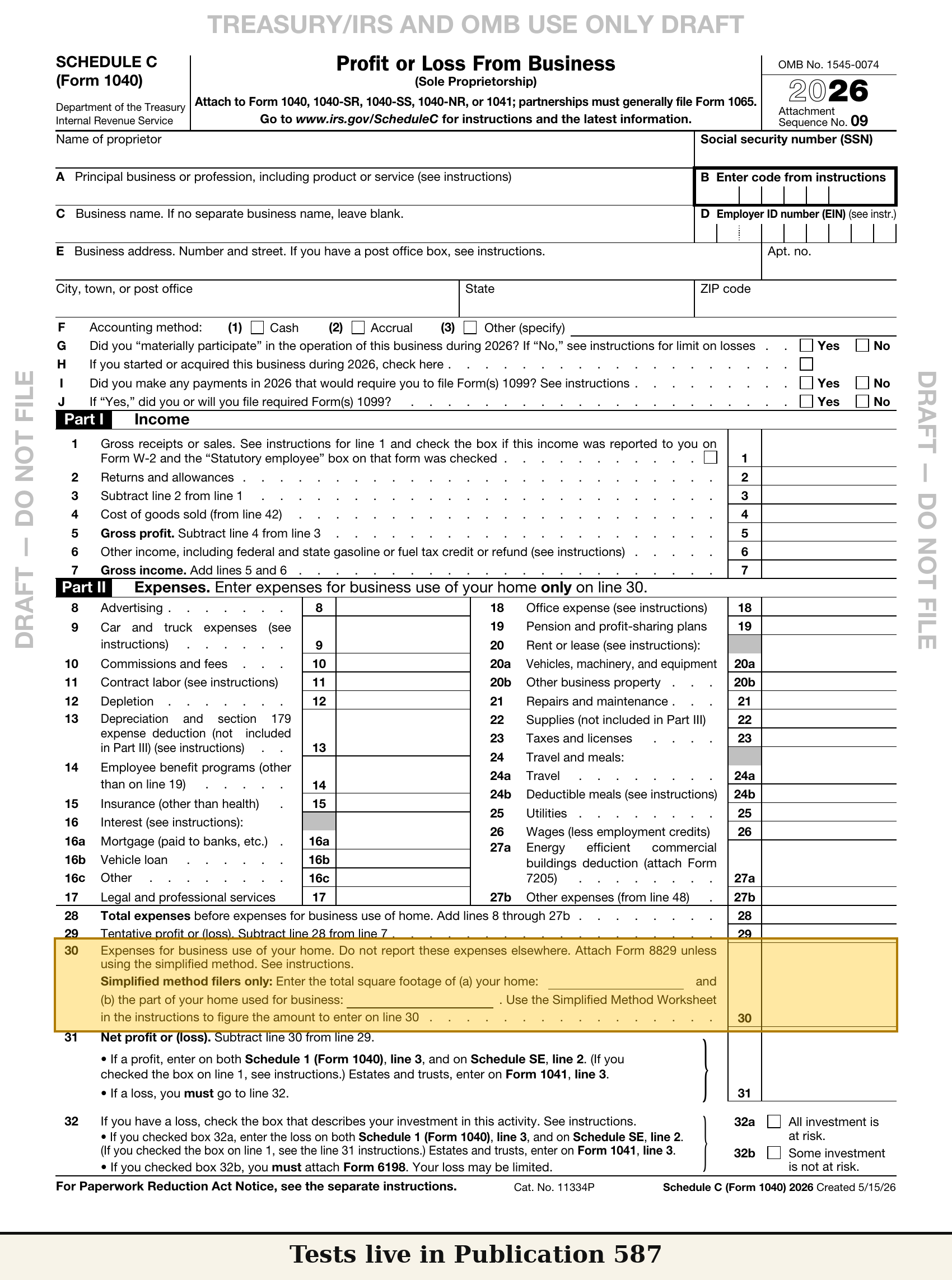
Schedule C full-page draft, greyed, with three callouts: "Tests live in Publication 587" / "Form 8829: named on line 30, not read here" / "State taxes: not covered".
What Schedule C does not settle, to close the reading.
It does not decide whether a given room passes the tests. Exclusive use, regular use, principal place — those questions live in Publication 587 and in the facts of the space, and line 30 asks none of them; it takes an amount.
It does not read Form 8829 for you: the regular method's form is named on line 30 and not opened in this article, so no line of it is stated here.
It does not choose between the doors. The simplified build and the regular build can produce different amounts for the same room in the same year, and the form prints both without ranking them.
And it does not cover state taxes — this site does not cover state taxes, in this article or any other.
§10Software numbers vs ask-a-human numbers
The split, applied to this article's two doors.
The numbers a piece of software can carry on this one: the simplified multiplication itself — square feet times five dollars, with the 300-square-foot limit applied (multiplication tops out at $5 × 300 sq ft = $1,500) — and the subtraction at line 31, provided the square footage handed to it is the square footage the tests would recognize.
Numbers and questions to take to a human before you act on them: whether the space in your year actually meets the exclusive use and regular use tests as Publication 587 states them; whether a filer's work pattern meets the principal-place tests at all — a facts question, not an arithmetic one — read with the post-1999 rule beside it; and what the regular method would produce on Form 8829, since that form's lines were not read here.
That is line 30, as the draft prints it for 2026: tentative profit at line 29, the home entering at line 30 through one of two printed doors — $1,200 on 240 square feet in this article's example — and net profit coming out at line 31. IRS draft as of October 7, 2026.
Next article: the car. Line 9, Part IV, and a mileage rate that changes its price in the middle of the year. Article 10
Frequently asked questions
3 questionsReal questions first-time filers asked in public forums — answered only from the lines read in this article.
How do I know if I'm eligible for the home office deduction, and do I take the simplified method or the actual method?
Before either method produces a number, the tests stand in front of the line — exclusive use, regular use, and principal place of business, all stated in Publication 587; Schedule C, line 30 assumes those questions and asks none of them. Past the tests, line 30 has two printed doors: the simplified method — $5 per square foot, up to 300 square feet and a $1,500 maximum, worked on a worksheet in the Schedule C instructions — and the regular method, figured on Form 8829 from the home's actual expenses.
Running under a home office — can I take the square footage of my actual office as a write-off from rent paid?
The simplified route is figured from area alone, not from what the home cost to run: square feet used for business times $5, inside the two printed limits of 300 square feet and $1,500 — in this article's example, 240 square feet produce $1,200 on line 30. The route that runs from the home's actual expenses is the other door, Form 8829.
My accountant claimed half the house as a home office when the measured area is 12% — is that defensible?
The percentage follows the space that passes the tests, and exclusive use is decided room by room. In the 2011 Tax Court case this article reads, a self-employed accountant's bedroom office counted at 8.45 percent of his home, but the hallway and bathroom next to it counted for nothing, because his children and guests occasionally used the bathroom.
Sources
10 claimsEvery claim above traces to a document, a tax year, a line, and the date it was checked.
-
1
Line 28 is the Part II expense total before home-office expenses; line 29 is tentative profit or loss (gross income minus line 28); line 30 is "Expenses for business use of your home" and its printed text reads: attach Form 8829 unless using the simplified method, whose worksheet is in the Schedule C instructions; line 31 = line 29 minus line 30, and line 31's text points to Schedule 1 line 3 and Schedule SE line 2
- YEAR
- 2026 draft
- LINE
- Lines 28, 29, 30, 31
- CHECKED
- 2026-10-07 — IRS draft as of 2026-10-07; footer date re-verified 2026-10-27
-
2
Simplified method: $5 per square foot of the part of the home used for business, up to 300 square feet ($5 × 300 sq ft = $1,500 by arithmetic; no separate $1,500 figure printed in Publication 587 or Topic 509 as checked 2026-10-27); the simplified-method worksheet is in the Schedule C instructions; the regular method is figured on Form 8829
- YEAR
- Current as verified
- LINE
- Simplified method figures
- CHECKED
- 2026-10-27
-
3
The exclusive use and regular use tests and the principal place of business test are stated in Publication 587; Schedule C line 30 does not itself state them
- YEAR
- Current edition
- LINE
- Tests
- CHECKED
- 2026-10-06
-
4
"What changed for tax year 2026" table: simplified method $5 per square foot, 300 square feet, $5 × 300 sq ft = $1,500 arithmetic maximum, and the two-door choice — all unchanged
- YEAR
- 2026
- LINE
- Simplified method figures; tests
- CHECKED
- 2026-10-27
-
5
Bulas v. Commissioner, T.C. Memo. 2011-201 (tax year 2007) — named as the exclusive-use case example only; no figure from the case is printed (no official full text located on re-check 2026-10-27)
- DOC
- Bulas v. Commissioner, T.C. Memo. 2011-201
- YEAR
- Tax year 2007; filed 2011-08-17
- LINE
- Case name only
- CHECKED
- 2026-10-27
-
6
Soliman: the Supreme Court's comparative principal-place-of-business test (relative importance of activities at each place; time spent at each place); decided 1993 under pre-1999 law; the 1997 Act's administrative/management rule (effective 1999) can change a solo filer's outcome today — test source only, never today's result
- YEAR
- Case decided 1993
- LINE
- Holding
- CHECKED
- 2026-10-27
-
7
Popov: 9th Circuit (2001) applied the same comparison the other way on extreme exclusivity facts (a living room used 4–5 hours daily for practice and for nothing else); taxpayer was a W-2 employee, 1993 tax year, pre-1999 law, 9th Circuit only — used for the shape of the analysis only
- DOC
- Popov v. Commissioner, 246 F.3d 1190 (9th Cir. 2001)
- YEAR
- Case decided 2001
- LINE
- Holding
- CHECKED
- 2026-10-06
-
8
Line 31 = line 29 minus line 30, and line 31's text points to Schedule 1, line 3, and Schedule SE, line 2 — applied in the 2026-10-26 illustration to a hypothetical line 29 of $58,360, the worked example's $1,200 at line 30, and a line 31 of $57,160
- YEAR
- 2026 draft
- LINE
- Lines 29, 30, 31
- CHECKED
- 2026-10-26 — IRS draft as of 2026-10-07; footer date re-verified 2026-10-27
-
9
Form 8829 Part I, line 1 caption includes "for storage of inventory or product samples" alongside regular and exclusive business use
- DOC
- Form 8829
- YEAR
- 2025
- LINE
- Part I, line 1
- CHECKED
- 2026-11-09
-
10
Storage of inventory or product samples is an exception to the exclusive-use requirement
- YEAR
- 2025
- LINE
- "Who Can Deduct"
- CHECKED
- 2026-11-09
Update log
Changes are dated and kept. Old figures are never silently overwritten.
Browse the Schedule C hub — its lines, articles, and tools.
- Same form Do I Have to Report Income Without a 1099? (2026)
- Next form Self-Employment Tax 2026, Line by Line: Where It Is Figured — Schedule SE, Line 12
- Tool Schedule SE Estimator
Free one-page sheet: The $1,000 Line reads the $1,000 test on the 2026 Estimated Tax Worksheet.