Self-Employment Tax 2026, Line by Line: Where It Is Figured — Schedule SE, Line 12
This is education, not tax advice. I'm not a CPA or EA. State taxes are not covered.
Schedule SE cited below is the final 2026 form (Cat. No. 11358Z, Created 4/27/26) and its final instructions (Cat. No. 24334P, Aug 5, 2026). Schedule C is cited as the final 2026 form (posted Oct 29, 2026); its instructions are still a draft, cited as 'IRS draft as of 2026-10-08'. Schedule 1 and Schedule 2 are cited as 2026 drafts. If a line changes, this page is updated in place with a dated note at the foot of the article.
- Last checked
- Tax year
- 2026
- Core line
- Schedule SE, line 12
- Changes
- Update log (9)
Schedule SE takes net profit from Schedule C, line 31, shrinks it to 92.35 percent, and — past the $400 gate at line 4c — splits it between a capped 12.4 percent part (line 10) and an uncapped 2.9 percent part (line 11). The sum is the self-employment tax at line 12, sent to Schedule 2, line 4; half of it is then deducted at line 13, onto Schedule 1, line 15. In this article's example, $80,000 of net profit becomes $11,303.64 of self-employment tax.
This article is for you if you're a real estate agent filing Schedule C and want to see, line by line, where the self-employment tax on your profit is figured.
§1One job, one tax year, one line
The job is real estate agent. The year is 2026. The line is Schedule SE, line 12 — the self-employment tax itself, the number this whole short form exists to produce.
Article 1 covered estimated tax: the worksheet that spreads a year of tax into four payments. This article is one of the taxes inside that estimate. Schedule SE takes one number in — net profit from Schedule C — shrinks it, tests it against a printed ceiling, splits it between two rates, and sends the answer to two different schedules. We read every line it passes through.
§2Where the profit lands before this form starts
Start where Schedule SE starts: not at its line 1, but at the last line of a different form.
Schedule C figures the business's net profit at line 31 — on the 2026 draft, line 31 is still the net profit line, and its own printed text points to two destinations: Schedule 1, line 3, for income tax, and Schedule SE, line 2, for this tax.
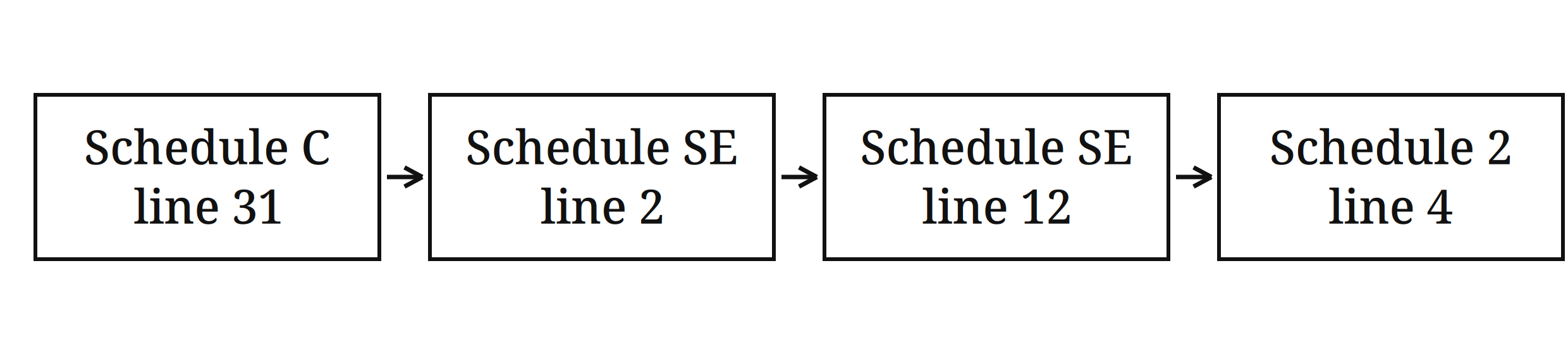
So line 2 of Schedule SE reads that net profit in. If there are also amounts from a Schedule K-1, box 14, code A, the line's text adds those — our example has none. Line 3 then combines lines 1a, 1b, and 2 into one starting figure.
Notice what has not happened yet. No percentage has been applied, and no rate has appeared. The form first re-states the profit in its own terms, and its first real operation is not a tax rate at all. It is a multiplier — and before the multiplier, there is a gate the form makes you pass: a dollar floor, printed right on the form, that can end this entire calculation in four lines.
What enters at line 2 is not always pay for work done in the year being filed. One case, stated as fact:
A retired Mary Kay national sales director — an independent beauty consultant since 1982 — received $489,707 in 2009 under the company's Family Security Program and Great Futures Program, after she had stopped working. The payments were deferred compensation: one program keyed them to her average commissions over her last five working years, the other to her sales network's later wholesale volume. She took the position that the distributions were not self-employment income. The Tax Court held they were — money tied to the quantity and quality of the work she had done before retiring enters the self-employment tax computation when it arrives.
— Peterson v. Commissioner, T.C. Memo. 2013-271 · Tax year at issue: 2009
The opinion prints no single self-employment tax total for that year — the final figure was left to a computation under Rule 155 — so none is printed here either.
§3The gate: line 4 and the $400 stop

Line 4a takes line 3 and multiplies it by 92.35 percent — 0.9235 — when line 3 is over zero. Whatever your net profit was, the amount this form works with from here on is 92.35 percent of it. The form does not round this to a simpler fraction, and neither will we.
Line 4b is where optional methods would enter. Our example uses none, so line 4b is zero — the optional-method lines are on the form, they are simply not read in this article.
Line 4c adds 4a and 4b. And here is the gate, in the form's own structure: if line 4c is less than $400, stop. No self-employment tax is owed on that amount, and the instructions' filing trigger is the same line read the other way — line 4c of $400 or more is when this form must be filed. One printed exception continues past the stop: church employee income, which goes to line 5. That is not a real estate agent's line, and it is the last time it is mentioned.
That is the whole of the gate as the form prints it — a floor at line 4c and a stop. Past it, line 6 carries the shrunken figure down under a name worth reading exactly: net earnings from self-employment.
§4Worked example: $80,000 of net profit, start to finish
One worked example, with numbers used only in this article.
A real estate agent — hypothetical, not a prediction, not your numbers — finishes 2026 with net profit of $80,000 on Schedule C, line 31. No Schedule K-1 amounts. No optional methods. And in 2026, no W-2 wages at all — that last input matters in about a minute, at line 9.
Line 2 reads in the $80,000. Line 3 is $80,000.
Line 4a: $80,000 times 0.9235. That is $73,880. Line 4b is zero, so line 4c is $73,880 — well over the $400 gate, so the form continues.
Line 6, net earnings from self-employment: $73,880.
Now lines 7 through 9 set up a ceiling before any rate is applied. Line 7 is preprinted on the final 2026 form: $184,500 — the maximum amount of combined wages and self-employment earnings subject to the Social Security part of this tax. Lines 8a through 8d collect W-2 Social Security wages and the related amounts the form lists. This example has none, so line 8d is zero. Line 9 is line 7 minus line 8d: $184,500 minus zero — $184,500 of ceiling still available.
Keep $73,880 and $184,500 side by side. Line 10 is about to compare them, and line 11 is about to ignore the comparison entirely.
| Step | Schedule SE line | Operation | Amount |
|---|---|---|---|
| Net profit, Schedule C line 31 | Input to line 2 | Hypothetical input; no K-1 amounts | $80,000 |
| Combined starting figure | Line 3 | Lines 1a + 1b + 2 | $80,000 |
| Shrunk earnings base | Line 4a | $80,000 × 92.35% (0.9235) | $73,880 |
| Optional methods | Line 4b | None in this example | $0 |
| Gate test | Line 4c | $73,880 + $0 — is it $400 or more? Yes → continue | $73,880 |
| Net earnings from self-employment | Line 6 | Line 4c + line 5b ($0) | $73,880 |
| Social Security ceiling, preprinted (final 2026 form) | Line 7 | Printed on the form | $184,500 |
| W-2 Social Security wages etc. | Line 8d | None in this example | $0 |
| Remaining ceiling | Line 9 | $184,500 − $0 | $184,500 |
| Capped portion | Line 10 | Smaller of line 6 ($73,880) or line 9 ($184,500) × 12.4% | $9,161.12 |
| Uncapped portion | Line 11 | Line 6 × 2.9% — no ceiling comparison | $2,142.52 |
| Self-employment tax → Schedule 2, line 4 | Line 12 | $9,161.12 + $2,142.52 | $11,303.64 |
| Deductible half → Schedule 1, line 15 (income deduction; does not reduce line 12) | Line 13 | $11,303.64 ÷ 2 | $5,651.82 |
§5The Fork: one rate with a ceiling, one rate without
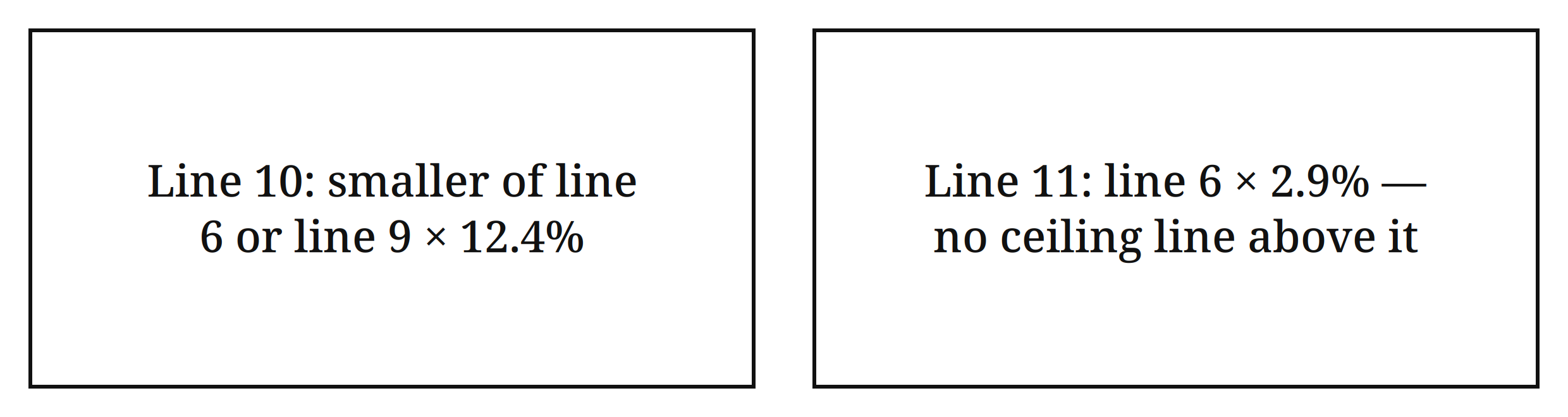
Split card — Line 10: smaller of line 6 or line 9 × 12.4%; Line 11: line 6 × 2.9% — no ceiling line above it.
Line 10 reads: take the smaller of line 6 or line 9, and multiply by 12.4 percent.
Smaller of $73,880 and $184,500 is $73,880 — the earnings figure is under the ceiling, so the ceiling changes nothing in this example. $73,880 times 12.4 percent is $9,161.12. That is line 10.
Line 11 reads differently, and the difference is the whole fork. Line 11 takes line 6 — not the smaller of anything — and multiplies by 2.9 percent. There is no line 9 in it. No ceiling is compared. $73,880 times 2.9 percent is $2,142.52. That is line 11.
Same earnings figure, two printed treatments: one percentage runs against a capped base, the other runs against the full figure. If this agent had also held a W-2 job in 2026, line 8d would not be zero, line 9 would shrink by exactly those W-2 Social Security wages, and only line 10 would feel it — line 11's base would stay line 6, unchanged. The form does not explain why it is built this way, and this site does not fill that silence in. It reads the build: capped on line 10, uncapped on line 11.
§6Three questions before line 10: a decision tree for the ceiling
The fork above says line 10 is capped and line 11 is not. The three questions below decide, in order, whether the cap does anything at all in a given year — and a second hypothetical, with numbers used only in this article, runs the branch where it does. The ceiling figure below is the final 2026 figure, re-checked 2026-11-10; it is unchanged from the draft figure.
Question 1 — Is line 4c $400 or more? Line 4a shrinks line 3 by 92.35 percent, and line 4c is that figure plus any optional-method amount. If line 4c is less than $400, stop: no self-employment tax is owed on that amount, and the tree ends here (the church-employee exception in Article 40 is the one printed door past the stop). If line 4c is $400 or more, go to Question 2.
Question 2 — Are there W-2 Social Security wages in the year? Lines 8a through 8d collect them, and line 9 is line 7 minus line 8d. With none, line 9 is the whole final 2026 ceiling — $184,500 — and line 10 is the smaller of line 6 or $184,500, which is the main example's branch: $73,880 under the ceiling, so the ceiling changes nothing. With W-2 wages, go to Question 3.
Question 3 — Do the W-2 wages leave any ceiling at all? Take the same $80,000 profit — line 6 still $73,880 — and add $142,000 of W-2 Social Security wages. Line 9 is $184,500 minus $142,000, or $42,500 of ceiling left. Line 10 is the smaller of $73,880 or $42,500, times 12.4 percent: $42,500 × 12.4% = $5,270.00. Line 11 does not move: line 6 × 2.9% = $2,142.52, the same figure as in the main example, because no ceiling is compared on line 11. Line 12 is $5,270.00 + $2,142.52 = $7,412.52, and line 13 is half of that, $3,706.26. The W-2 wages cut the 12.4 percent part by $3,891.12 against the main example's $9,161.12 and left the 2.9 percent part untouched — that split is the whole point of the fork.
If the W-2 wages had reached the full $184,500 ceiling, line 9 would be $0 and line 10 would be $0 with it, leaving line 11 alone — the tree's last branch, stated here as arithmetic from the smaller-of rule, not as a worked year. Where the mixed W-2 and self-employment year is walked in full is Article 42; the estimated-tax machinery that carries a line 12 figure through the year is Article 1; and the Schedule C profit that enters at line 2 is walked in Article 5. How each figure above was checked is described on the site's How we verify page.
§7Line 12, and the second landing at line 13

Line 12 adds line 10 and line 11. $9,161.12 plus $2,142.52 is $11,303.64. That is the self-employment tax for this example — the core line of this article, reached.
Where does line 12 go? Its text sends it to Schedule 2, line 4 — the line that reads "Self-employment tax. Attach Schedule SE." On the 2026 draft, Schedule 2 totals its additional taxes at line 21, and that total enters Form 1040 at line 23. That is landing one: the tax itself, added into the return's tax total.
Then line 13 does something first-time filers routinely misread, so read its structure, not just its number. Line 13 is one-half of line 12: half of $11,303.64 is $5,651.82. Its text sends it to Schedule 1, line 15, in Part II — the line labeled "Deductible part of self-employment tax."
Two things line 13 is not. It is not a second tax — nothing is added at Schedule 1, line 15; Part II is the adjustments section, and Schedule 1 totals it at line 26 into Form 1040, line 10. And it is not a reduction of the tax on line 12: the $11,303.64 on Schedule 2 does not become $5,651.82. The full tax stands in one place, and half of it is deducted from income in another place. One tax, two landings — that is the build of this form. The income tax that lands separately from this tax — the standard deduction subtracted and the bracket slices applied to what remains — is Article 54's walk.
§8What this form does not cover
What Schedule SE does not do, to close the reading.
It does not figure your profit. By the time line 2 reads a number in, Schedule C has already done that work — every expense question lives on that form. It does not decide estimated payments: the $11,303.64 in this example is a full-year figure on a return, and how a tax like this is spread across the year is Form 1040-ES and Publication 505 — Article 1's worksheet, not this form. It does not figure the 0.9 percent Additional Medicare Tax: when that tax applies, it is figured on a separate form, Form 8959, which is not read here — the uncapped 2.9 percent on line 11 is the only Medicare rate this form prints. It does not cover state taxes — this site does not cover state taxes, in this article or any other. And its optional methods — line 4b and Part II (Optional Methods To Figure Net Earnings) behind it — are printed on this form but are not read here; an example with no optional methods is the only example this article claims to walk through.
Software numbers vs ask-a-human numbers. The numbers software can carry on this form: the 92.35 percent multiplication on line 4a, the smaller-of comparison on line 10, the two rate multiplications, and the half on line 13 — provided the inputs it is handed are the inputs the form asks for. Numbers to take to a human before you act on them: what belongs in line 8 if a W-2 job and self-employment overlapped in the same year, because that input alone moves the line 10 ceiling; whether any amount in your year belongs on line 2 from a Schedule K-1; and whether an optional method is even available in your situation, since those lines were not read here.
That is Schedule SE, as the final 2026 form prints it: profit in at line 2, shrunk to 92.35 percent at line 4a, tested at the $400 gate, capped on line 10 and uncapped on line 11, taxed at line 12 — $11,303.64 on $80,000 of profit in this article's example — and half of it deducted at line 13. Final 2026 form (Cat. No. 11358Z).
Next article: the form that never arrived — whether income is taxable when no 1099 shows up at all. Article 3
Frequently asked questions
6 questionsReal questions first-time filers asked in public forums — answered only from the lines read in this article.
I'm a W-2 employee with side work — why does my return show self-employment tax when I say I'm not self-employed?
Schedule SE does not ask what you call yourself; it reads a number in. The net profit on Schedule C, line 31 enters Schedule SE at line 2, and the form figures self-employment tax on it down to line 12 — side income that runs through Schedule C is what this form taxes.
First-year LLC owner-operator: how does self-employment tax work, and how much should be set aside?
The form builds the tax from net profit, not from revenue: line 4a multiplies the profit by 92.35 percent, line 4c stops the whole calculation if the result is less than $400, and past the gate the tax is 12.4 percent of the capped portion at line 10 plus 2.9 percent of the full figure at line 11, added at line 12. In this article's example, $80,000 of net profit produces $11,303.64 at line 12 — the set-aside is whatever your own run through those lines produces.
If I file as a business, do I get taxed twice — once as a business and again on my total earnings?
The same profit is read by two forms for two different taxes, and the form keeps them apart. Net profit enters Schedule 1, line 3 for income tax, and Schedule SE, line 2 for self-employment tax, which is figured at line 12 and sent to Schedule 2, line 4 — and line 13 then deducts one-half of that tax from income on Schedule 1, line 15, without reducing the tax itself.
If my W-2 job already maxes Social Security tax, is Social Security tax still owed on the 1099 income — on both halves?
Read lines 8 through 11. W-2 Social Security wages enter at line 8d and shrink the remaining ceiling at line 9, and only line 10 — the 12.4 percent part — is figured against that reduced ceiling. Line 11 takes the full line 6 figure at 2.9 percent with no ceiling compared at all, so the two parts of the tax do not move together when W-2 wages are in the year.
I'm an independent contractor paid $2,000 on a 1099, and my total income is under the general filing threshold — do I still have to file and pay self-employment tax?
The gate this article reads is not the general filing threshold and not the $2,000 on the form. Schedule SE's own test is at line 4c: net profit shrunk by 92.35 percent at line 4a, and if line 4c is less than $400, stop — no self-employment tax is owed on that amount; at $400 or more the form must be filed. Whether a return is required for other reasons is a question this article's walk does not decide.
I earned $500 from painting and spent $600 on supplies — my net is under $400, so do I have to file Schedule SE?
The gate is tested on the shrunken net figure, not on the $500 gross: line 4a multiplies line 3 by 92.35 percent when line 3 is over zero, and line 4c under $400 stops the whole calculation. Whether any filing duty arises from other income in the year is outside this walk, and the thread's late-filing penalty strand is not decided here.
Sources
10 claimsEvery claim above traces to a document, a tax year, a line, and the date it was checked.
-
1
Line 2 reads net profit from Schedule C line 31 (plus Schedule K-1 box 14, code A amounts where they apply); line 3 combines lines 1a, 1b, and 2
- YEAR
- Form text 2026 final (Cat. No. 11358Z, Created 4/27/26)
- LINE
- Lines 2, 3
- CHECKED
- 2026-10-06; final confirmed 2026-11-10
-
2
Line 4a: line 3 × 92.35% (0.9235) when line 3 is over $0; line 4c under $400 — stop, no SE tax (church-employee exception continues to line 5); filing trigger is line 4c of $400 or more
- YEAR
- 2025, latest posted at check date; $400 wording confirmed kept on the final 2026 form
- LINE
- Lines 4a–4c; i1040sse "Who Must File"
- CHECKED
- 2026-10-06; final confirmed 2026-11-10
-
3
Line 6: net earnings from self-employment = line 4c + line 5b
- YEAR
- 2026 final; structure cross-checked on the final 2026 form
- LINE
- Line 6
- CHECKED
- 2026-10-06; final confirmed 2026-11-10
-
4
Line 7: maximum combined wages and self-employment earnings subject to Social Security tax, preprinted $184,500 for 2026; line 9 = line 7 − line 8d (W-2 Social Security wages and related amounts, lines 8a–8d)
- YEAR
- 2026
- LINE
- Lines 7, 8a–8d, 9
- CHECKED
- 2026-10-06; final confirmed 2026-11-10
-
5
Line 10: smaller of line 6 or line 9, × 12.4%; line 11: line 6 × 2.9%, no cap
- YEAR
- 2026 final; cross-checked on the final 2026 form
- LINE
- Lines 10, 11
- CHECKED
- 2026-10-06; final confirmed 2026-11-10
-
6
Line 12: self-employment tax, reported on Schedule 2 (Form 1040) line 4; Schedule 2 line 21 then feeds Form 1040 line 23
- YEAR
- 2026
- LINE
- Schedule SE line 12; Schedule 2 lines 4, 21
- CHECKED
- 2026-10-06; SE final confirmed 2026-11-10
-
7
Line 13: one-half of line 12, reported on Schedule 1 (Form 1040) line 15, Part II — "Deductible part of self-employment tax. Attach Schedule SE"; it is an income deduction and does not reduce the SE tax itself; Schedule 1 line 26 feeds Form 1040 line 10
- YEAR
- 2026
- LINE
- Schedule SE line 13; Schedule 1 lines 15, 26
- CHECKED
- 2026-10-06; SE final confirmed 2026-11-10
-
8
Schedule C net profit stays on line 31 in the 2026 draft, and its own text points to Schedule 1 line 3 and Schedule SE line 2
- YEAR
- 2026
- LINE
- Line 31
- CHECKED
- 2026-10-06 — IRS draft as of 2026-10-06; footer date re-verified 2026-10-27
-
9
2026 Social Security wage base $184,500, printed on the final 2026 Schedule SE line 7 and announced by SSA on October 24, 2025; the form was listed on the IRS draft-tax-forms page at the check date and has since posted as final (Cat. No. 11358Z)
- YEAR
- 2026
- LINE
- Wage base; final form
- CHECKED
- 2026-10-26; final confirmed 2026-11-10
-
10
Case (one factual passage only): $489,707 of 2009 deferred-compensation distributions (Mary Kay Family Security Program and Great Futures Program) received after retirement were held subject to self-employment tax as earnings derived from the taxpayer's earlier business; the opinion prints no single SE-tax total (Rule 155)
- DOC
- Peterson v. Commissioner, T.C. Memo. 2013-271 — official opinion text read via U.S. Tax Court (DAWSON), cross-checked 2026-10-13
- YEAR
- Opinion filed 2013
- LINE
- Whole opinion
- CHECKED
- 2026-10-13
Update log
Changes are dated and kept. Old figures are never silently overwritten.
Browse the Schedule SE hub — its lines, articles, and tools.
- Same form Notary Taxes 2026: The Schedule C Income That Skips Schedule SE
- Next form Family Daycare Taxes 2026: Form 8829's Time-Space Percentage, Line by Line
- Tool Schedule SE Estimator
Free one-page sheet: The $1,000 Line reads the $1,000 test on the 2026 Estimated Tax Worksheet.