Realtor Car Expenses 2026: The Split Mileage Rate on Schedule C Line 9
This is education, not tax advice. I'm not a CPA or EA. State taxes are not covered.
Schedule C cited below is the final 2026 form (posted October 29, 2026). The 2026 instructions are still draft. If a line changes, this page is updated in place with a dated note at the foot of the article.
- Last checked
- Tax year
- 2026
- Core line
- Schedule C, line 9 — car and truck expenses; with Part IV, lines 43–47b
- Changes
- Update log (12)
In 2026 the standard mileage rate is split: 72.5 cents per business mile from January 1 through June 30, and 76 cents from July 1 through December 31 — so the line 9 amount is built in two halves, and the miles behind it are split three ways in Part IV: business, commuting, and other. In this article's example, 6,200 first-half miles and 5,400 second-half miles produce $8,599 at line 9.
This article is for you if you're a real estate agent who drives your own car for the business and builds line 9 from miles.
§1One job, one tax year, one line
One job, one tax year, one line. The job is real estate agent. The year is 2026. The line is Schedule C, line 9 — car and truck expenses — and the short section behind it, Part IV, where the form asks what the car actually did all year.
Line 9 holds a single amount. But 2026 gives that amount an unusual build when it comes from miles: the price of a business mile is one number for the first half of the year and a different number for the second half. This article reads the line, the two printed prices, and the mileage split the form demands behind them.
§2Where line 9 sits
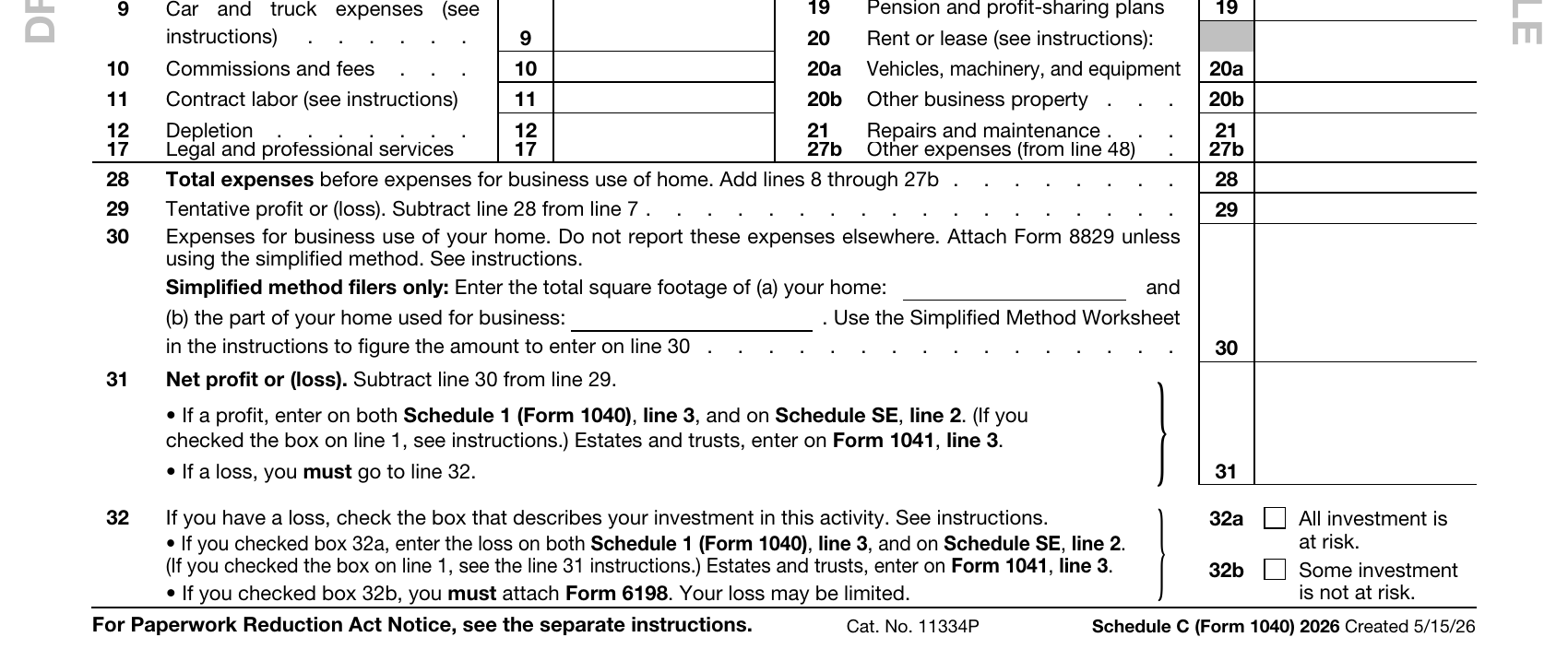
Line 9 sits near the top of Part II, the expense section of Schedule C, at car and truck expenses. It is one entered amount among the expense lines that total at line 28, flow through tentative profit at line 29, and come out as net profit at line 31 — the figure Schedule 1, line 3, and Schedule SE, line 2, both read.
What makes line 9 different from its neighbors is that the form does not leave it alone. Further down the same form sits Part IV, Information on Your Vehicle, and its printed condition is narrow: it is completed only if line 9 is being claimed and the filer is not required to file Form 4562. Line 43 asks when the vehicle was placed in service. Lines 44 through 47b ask how the vehicle was used and what evidence stands behind the claim.
So the architecture is two-part: a single dollar figure at line 9, and a set of questions behind it that the same form insists on. The dollars are read first — because in 2026, the dollars have a seam in the middle.
§3The 2026 rate: a price that changes mid-year
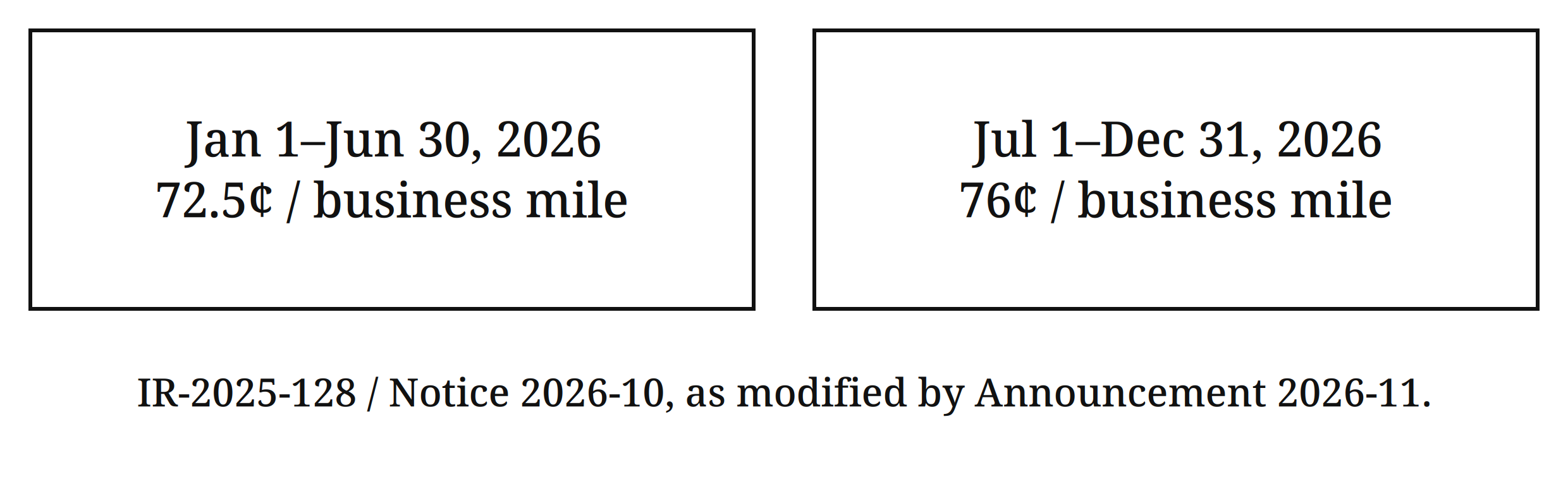
Two-rate card — Jan 1–Jun 30, 2026: 72.5¢ / business mile; Jul 1–Dec 31, 2026: 76¢ / business mile. Source: IR-2025-128 / Notice 2026-10, as modified by Announcement 2026-11.
The Internal Revenue Service prices a business mile each year, and for 2026 it priced the year in two pieces. The announcement — IR-2025-128, carrying Notice 2026-10, later modified by Announcement 2026-11 — prints the standard mileage rate for business use as 72.5 cents per mile for January 1 through June 30, and 76 cents per mile for July 1 through December 31.
The same two documents price the other uses, and none of them is a Schedule C, line 9 rate. For January 1 through June 30, medical use and qualifying moving use is 20.5 cents per mile and charitable-service use is 14 cents per mile; from July 1, medical use and qualifying moving use is 23.5 cents per mile, while charitable-service use stays at 14 cents per mile because section 170(i) fixes it by statute. A business mile is the only mile this article prices for line 9.
Read what that does to the calendar. A mile driven to a showing in March is priced at 72.5 cents. The same mile, to the same showing, in September is priced at 76 cents. The rate does not average the year, and the form asks for no separate line per half — the split lives inside the build of the line 9 amount, which means the year's business miles have to be known in two piles before line 9 can be figured by this route at all. Figure it with the mileage calculator.
That is the first thing the 2026 rate asks of a first-year agent: not a total, but a total with a date seam at June 30.
§4Worked example: 11,600 business miles, priced in two halves
One worked example, with numbers used only in this article.
A real estate agent — hypothetical, not a prediction, not your numbers — drives for the business all through 2026, and the year's record separates the business miles the way the rate splits the year.
First half: 6,200 business miles between January 1 and June 30. At 72.5 cents a mile — 6,200 times $0.725 — that is $4,495.00.
Second half: 5,400 business miles between July 1 and December 31. At 76 cents a mile — 5,400 times $0.76 — that is $4,104.00.
Add the two halves: $4,495.00 plus $4,104.00 is $8,599.00. That is the amount this example enters at line 9, built entirely from the standard mileage rate — nothing else enters line 9 in this example; the rate build is the amount.
Hold the shape of it, not just the total. The same 11,600 business miles priced at one flat rate would be a different number; 2026 does not offer one flat rate. Every mile is priced by the half of the year it was driven in, and the two multiplications are the whole build.
| Step | Source line | Operation | Amount |
|---|---|---|---|
| Business miles, Jan 1–Jun 30, 2026 | Hypothetical input | Invented for this article | 6,200 miles |
| First-half rate | Notice 2026-10, as modified | Printed business standard mileage rate | $0.725 / mile |
| First-half amount | Build | 6,200 × $0.725 | $4,495.00 |
| Business miles, Jul 1–Dec 31, 2026 | Hypothetical input | Invented for this article | 5,400 miles |
| Second-half rate | Notice 2026-10, as modified | Printed business standard mileage rate | $0.76 / mile |
| Second-half amount | Build | 5,400 × $0.76 | $4,104.00 |
| Standard-mileage amount entered on Schedule C | Line 9 | $4,495.00 + $4,104.00 | $8,599.00 |
| Part IV — business miles (the only miles the rate touches) | Line 44a | 6,200 + 5,400 | 11,600 |
| Part IV — commuting miles (shown so the split is visible; not priced) | Line 44b | Hypothetical input | 1,900 |
| Part IV — other miles (shown so the split is visible; not priced) | Line 44c | Hypothetical input | 2,300 |
| Part IV — total miles accounted for | Lines 44a + 44b + 44c | 11,600 + 1,900 + 2,300 | 15,800 |
§5A month-by-month split: the same rate seam, read in twelve rows
A second agent, hypothetical, with numbers used only in this article. Her year is read month by month, because the rate follows the month the mile was driven — a June mile at 72.5 cents, a July mile at 76 cents — and a year total alone cannot show where the seam falls.
| Month | Business miles | Rate | Amount |
|---|---|---|---|
| January | 700 | $0.725 | $507.50 |
| February | 650 | $0.725 | $471.25 |
| March | 900 | $0.725 | $652.50 |
| April | 850 | $0.725 | $616.25 |
| May | 900 | $0.725 | $652.50 |
| June | 800 | $0.725 | $580.00 |
| First half | 4,800 | — | $3,480.00 |
| July | 950 | $0.76 | $722.00 |
| August | 900 | $0.76 | $684.00 |
| September | 800 | $0.76 | $608.00 |
| October | 850 | $0.76 | $646.00 |
| November | 800 | $0.76 | $608.00 |
| December | 800 | $0.76 | $608.00 |
| Second half | 5,100 | — | $3,876.00 |
| Year, to line 9 | 9,900 | — | $7,356.00 |
The seam is visible in the table's middle: June's 800 miles at 72.5 cents are $580.00, and July's 950 miles at 76 cents are $722.00 — the same kind of month, priced by different halves of the year. This table prices business miles only; it does not build Part IV's full split, whose commuting and other piles the main example above already shows. For a mile a client reimburses rather than a mile the agent claims — a different question, under the actual-expense method — see Article 47; the Schedule SE walk behind any line 9 amount is Article 2; and the year's last estimated-tax deadline is Article 11. How each figure above was checked is described on the site's How we verify page.
§6Part IV: the questions behind the amount, and one case
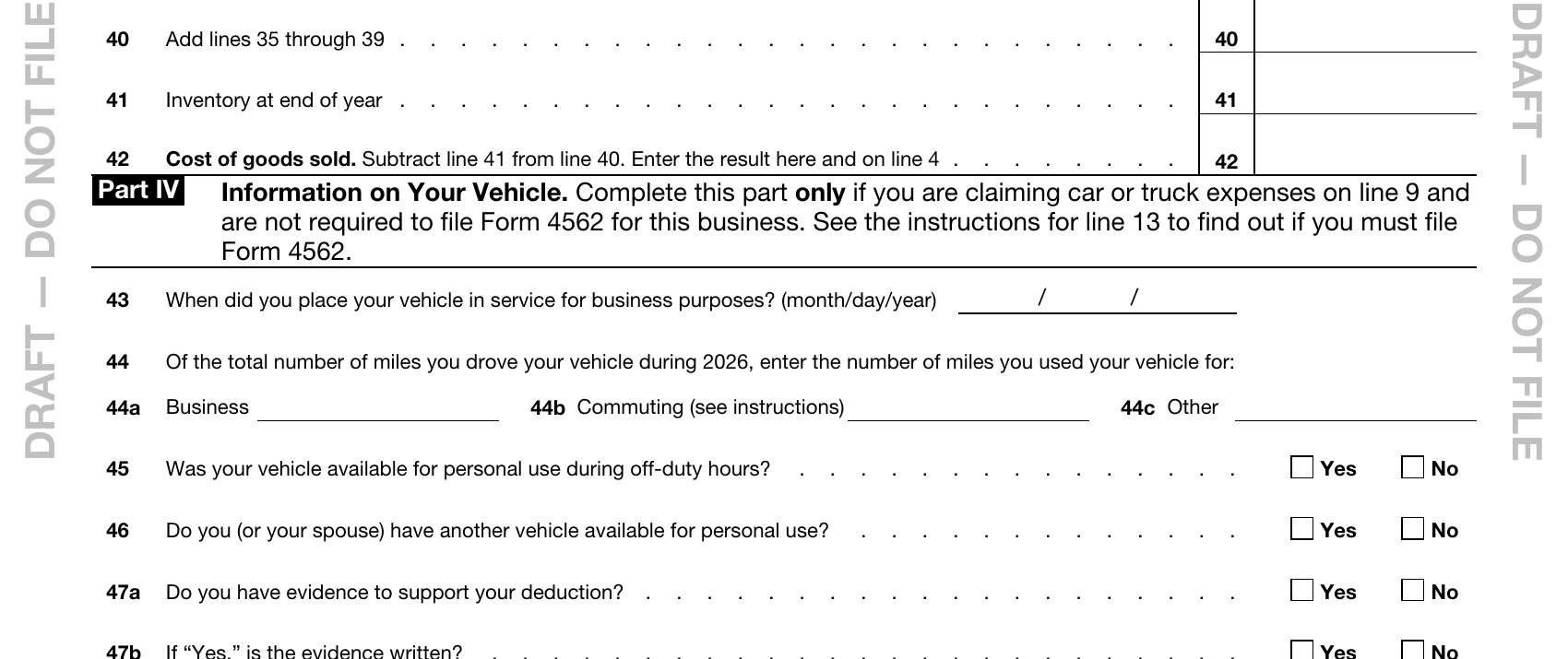
Behind the $8,599 sits Part IV, and Part IV does not ask about dollars at all. It asks about miles — all of them.
Line 44 takes the vehicle's driving for the year and splits it three ways, in print: line 44a, business miles; line 44b, commuting miles; line 44c, other miles. In this article's example, the entries read: 44a, 11,600 business miles — the same miles the rate was applied to; 44b, 1,900 commuting miles; 44c, 2,300 other miles. Together they account for 15,800 miles driven in the year, and the rate touched only the 44a pile.
The remaining questions are about use and proof. Line 45: was the vehicle available for personal use during off-duty hours. Line 46: was another vehicle available for personal use. Line 47a: is there evidence to support the deduction. Line 47b: is the evidence written.
Why does the form insist on the three-way split? In one Tax Court case — a summary opinion, Craddock, decided in 2023, which by statute is not precedent for any other case — car and truck expenses of $14,710 were denied in full: the mileage log the taxpayer kept never separated business miles from personal miles, and its entries conflicted with his bank records, and the strict substantiation rule blocked the court from estimating an amount in its place. The split Part IV prints at 44a, 44b, and 44c is exactly the split that log never made.
The split is not the only way a mileage record fails — the log's own total has to survive contact with records the taxpayer did not write.
The taxpayer held W-2 jobs and also reported a consulting activity on Schedule C — one that showed no income for 2018. His mileage log claimed 81,186 business miles for 2018, a total rebuilt from map distances rather than read off the odometer. Texas vehicle-inspection records told a different story: the car's odometer stood at 182,291 in October 2017 and at 204,107 in November 2018 — 21,816 miles driven in total over about thirteen months, fewer miles than the log claimed for business alone. The court denied the $22,499 of car and truck expenses in full.
— Mitchell v. Commissioner, T.C. Summary Opinion 2023-9 · Tax year at issue: 2018
§7The Fork: two builds for the same line
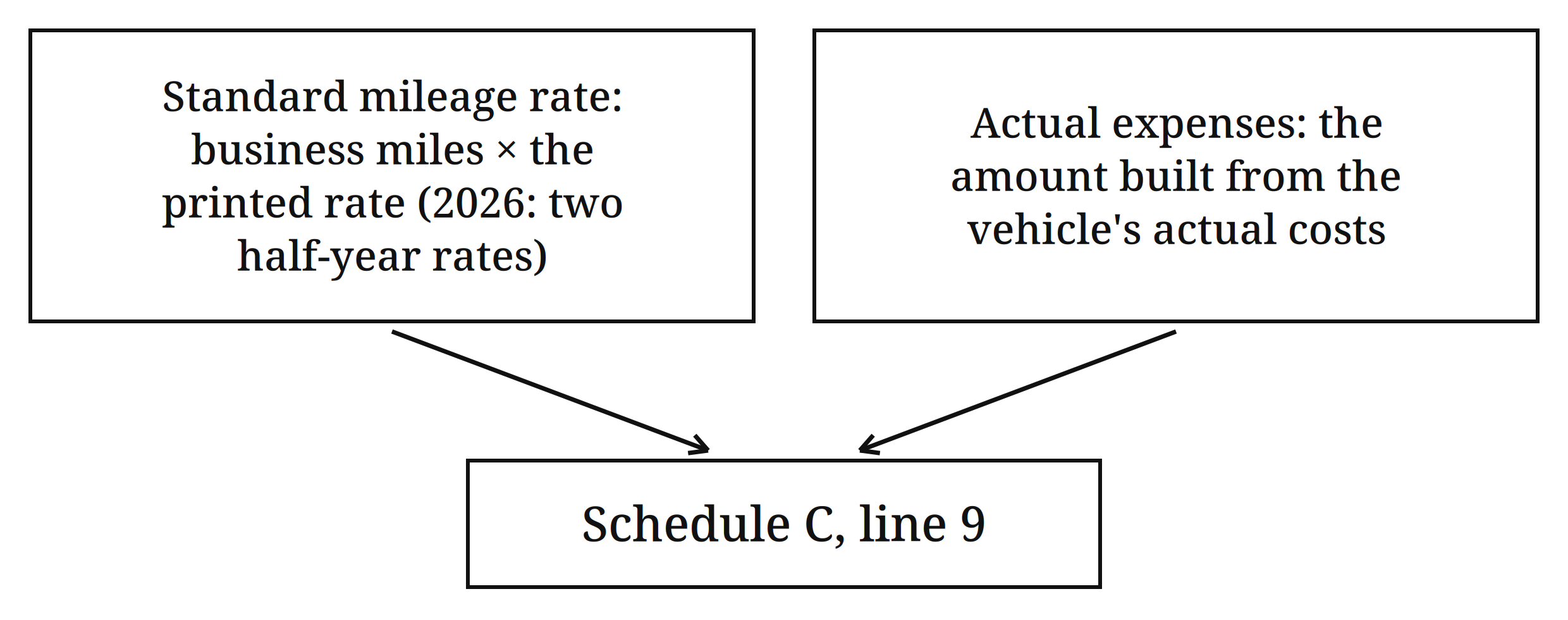
Split card — Standard mileage rate: business miles × the printed rate (2026: two half-year rates); Actual expenses: the amount built from the vehicle's actual costs; both arrows point to Schedule C, line 9.
Now the fork itself, because the standard mileage rate is only one of the two printed ways to build line 9.
Route one is what this article computed: business miles, priced by the IRS's rate — in 2026, by the two half-year rates — and the product is the amount.
Route two is actual expenses: the amount built from what the vehicle actually cost to run for the business during the year. The same line receives it. Schedule C prints one line for it: line 9 takes one entered amount for the vehicle for the year, and Part IV asks for the mileage split behind whichever build produced that amount.
What does not change between the routes is Part IV. When line 9 is claimed and Form 4562 is not required, the vehicle questions are asked — the date placed in service, the three-way mile split, the evidence questions — whichever build produced the dollars.
A rented or leased vehicle — an owner-operator's leased truck is the shape this takes most often — never reaches line 9 at all. The draft instructions for line 20a read: "If you rented or leased vehicles, machinery, or equipment, enter on line 20a the business-use portion of your rental cost." Line 20a on the final 2026 form reads "Vehicles, machinery, and equipment," and the instructions draw no line between a rented vehicle and a leased one: both land on line 20a. The fork is ownership. A vehicle the business owns is recovered through depreciation on line 13, figured on Form 4562; a vehicle the business rents or leases is deducted as rent on line 20a. The line 9 instructions print the same routing for a vehicle's costs — depreciation on line 13, vehicle loan interest on line 16b, rent or lease payments on line 20a, and personal property taxes on the vehicle on line 23. One more step rides with a lease of 30 days or more: the deduction may have to be reduced by an inclusion amount, figured in chapter 4 of Publication 463. For the mileage choice on a leased car — the standard mileage rate, once chosen, must be used for the entire lease period — see Article 66, which walks that rule; it is not restated here. Compare the mileage route against the business share of actual costs with the mileage calculator.
This site reads both doors and walks through neither. Which build fits a given agent's year turns on records and facts the form alone does not weigh, and the form prints no ranking.
§8What this form does not cover
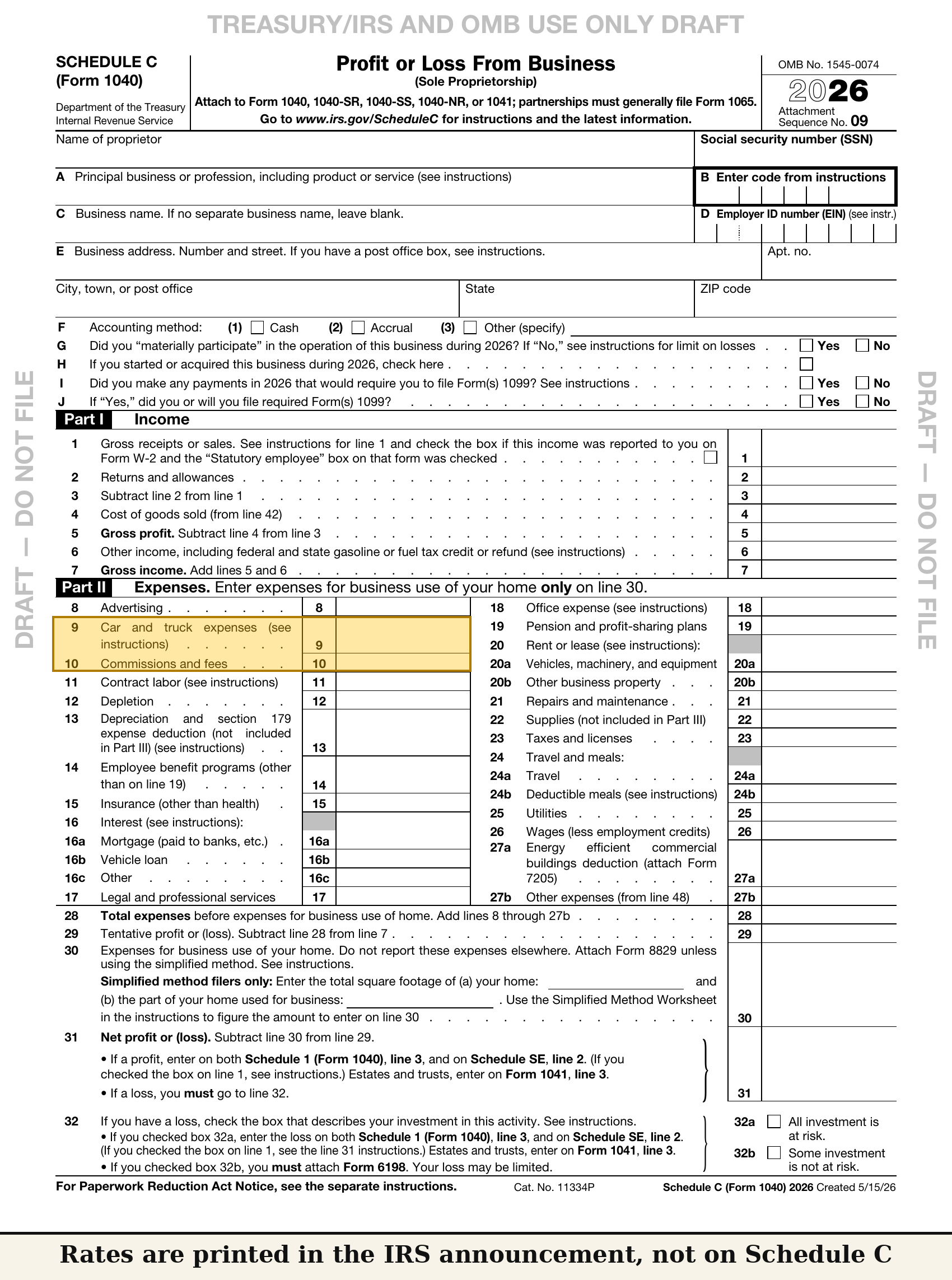
Schedule C full-page draft, greyed, with three callouts: "Rates are printed in the IRS announcement, not on Schedule C" / "Part IV asks about evidence — it does not create the record" / "State taxes: not covered".
What Schedule C does not do, to close the reading.
It does not keep the record for you. Part IV asks whether evidence exists and whether it is written — it does not create the log, and line 9's amount stands or falls on records the form never sees.
It does not price the mile itself: the rates read in this article come from the IRS's announcement for 2026, not from anything printed on Schedule C, and a different tax year carries different printed rates.
It does not decide between the standard mileage build and the actual expense build — both are printed routes into the same line, and this article has ranked neither.
And it does not cover state taxes — this site does not cover state taxes, in this article or any other.
§9Software numbers vs ask-a-human numbers
The split, applied to line 9.
The numbers a piece of software can carry on this one: the two half-year multiplications and their addition — once the business miles for each half of the year are known — and the transfer of the total to line 9.
Numbers and questions to take to a human before you act on them: how a vehicle's miles should be separated when business, commuting, and personal driving run through the same car all year, because the 44a, 44b, and 44c split is an input, not an output; whether the records behind a line 9 claim would satisfy the evidence questions Part IV asks at 47a and 47b; and which of the two builds belongs in your year at all.
That is line 9, as the final form prints it for 2026: one entered amount — $8,599 in this article's example, built from 6,200 miles at 72.5 cents and 5,400 miles at 76 cents — with Part IV's split and evidence questions standing behind it. Final 2026 form, posted October 29, 2026.
Next article: the year's last estimated-tax deadline — the Q4 payment, and the safe harbor lines that decide what it has to be. Article 11
Frequently asked questions
5 questionsReal questions first-time filers asked in public forums — answered only from the lines read in this article.
A CPA letter says people with W-2 income cannot deduct business mileage anymore — does that bar mileage for a side business too?
This article reads the Schedule C side of that question. A separate business's own driving is figured at line 9, and Part IV of the same form splits the vehicle's year three ways — business miles on line 44a, commuting miles on line 44b, other miles on line 44c — and the standard mileage rate prices only the business pile.
I'm a leased-on owner-operator — can I claim my fuel expenses and also claim the miles I ran in the year?
This article reads line 9 through a real estate agent's car. Line 9 takes one entered amount for the vehicle for the year, and the form prints two builds for it: business miles priced at the standard mileage rate — in 2026, 72.5 cents a mile for January 1 through June 30 and 76 cents for July 1 through December 31 — or the amount built from the vehicle's actual costs. Whichever build produced the dollars, Part IV asks the same questions behind the amount; this site reads both doors and walks through neither.
I commute pretty far for work and have gotten a deduction for it in the past — where can I enter my mileage?
Commuting miles appear on this form in exactly one place: line 44b, inside Part IV's three-way split of the vehicle's year, shown so the split is visible. They are not priced — the standard mileage rate touches only the business miles on line 44a, and the amount built from those miles is what enters line 9.
If I am taking the standard mileage deduction for my business, do I have to fill out Part IV of Schedule C or Form 4562?
Part IV — when its printed condition is met. Part IV, "Information on Your Vehicle," is completed only if line 9 is claimed and the filer is not required to file Form 4562. What does not change between the two builds is Part IV: when line 9 is claimed and Form 4562 is not required, the vehicle questions are asked — the date placed in service at line 43, the three-way mile split at lines 44a, 44b, and 44c, and the evidence questions at 47a and 47b — whichever build, standard mileage or actual expenses, produced the amount on line 9.
A mixed trip: 141 miles to a supplier, 10 miles to a friend, 151 miles home — business 141, personal 161, right?
From this article's split only: the standard mileage rate prices the business pile — line 44a — and Part IV splits the vehicle's year three ways: business miles on line 44a, commuting miles on line 44b, other miles on line 44c. The 141 supplier miles are the business pile the rate is built for; the rate touches no other pile. Which pile the home leg belongs in — commuting or other — is not decided by this article's split alone, and the 'choose freely between builds' strand is not settled here either: this site reads both builds and walks through neither.
Sources
10 claimsEvery claim above traces to a document, a tax year, a line, and the date it was checked.
-
1
Line 9 is "Car and truck expenses" in Part II; the Part II lines total at line 28, tentative profit is line 29, net profit is line 31, whose text points to Schedule 1 line 3 and Schedule SE line 2
- YEAR
- 2026 final
- LINE
- Lines 9, 28, 29, 31
- CHECKED
- 2026-11-10 — final form, posted Oct 29, 2026; footer "Created 5/15/26" re-verified; no DRAFT watermark
-
2
Part IV, "Information on Your Vehicle," is completed only if line 9 is claimed and the filer is not required to file Form 4562; line 43 asks the date the vehicle was placed in service; line 44 splits total miles into 44a business / 44b commuting / 44c other; line 45 asks whether the vehicle was available for personal use during off-duty hours; line 46 asks whether another vehicle was available for personal use; line 47a asks whether there is evidence to support the deduction; line 47b asks whether the evidence is written
- YEAR
- 2026 final
- LINE
- Part IV, lines 43–47b
- CHECKED
- 2026-11-10 — final form, posted Oct 29, 2026; footer "Created 5/15/26" re-verified; no DRAFT watermark
-
3
2026 business standard mileage rate splits mid-year: 72.5¢ per mile Jan 1–Jun 30, 76¢ per mile Jul 1–Dec 31
- YEAR
- 2026
- LINE
- Rate announcement
- CHECKED
- 2026-10-06
-
4
2026 other-use standard mileage rates: medical use and qualifying moving use 20.5¢ per mile Jan 1–Jun 30, 23.5¢ per mile from Jul 1; charitable-service use 14¢ per mile all year, fixed by section 170(i)
- DOC
- Notice 2026-10, as modified by Announcement 2026-11 (2026-29 I.R.B. 49)
- YEAR
- 2026
- LINE
- Rate announcement; Announcement 2026-11
- CHECKED
- 2026-11-03
-
5
2026 business standard mileage rate, re-checked for the month-by-month table: 72.5¢ per mile Jan 1–Jun 30 (IR-2025-128), 76¢ per mile Jul 1–Dec 31 (IR-2026-29)
- YEAR
- 2026
- LINE
- Mileage rates table, 2026 rows
- CHECKED
- 2026-10-26
-
6
Craddock: a mileage log that never split business from personal miles, and whose entries conflicted with bank records, led to $14,710 of car and truck expenses being denied in full; §274(d) substantiation blocked any court estimate. Summary Opinion — §7463(b), not precedent
- DOC
- Craddock v. Commissioner, T.C. Summary Opinion 2023-4
- YEAR
- Case decided 2023
- LINE
- Holding
- CHECKED
- 2026-10-06
-
7
Mitchell: a mileage log claiming 81,186 business miles, against Texas vehicle-inspection records showing the car driven only 21,816 miles in total over about 13 months, led to $22,499 of car and truck expenses being denied in full. Summary Opinion — §7463(b), not precedent
- DOC
- Mitchell v. Commissioner, T.C. Summary Opinion 2023-9
- YEAR
- Case decided 2023
- LINE
- Holding
- CHECKED
- 2026-10-10
-
8
Line 20a on the final 2026 form reads "Vehicles, machinery, and equipment"; the draft instructions route rented or leased vehicles, machinery, or equipment to line 20a at the business-use portion of the rental cost, with no distinction between rented and leased
- YEAR
- 2026 final form / 2026 draft instructions
- LINE
- Form lines 20–20b; instructions Lines 20a and 20b
- CHECKED
- 2026-11-09 — form FINAL; instructions IRS draft as of 2026-10-08
-
9
Owned property is recovered through depreciation on line 13, figured on Form 4562; the line 9 instructions route a vehicle's costs as depreciation on line 13, vehicle loan interest on line 16b, rent or lease payments on line 20a, and personal property taxes on the vehicle on line 23
- YEAR
- 2026 draft
- LINE
- Lines 9 and 13
- CHECKED
- 2026-11-09 — IRS draft as of 2026-10-08
-
10
A lease of 30 days or more may require reducing the deduction by an inclusion amount, figured in chapter 4 of Publication 463; the amount is a percentage of part of the vehicle's fair market value multiplied by the business-use percentage, prorated for the days of the lease term in the tax year
- YEAR
- 2025
- LINE
- Chapter 4, "Leasing a Car" / "Inclusion Amounts"
- CHECKED
- 2026-11-09
Update log
Changes are dated and kept. Old figures are never silently overwritten.
Browse the Schedule C hub — its lines, articles, and tools.
- Same form How to Fill Out Schedule C for Realtors, 2026: The Income Side First (Line 7)
- Next form Schedule SE
- Tool Mileage Comparison
Free one-page sheet: The $1,000 Line reads the $1,000 test on the 2026 Estimated Tax Worksheet.