Etsy Seller Taxes 2026: Your 1099-K Is Gross — a Schedule C Line 1 Walkthrough
This is education, not tax advice. I'm not a CPA or EA. State taxes are not covered.
Schedule C line captions cited below were read from the final 2025 Schedule C and re-checked against the final 2026 Schedule C (posted October 29, 2026) — every cited caption matches. The Form 1099-K instructions cited are the 12/2026 edition. If a line changes, this page is updated in place with a dated note at the foot of the article.
- Last checked
- Tax year
- 2026
- Core line
- Schedule C, line 1
- Changes
- Update log (8)
Form 1099-K, box 1a is gross by definition — figured without regard to fees, refunds, or shipping — so the whole amount goes on Schedule C, line 1, and the pieces come out on their own lines: refunds on line 2, platform fees on line 10, and seller-imposed sales tax collected from buyers on line 23. In this article's example, a $48,750 box 1a walks to a $46,600 line 3, and the arithmetic check across the three placements is $39,350 — a check figure, not a profit.
This article is for you if you're a marketplace seller — an Etsy shop first — whose 1099-K total doesn't match your deposits.
§1One job, one tax year, one line
The job is marketplace seller — one person, one shop, selling through Etsy. The year is 2026. And the line this article locks onto is Schedule C, line 1: gross receipts or sales.
Line 1 is where this job's tax year starts, and it is the line most often misread, because the number that arrives from the platform — Form 1099-K, Box 1a — is a gross number. It is not the deposit total. It is not profit. It is not net of anything. This article walks that gross number onto line 1, then walks each piece that is not supposed to stay inside it to the line the form gives it: refunds to line 2, platform fees to line 10, and one kind of collected sales tax out on line 23.
§2Where this money lands, and why the form is gross
A sole proprietor reports Form 1099-K payment information on Schedule C, and the Instructions for Schedule C say the same thing from the other side: line 1 is the gross receipts or sales of the trade or business, and the forms 1099 received during the year are checked for amounts that belong on that line.
The platform's number and the shop's bank deposits are built differently — and the difference is printed in the Form 1099-K instructions themselves. Box 1a is the gross amount of reportable payment transactions, figured without regard to adjustments for credits, cash equivalents, discounts, fees, refunded amounts, shipping amounts, or any other amounts. Every item a seller is tempted to subtract before writing anything down is named in the definition of what was not subtracted. So the reconciliation does not happen by netting the form. It happens through the return's own lines, each one read in the next section.
One threshold belongs here, stated as the IRS prints it. A third-party settlement organization — the category Etsy falls into for this purpose — reports third-party network transactions on Form 1099-K only if the calendar-year gross amount exceeds $20,000 AND the number of transactions exceeds 200. Both halves. A form can still arrive below that test, and payment-card receipts are a different category with no such threshold at all. What the threshold is not: a taxability line. Section 6 takes that up.
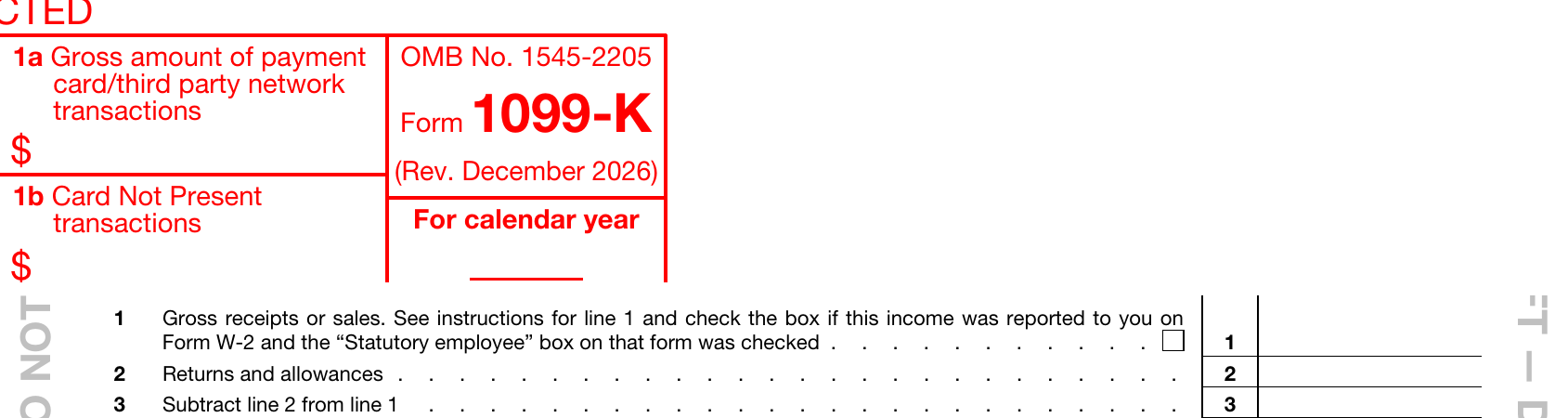
§3The walk: gross in, four placements out
Step 1 — Box 1a is the starting figure, not the answer. The IRS's recipient guidance repeats the definition in plain terms: the Box 1a amount is not adjusted for fees, credits, refunds, shipping, cash equivalents, or discounts, and those items are worked out from the filer's own records when the income is reported. The form is an input to the return; the records reconcile it.
Step 2 — Line 1 takes the gross. The 1099-K amount that belongs to the business goes on line 1 as a gross figure. Nothing has reduced it yet, because the form reduces it in specific places — the next step is the first of them.
Step 3 — Refunds go on line 2, and only line 2. Line 2 is sales returns and allowances: cash and credit refunds for returned goods, and price reductions, entered as a positive number. Line 3 is then the form's printed subtraction — line 1 minus line 2. A refund is not netted silently against deposits; it has its own line, above the first subtotal on the form.
Step 4 — Platform fees go on line 10, not against line 1. Line 10 is commissions and fees. The instructions draw a distinction the walk depends on: commissions and fees paid to facilitate the sale of property are generally capitalized, except for a dealer in property — defined there as a person who regularly sells property in the ordinary course of their trade or business — who enters them on line 10. A marketplace seller selling through the shop in the ordinary course is the reader those words describe. The fees are an expense placement on line 10, never a subtraction from line 1.
Step 5 — One kind of collected sales tax enters line 1 and leaves on line 23. The instructions split collected sales tax into two kinds. State or local sales tax imposed on the seller, collected from the buyer, is included in gross receipts on line 1 and deducted on line 23. Tax imposed on the buyer, which the seller only collects and remits, is in neither gross receipts nor deductible expenses. This article covers no state's sales-tax rules — only the federal form's placement of an amount already inside a gross figure. For the Etsy reader specifically, the platform evidence below records that sales tax Etsy itself collects and remits is not reflected in Etsy's 1099-K total at all — a statement about how that platform builds its gross number, not a tax rule.
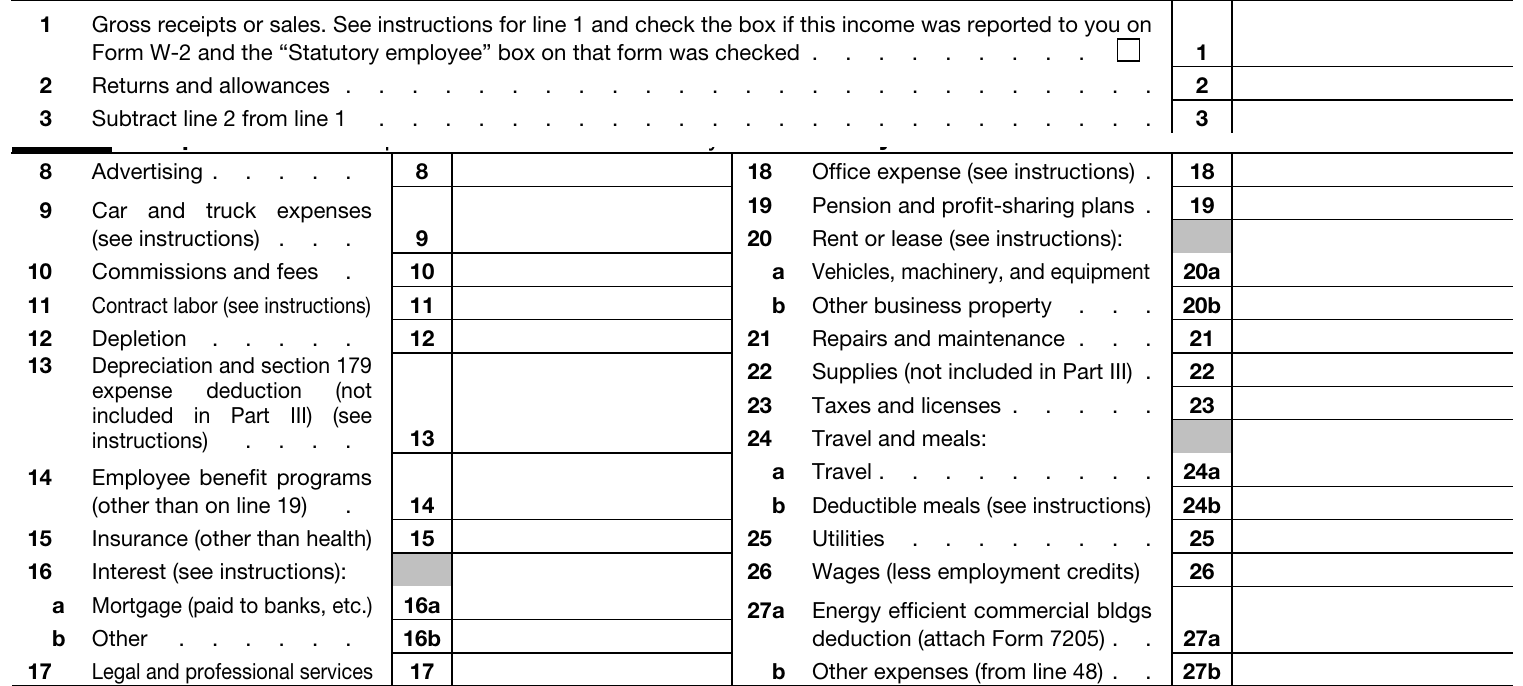
One placement this walk deliberately does not make: shipping costs. The 1099-K instructions name shipping amounts among the items Box 1a is not adjusted for, but the IRS sources read for this article do not assign outbound shipping costs to a single named Schedule C line — so no line is printed for them here.
Update, 2026-11-09 — the shipping placement is now closed. A firsthand re-read of the Instructions for Schedule C (2025) and Publication 334 (2025), Chapter 7, on 2026-11-09 assigns the three shipping pieces this walk left open. Postage goes on line 18: the line's caption reads "Include on this line your expenses for office supplies and postage." Freight-in — the cost of getting goods to the seller — is part of cost of goods sold, on line 39, "Other Costs," in Part III. Other outbound shipping of sold goods has no dedicated line on the form: it is listed by type (for example, "shipping") in Part V, whose total enters lines 48 and 27b under the catch-all wording "Include all ordinary and necessary business expenses not deducted elsewhere on Schedule C." No IRS original prints a dedicated "shipping to customers" line, and none is invented here.
§4The Amazon contrast: same lines, differently built gross
This section is platform evidence — how one platform describes its own form. It is not tax law, and no tax rule in this article rests on it.
Amazon's Form 1099-K does not build its Box 1a the way Etsy's does. Amazon's 1099-K information, as quoted inside Amazon's own Seller Central forums, builds Box 1a from product sales, FBA product sales, shipping credits, gift-wrap credits, promotional rebates — and product, shipping, and gift-wrap taxes and regulatory fees collected. Collected tax sits inside Amazon's gross figure; on Etsy's side, the platform states that sales tax it collects and remits is not reflected in the 1099-K total.
The contrast matters for one reason: the same IRS lines resolve both. If collected tax is inside the gross amount being walked, the placement question is the step-5 question. The platform decides what its gross contains; the form decides where each piece lands. The Amazon FBA walk gets its own treatment in the second seller article in this hub — this article is the Etsy-first read.
§5Worked example: one Etsy seller year, walked line by line
One worked example, with numbers used only in this article. The inputs below are hypothetical — one seller's records for one year, invented for this walk. They are not a prediction and not your numbers.
Her Form 1099-K shows $48,750 in Box 1a. Her own records for the same year show three amounts the walk has placements for: $2,150 refunded to buyers for returned goods, $6,300 in platform commissions and fees, and $950 of sales tax imposed on her as the seller and collected from buyers, already inside the gross figure.
Line 1 takes the gross amount: $48,750 — nothing subtracted yet, correctly, because the form has not reached a subtraction line. Line 2 takes the refunds, entered as a positive number: $2,150. Line 3 is the printed subtraction: $48,750 minus $2,150 is $46,600. The fees do not touch that subtotal; they are placed on line 10, in Part II: $6,300. The collected sales tax does not touch it either; it was inside line 1 and is placed on line 23: $950.
Now check the walk's arithmetic. The three named amounts total $2,150 + $6,300 + $950 = $9,400, and the gross minus those three is $48,750 − $9,400 = $39,350. That figure is an arithmetic check only — not line 5, not line 7, not net profit. Cost of goods sold on line 4 and every other expense in Part II still sit between this walk and any profit figure; cost of goods sold is the entire subject of the next seller article in this hub.
| Step | Line | Operation | Amount |
|---|---|---|---|
| Gross amount of payment transactions | Form 1099-K, Box 1a | Starting figure, as reported by the platform | $48,750 |
| Gross receipts or sales | Schedule C, line 1 | Enter the gross amount | $48,750 |
| Returns and allowances | Schedule C, line 2 | Refunds for returned goods, entered as a positive number | $2,150 |
| Subtotal | Schedule C, line 3 | Line 1 − line 2 = $48,750 − $2,150 | $46,600 |
| Commissions and fees | Schedule C, line 10 | Placement only — not subtracted from line 1 | $6,300 |
| Taxes and licenses | Schedule C, line 23 | Seller-imposed sales tax collected from buyers, already inside line 1 | $950 |
| Arithmetic check | (not a form line) | $2,150 + $6,300 + $950 = $9,400 named amounts; $48,750 − $9,400 | $39,350 |
§6Four bands, one line 1: what each gross band means for the form
The threshold in section 2 is a reporting rule for the platform, not a taxability rule for the seller. The four bands below — hypothetical gross figures, used only in this article, read as of 2026-10-26 — show what changes and what does not as a marketplace year crosses each bar. In every band, line 1 takes the gross figure from the seller's records; the band decides only what paper the platform must send.
| Band | Marketplace year (hypothetical) | Form the platform must send | What lands on line 1 |
|---|---|---|---|
| A — under both bars | $9,630 across 130 transactions | No Form 1099-K required at the federal level (one may still arrive) | $9,630, from the records |
| B — over dollars, under transactions | $27,840 across 170 transactions | No Form 1099-K required — both bars must be crossed | $27,840, from the records |
| C — over both bars | $33,410 across 280 transactions | Form 1099-K required; Box 1a is the gross figure | $33,410, the Box 1a gross |
| D — card payments, no bar at all | $5,370 taken by card, any transaction count | Form 1099-K expected — card payments carry no threshold | $5,370, from the records |
Bands A and B are the trap the threshold sets: no required form is not no income. The IRS's own page states it in one sentence — no matter the amount of reported payments, a seller must report all income on the return — and this article's 'If no 1099-K arrives' section is that sentence walked out. The refunds, fees, and seller-imposed tax placements inside any band's gross figure are the walk's Steps 3–5; the cost of goods sold that follows line 1 is Article 15, in its 2025 edition; the year with no form at all is Article 3; and the January bundle of forms is Article 44. How each figure above was checked is described on the site's How we verify page.
§7If no 1099-K arrives
The threshold in section 2 is a reporting rule for platforms. It is not a taxability rule for sellers, and the IRS's 1099-K guidance states the other half plainly: all income is reported whether or not a Form 1099-K arrives — including income paid in cash, property, goods, or digital assets. A seller under the $20,000-and-200 test reports the same line 1, from the same records, with no form in hand.
The mirror error is reporting the income in the wrong place.
A seller moving movie memorabilia on eBay took in $41,972 during 2019, paid through PayPal, which issued him a Form 1099-K for the amount. On his return he placed the receipts as "other income" instead of on Schedule C, and figured no self-employment tax on them. The mismatch between the Form 1099-K and the return surfaced in a CP2000 notice, and the case followed from it. The Tax Court held the eBay receipts were earnings from self-employment: the "other income" label did not take them out of Schedule SE, and self-employment tax was due on them.
— Clark v. Commissioner, T.C. Memo. 2025-13 · Tax year at issue: 2019
That is the same principle Trade Tax Desk reads for every job on this site — income with no form behind it is still income on the return — and it gets a full article of its own: No 1099 Arrived — Is It Still Taxable? Article 3
§8What this form does not cover
Schedule C does not decide whether an activity is a business at all. Its instructions route nonbusiness income off this form — to Schedule 1, line 8j — and whether a given shop is a business or a hobby is a fact-specific classification this walk does not make. Personal items are a separate boundary in the IRS's 1099-K guidance: a personal item sold at a loss produces no deductible loss, and one sold at a gain is figured on Form 8949 and Schedule D, not walked onto line 1 as business receipts.
Nor does Schedule C compute the rest of this job's year. Cost of goods sold — Part III, lines 35 through 42, feeding line 4 — is read in the next seller article. Estimated tax and self-employment tax have no seller-specific mechanics in the IRS documents behind this article; a marketplace seller is on the same Form 1040-ES and Schedule SE rails as the rest of this site's catalogue, read there. And state sales tax — who collects it, marketplace-facilitator rules, state 1099-K thresholds — is state law, outside this site's fence; the only sales-tax lines read here are the federal form's two placements for an amount already inside a federal gross figure.
Software numbers vs ask-a-human numbers. The figures software can carry: the Box 1a gross, the line 3 subtraction, and the placements on lines 2, 10, and 23 once each amount is identified in the records. Questions to take to a human: a Box 1a that still does not match the shop's records after the walk (the IRS guidance describes requesting a corrected form from the issuer, and filing with correct figures if the correction does not arrive), whether a stream of sales is business, hobby, or personal items, and any change to how inventory is accounted for — the instructions put method changes on Form 3115.
That is the walk, as the forms print it: a gross number in Box 1a, entered whole on line 1; refunds out on line 2; fees placed on line 10; seller-imposed collected tax out on line 23; and no version of this job's year in which a missing 1099-K makes the income disappear.
Next in this hub: Seller Article 2 — Part III for makers: materials, supplies, and line 42. Article 15
Frequently asked questions
8 questionsReal questions first-time filers asked in public forums — answered only from the lines read in this article.
My platform reports about $100k, but about $17k was platform fees and $4k was shipping — where are the fees and shipping expensed?
The fees have a line; outbound shipping, in the sources read for this article, does not. Box 1a is gross by definition — figured without regard to fees, refunded amounts, or shipping amounts — so the whole figure goes on Schedule C, line 1, and platform fees are placed in Part II, on line 10, never subtracted from line 1. The 1099-K instructions name shipping among the amounts Box 1a is not adjusted for, but the IRS sources read for this article assign outbound shipping costs to no single named Schedule C line, so this article prints none.
I refunded a buyer — does the Schedule C refunds line take the amount the platform charged me, or the full amount the buyer received back?
Refunds take their own line: line 2, sales returns and allowances — cash and credit refunds for returned goods, and price reductions, entered as a positive number. Line 3 is then the form's printed subtraction, line 1 minus line 2, so a refund is never netted silently against the gross figure or against the deposits.
I entered my net profit where the software asks for business income and keep hitting a “$0 income needs adjustment” error — what am I doing wrong?
Line 1 does not take a net figure. It takes the gross amount — in this article's walk, the $48,750 in Box 1a goes on line 1 whole — and the pieces come out on their own lines below it: refunds on line 2, platform fees on line 10, and seller-imposed sales tax collected from buyers on line 23. Entering profit at the top skips the subtractions the form performs itself.
I've read posts for an hour and still can't figure out how to enter a marketplace 1099-K — how does it go on the return?
Start with what the form is: Box 1a is a gross starting figure, not the answer. The 1099-K amount that belongs to the business goes on Schedule C, line 1 as a gross figure, and the return's own lines do the reconciling from the filer's records. And if no 1099-K arrives at all, the same line 1 is reported from the same records — the platform's reporting threshold is a rule about when the platform reports, not a taxability line.
If I have a seasonal craft business and accept payment cards, or accept payments through payment apps or online marketplaces, will I receive a Form 1099-K?
For app and marketplace payments, the printed test has two halves: a third-party settlement organization — the category Etsy falls into for this purpose — reports only if the calendar-year gross amount exceeds $20,000 AND the number of transactions exceeds 200. Both halves. A form can still arrive below that test. Payment-card receipts are a different category, with no such threshold at all. And the threshold is not a taxability line: the income is reported on Schedule C, line 1 from your own records whether or not a form arrives.
What do I do if I get a Form 1099-K?
Walk it onto the return's own lines. Box 1a is a gross starting figure — figured without regard to fees, refunded amounts, shipping amounts, or any other amounts — so the amount that belongs to the business goes on Schedule C, line 1 whole. The pieces then come out on their own lines: refunds on line 2, platform fees on line 10, and sales tax imposed on the seller and collected from buyers, already inside the gross figure, on line 23. The reconciliation happens through the return's lines, from your own records — not by netting the form.
Are all the payments reported on my Form 1099-K taxable?
Box 1a is a gross figure, not a taxability line: it is figured without regard to fees, refunded amounts, or shipping amounts, and the return's own lines do the reconciling from your records — refunds out on line 2, platform fees placed on line 10. The reporting threshold runs the same way: it is a rule about when the platform reports, not a line between taxable and not, and all income is reported whether or not a Form 1099-K arrives.
Where do eBay's per-sale fees go — commissions, or Other Miscellaneous Expenses?
On line 10 — commissions and fees. Platform fees are placed in Part II on line 10, never subtracted from line 1: Box 1a is gross by definition, figured without regard to fees, so the whole figure stands on line 1 and the fees come out on their own line. The instructions draw the distinction the placement rests on: commissions and fees paid to facilitate the sale of property are generally capitalized, except for a dealer in property — a person who regularly sells property in the ordinary course of their trade or business — who enters them on line 10.
Sources
18 claimsEvery claim above traces to a document, a tax year, a line, and the date it was checked.
-
1
line 1 is gross receipts or sales; check Forms 1099 for amounts belonging on this line
- YEAR
- 2025
- LINE
- Part I, "Line 1"
- CHECKED
- 2026-10-08
-
2
line 2 is sales returns and allowances, entered as a positive number
- YEAR
- 2025
- LINE
- Part I, "Line 2"
- CHECKED
- 2026-10-08
-
3
line 3 = line 1 − line 2; line 4 = COGS from line 42; line 5 = line 3 − line 4
- YEAR
- 2026 (final, posted Oct 29, 2026)
- LINE
- Part I, lines 1–7 as printed
- CHECKED
- 2026-11-10 — captions re-checked on the final 2026 form; unchanged from the 2025 form
-
4
line 10 commissions and fees; sale-facilitation fees capitalized except for a dealer in property, who enters them on line 10
- YEAR
- 2025
- LINE
- Part II, "Line 10"
- CHECKED
- 2026-10-08
-
5
sales tax imposed on the seller and collected from the buyer is in line 1 and deductible on line 23; tax imposed on the buyer is in neither
- YEAR
- 2025
- LINE
- "Line 23"
- CHECKED
- 2026-10-08
-
6
nonbusiness income is not reported on Schedule C; routed to Schedule 1, line 8j
- YEAR
- 2025
- LINE
- General Instructions, opening paragraph
- CHECKED
- 2026-10-08
-
7
TPSO de minimis exception: report only if gross exceeds $20,000 AND transactions exceed 200
- YEAR
- 12/2026
- LINE
- Box 1a, "Exception for de minimis payments"
- CHECKED
- 2026-10-08
-
8
Box 1a gross amount is without regard to fees, refunded amounts, shipping amounts, credits, discounts, or any other amounts
- YEAR
- 12/2026
- LINE
- "Box 1a. Gross Payment Card/Third Party Network Transactions"
- CHECKED
- 2026-10-08
-
9
Box 1a not adjusted for fees/refunds/shipping; items worked out from the filer's records; sole proprietors report 1099-K information on Schedule C; personal-item loss/gain treatment
- YEAR
- Current page, read 2026-10-08
- LINE
- "Gross payment amount (Box 1a)"; "Here's where to report…"; "If you sold personal items"
- CHECKED
- 2026-10-08
-
10
threshold restated for recipients; payment-card receipts have no threshold; all income reported whether or not a form arrives
- YEAR
- Current page, read 2026-10-08
- LINE
- "Reporting threshold"; "Who gets Form 1099-K"
- CHECKED
- 2026-10-08
-
11
product-seller chain restated: line 3 = line 1 − line 2; gross profit = line 3 − line 4
- YEAR
- 2025
- LINE
- Ch. 7, "Businesses that sell products"
- CHECKED
- 2026-10-08
-
12
Clark: $41,972 of eBay receipts that PayPal had reported on Form 1099-K were reported as "other income" instead of on Schedule C; held subject to self-employment tax
- DOC
- Clark v. Commissioner, T.C. Memo. 2025-13
- YEAR
- Case decided 2025
- LINE
- Holding
- CHECKED
- 2026-10-10
-
13
TPSO reporting threshold (over $20,000 in over 200 transactions), card payments with no threshold regardless of count or amount, forms that may still arrive below the threshold, and the duty to report all income whether or not a form arrives
- DOC
- IRS, 'Understanding your Form 1099-K' (irs.gov); IR-2025-107 / Fact Sheet 2025-08 (October 23, 2025)
- YEAR
- Current page; 2026 threshold
- LINE
- 'Who gets Form 1099-K'; 'Reporting threshold'
- CHECKED
- 2026-10-26
-
14
platform evidence, not tax law: Etsy's gross has no subtraction of fees, refunds, or shipping; sales tax Etsy collects and remits is not reflected in the total
- DOC
- Etsy Help Center, "How Is the Total on My 1099-K Calculated?"
- YEAR
- Platform page, read 2026-10-08
- LINE
- Whole page
- CHECKED
- 2026-10-08
-
15
platform evidence at one remove, not tax law: Box 1a includes taxes and regulatory fees collected
- DOC
- Amazon Seller Central forums, quoting Amazon's 1099-K information page
- YEAR
- Platform page, read 2026-10-08
- LINE
- Forum quotation of Amazon's 1099-K information
- CHECKED
- 2026-10-08
-
16
Postage goes on line 18: "Include on this line your expenses for office supplies and postage"
- YEAR
- 2025
- LINE
- Part II, "Line 18"
- CHECKED
- 2026-11-09
-
17
Freight-in, express-in, and cartage-in on merchandise purchased for sale are part of cost of goods sold, on line 39 "Other Costs" in Part III
- YEAR
- 2025
- LINE
- Ch. 7, "Businesses that sell products"
- CHECKED
- 2026-11-09
-
18
Other outbound shipping of sold goods has no dedicated line; it is listed by type in Part V, whose total enters lines 48 and 27b — "Include all ordinary and necessary business expenses not deducted elsewhere on Schedule C"
- YEAR
- 2025
- LINE
- Part V, "Line 48"
- CHECKED
- 2026-11-09
Update log
Changes are dated and kept. Old figures are never silently overwritten.
Browse the Schedule C hub — its lines, articles, and tools.
- Same form Do I Have to Report Income Without a 1099? (2026)
- Next form Self-Employment Tax 2026, Line by Line: Where It Is Figured — Schedule SE, Line 12
- Tool 1099-K Box-to-Line Mapper
Free one-page sheet: The $1,000 Line reads the $1,000 test on the 2026 Estimated Tax Worksheet.