Amended Return 2026: Form 1040-X for a Schedule C Mistake
This is education, not tax advice. I'm not a CPA or EA. State taxes are not covered.
Form 1040-X and its instructions are read in the December 2025 revision — the current revision of a continuous-use form (the instructions' own Reminders record the conversion from an annual revision to continuous use in tax year 2021), not a 2026 edition of the form. The worked example amends a 2025 return, so the forms underneath it — the updated Form 1040, Schedule C, Schedule SE, and the Tax Table — are the final 2025 documents, read firsthand. Topic No. 308 and the IRS's amended-return FAQ pages are read as posted. If a line changes, this page is updated in place with a dated note at the foot of the article.
- Last checked
- Tax year
- 2026
- Core line
- Form 1040-X, line 1 — adjusted gross income in three columns: A as previously adjusted, B the change, C correct
- Changes
- Update log (6)
A return already filed with a Schedule C mistake is not edited — the correction files on Form 1040-X, in three columns: A, the amount as previously adjusted; B, the net change; C, the correct amount. In this article's example, a $5,900 client payment left off a 2025 Schedule C lifts line 31 profit from $38,100 to $44,000; the self-employment tax rises $833.64 by way of Schedule 2 into Form 1040-X line 10, and the amendment ends at line 20 — $1,487.64 owed.
This article is for you if you already filed a return with a Schedule C on it and have since found income left off it, or another figure carried wrong.
§1The correction files on a different form
This article is for you if you already filed a return with a Schedule C on it and have since found a mistake in it — income left off, an expense entered twice, a figure carried to the wrong line. The original return is not edited. The correction files on its own form, Form 1040-X, and the 1040-X is a summary machine: it does not re-ask the whole return. It takes the return as it stands, states each change as a single net figure in a middle column, and lands on the corrected totals — with a completed, updated Form 1040 and the changed schedules riding behind it as the working papers.
Three boundaries stand at the door. This article reads the federal correction only: Topic No. 308 points to the state tax agency for a state amendment, and this site prints nothing about state returns. It never decides whether a particular reader should amend — the IRS prints a fork for that (Step 1 reads it), and the article reports the fork without applying it to anyone. And it never computes a penalty: the estimated-tax underpayment machinery belongs to Article 1, Article 4, and Article 11, and this form's contact with that machinery is exactly three printed slots, each named where it occurs below.
§2Step 1: the fork — the returns the IRS says not to amend
The first text is a negative. Topic No. 308 opens with it: the IRS may correct certain errors on a return and may accept returns without certain required forms or schedules, and in those instances there is no need to amend. The amended-return FAQ page fills in the same side of the fork: many mathematical errors are caught during processing and corrected by the IRS; if the IRS writes asking for a missing form or information, the move is to respond with the requested items, not to amend; and if a notice proposes a change, the notice itself may let the filer agree to the proposed change without amending. What does call for the form, in Topic 308's sentence, is a change in filing status, income, deductions, credits, or tax liability — which is where a Schedule C mistake lives.
Two wrong doors are named in the instructions so they are not mistaken for this one. A Form 1040-X is not filed only to claim a refund of penalties or interest, or an addition to tax already paid — that claim files on Form 843. It is not the vehicle for an injured spouse's share of a joint overpayment — that files on Form 8379 (though an 8379 may ride along with an e-filed 1040-X). And after the original due date, the instructions warn against filing another original return for the same year: it can delay the refund. The correction after the due date is this form, one per year amended.
One window sits inside the fork and matters to a filer who catches the mistake early. Topic 308, under "Balance due," prints the superseding rule: if additional tax is owed and the due date for that year's return has not passed, filing Form 1040-X — or a corrected Form 1040 — and paying the tax by that due date (without regard to any extension) makes the corrected return replace or supersede the original, and penalties and interest are avoided on that amount. The FAQ page prints the same rule. After the due date the window is shut and the amendment is an amendment, with the interest rules of Step 6.
A last edge from the FAQ page, because it arrives as a check: if the IRS did not catch the error and a refund check is already in hand, the filer files the 1040-X as soon as possible and returns the check with a letter of explanation, "Void" written in the endorsement section — not stapled, bent, or paper-clipped — allowing six weeks for the returned check to be credited.
§3Step 2: the clock — three years, two years, and the lookback
The instructions' "When To File" (Instructions for Form 1040-X, p. 3) prints the governing rule whole: file Form 1040-X only after the original return has been filed; a return may be amended more than once, as long as each amendment is timely; and generally, for a credit or refund, the form must be filed within 3 years (including extensions) after the date the original return was filed, or within 2 years after the date the tax was paid, whichever is later.
Two filing-date fictions do the rule's quiet work, and both are printed. A return filed early — the instructions' example is a calendar-year return filed March 1 — is considered filed on the due date, generally April 15. But a return filed under an extension is considered filed when it was actually received: with an extension to October 15 and a return received July 1, the filing date is July 1, not October 15. Topic No. 308 prints the same rule and adds that withholding is deemed to be tax paid on the due date.
The 3-year door and the size of the refund behind it are two different tests, and the instructions print the second one separately ("Filing limits due to lookback period," p. 3). The amount of credit or refund is limited to the tax paid within the lookback period: when the claim is filed within 3 years of filing the return, the lookback is 3 years plus any extension period; otherwise it is the 2 years immediately before the claim. Income tax withheld and estimated tax are considered paid on the return's due date for this test — one reason the deemed-paid rule above is worth printing next to it.
The same section prints longer windows, and this article names them without reading them: generally 7 years for a bad debt or worthless security claim, 10 years for a foreign tax credit claim, a suspension of the period for financial disability (its details live in Publication 556), and disaster extensions with their own printed rules. A reader inside one of those windows is holding a different document than this article; the desk's rule is that the windows are on the record and their contents are not summarized here.
§4Step 3: the machine — three columns and an updated Form 1040 underneath
Form 1040-X (Rev. December 2025) runs lines 1–23 in three columns, and the column headings are the whole method: A — "Original amount reported or as previously adjusted"; B — "Net change — amount of increase or (decrease) — explain in Part II"; C — "Correct amount." The instructions ("Columns A Through C," pp. 6–7) load column A with a filer-protecting subtlety: A is not necessarily the as-filed return. If the IRS — or an earlier amendment — already adjusted the return, column A takes the adjusted figures. Their own example: the IRS added $10,000 of unreported income, making taxable income $100,000; column A of the next amendment shows $100,000, not the number originally filed. Column B carries only the net change this amendment makes, line by line, with a decrease in parentheses; column C is A plus or minus B; and a line the amendment does not touch repeats its A figure in C.
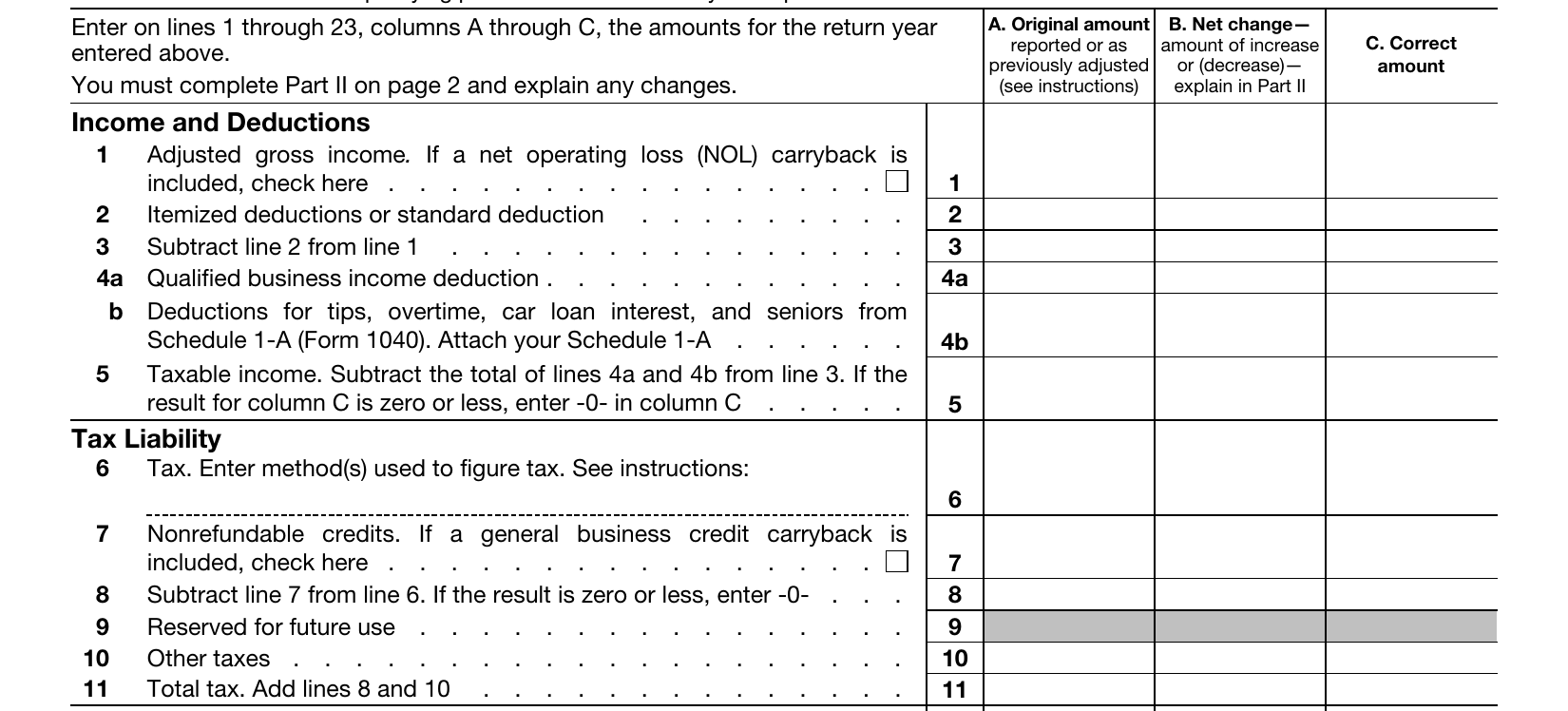
Form 1040-X, page 1: the instruction to enter on lines 1 through 23, columns A through C, and the three column headings — A, original amount reported or as previously adjusted; B, net change, explained in Part II; C, correct amount — over lines 1–11, income and deductions and tax liability, down to line 10, other taxes, and line 11, total tax. Per Form 1040-X (Rev. December 2025), final; checked on 2026-10-16.
Above the columns, two header mechanics are printed on the form itself. One of the filing-status checkboxes must be checked even if the status is not changing, with the printed caution that, in general, a joint return cannot be changed to separate returns after the due date. And the form's own header instruction states the attachment rule in one sentence: "Attach a completed Form 1040, 1040-SR, or 1040-NR, with your changes, for the return year entered below" — the December 2025 instructions carry the same requirement as their What's New item, for paper filers: the completed, updated Form 1040, with the changes in it, rides behind the 1040-X. The underlying figures come from the forms and instructions for the year being amended, not the current year's editions (the instructions' Reminders say so) — a 2025 amendment is built out of 2025 forms wearing a December 2025 amendment form.
The instructions print a chart for how much of the form a given change touches ("Lines 1 Through 30 — Which Lines To Complete," p. 7), and a Schedule C income change sits at its widest setting:
| What changes | Lines to complete |
|---|---|
| Income | Lines 1–23 |
| Qualified business income deduction, or the Schedule 1-A deductions | Lines 4a–23 |
| Tax before credits | Lines 5–23 |
| Nonrefundable credits, or other taxes | Lines 6–23 |
| Payments and refundable credits | Lines 11–23 |
Whatever the change, the top of page 1 through filing status, Part II, and the signature are always completed — Part II's instruction is three words: "You must complete Part II." Assembly has its own printed order ("Assembling Your Return," p. 11): the updated Form 1040 behind the 1040-X; new or changed schedules and forms behind that, in Attachment Sequence No. order; supporting statements last; copies of Forms W-2, W-2c, or 2439 that support a change go in front. Do not attach a copy of the original return or correspondence unless required. And the caution that gives the order its teeth, from the Special Situations pages: "You must attach all appropriate forms and schedules to Form 1040-X or it will be returned."
§5Step 4: how a Schedule C correction travels — line 1 in, Schedule SE by way of Schedule 2 to line 10
A corrected Schedule C does not enter the 1040-X directly. It enters the updated Form 1040 the way it entered the original: business income on Schedule 1, line 3, up into adjusted gross income — and the 1040-X picks the result up at line 1. The Line 1 instruction (p. 7) prints the pass-through in one sentence: "Any change to the income or adjustments on the return you are amending will be reflected on this line." The same instruction carries the cascade duty: an AGI change can move AGI-limited credits and deductions, and those amounts must be refigured, with the applicable forms and schedules attached to support them. One cascade is built into every Schedule C correction and the worked example below runs it openly: when Schedule C profit rises, the self-employment tax rises, and half of that tax is itself a deduction (Schedule SE, line 13, onto Schedule 1, line 15) — so the corrected AGI rises by the profit increase minus the added half-deduction, not by the profit increase alone.
The self-employment tax reaches the amendment by a different door, and it is worth walking slowly because the form gives it no line of its own. Schedule SE's tax never appears on the 1040-X as "self-employment tax." The chain is: corrected Schedule C → corrected Schedule SE → its total lands in the other-taxes section of Schedule 2 for the year amended → the 1040-X takes that Schedule 2 total at line 10, Other taxes. The Line 10 instruction (p. 9) is what verifies both ends of the chain: column A takes "the amount you reported on the line for total other taxes from Schedule 2 (Form 1040) for the year you are amending," and the same instruction warns that a filer who changed lines 1 through 6 "may need to refigure other taxes that were included in the same section on your original return" — the section self-employment tax sits in. The corrected Schedule SE itself rides in the attachment stack under Step 3's assembly order, like every changed schedule. In the example below, the Schedule SE tax is the only entry in that Schedule 2 section, so line 10 carries it whole; a return with other Schedule 2 taxes refigures the section's total, not just the SE line.
Nothing in that chain recomputes how the self-employment tax is figured — Schedule SE is re-run, not re-taught; Article 2 is this site's read of that form. And nothing in the chain touches the estimated-tax underpayment computation: estimated payments already made enter this form once, as payments at line 13, a reporting slot — Step 5 reads the payments block whole.
§6Step 5: worked example — a $5,900 payment left off a 2025 Schedule C
One worked example, with numbers used only in this article. These are hypothetical figures, not a prediction and not your numbers.
As filed. A freelance designer, filing single, filed her 2025 return in 2026. Her Schedule C showed gross receipts of $57,300 and expenses of $19,200 — line 31 net profit $38,100. On Schedule SE, $38,100 × 92.35 percent = $35,185.35 of net earnings; × 15.3 percent = self-employment tax $5,383.36 (no W-2 wages, and the earnings are nowhere near the Social Security wage ceiling, so the form's two printed rates run together as 15.3 percent). Half of it, $2,691.68, was deducted on Schedule 1, line 15. Her adjusted gross income was $38,100 − $2,691.68 = $35,408.32; the 2025 standard deduction for a single filer, $15,750, left taxable income of $19,658.32; the 2025 Tax Table (row $19,650–$19,700, single) gave a tax of $2,123. Total tax: $2,123 + $5,383.36 = $7,506.36, covered by $5,200 of estimated tax payments and $2,306.36 paid with the original return. No overpayment; nothing refunded.
What she found. Reconciling the year's bookkeeping, she finds one client payment of $5,900, received in 2025 and sitting in her records, that never reached Schedule C, line 1. Receipts were understated; the expenses were right. The correction is one change with a long shadow, and the amendment is filed in 2026 — comfortably inside Step 2's clock for a 2025 return.
The correction underneath (the updated Form 1040's stack — corrected Schedule C, corrected Schedule SE):
| Line | As filed | Change | Corrected |
|---|---|---|---|
| Schedule C, line 1 — gross receipts | $57,300 | +$5,900 | $63,200 |
| Schedule C, expenses | $19,200 | — | $19,200 |
| Schedule C, line 31 — net profit | $38,100 | +$5,900 | $44,000 |
| Schedule SE — net earnings (× 92.35%) | $35,185.35 | $40,634.00 | |
| Schedule SE, line 12 — self-employment tax | $5,383.36 | +$833.64 | $6,217.00 |
| Schedule SE, line 13 — deductible half | $2,691.68 | +$416.82 | $3,108.50 |
The amendment itself (Form 1040-X, columns A / B / C — A as previously adjusted; nothing on this return had been adjusted before, so A is the as-filed return):
| 1040-X line | A — as filed | B — change | C — correct |
|---|---|---|---|
| 1 — Adjusted gross income | $35,408.32 | +$5,483.18 | $40,891.50 |
| 2 — Standard deduction | $15,750 | — | $15,750 |
| 3 — Subtract line 2 from line 1 | $19,658.32 | +$5,483.18 | $25,141.50 |
| 5 — Taxable income (lines 4a and 4b are zero here, so line 5 repeats line 3) | $19,658.32 | +$5,483.18 | $25,141.50 |
| 6 — Tax (2025 Tax Table: row $25,100–$25,150, single) | $2,123 | +$654 | $2,777 |
| 10 — Other taxes (Schedule 2 total; the SE tax is its only entry) | $5,383.36 | +$833.64 | $6,217.00 |
| 11 — Total tax (line 8 + line 10; no credits) | $7,506.36 | +$1,487.64 | $8,994.00 |
Read line 1's column B against the Schedule C table: the profit rose $5,900, but AGI rises only $5,483.18, because the deductible half of the higher SE tax rose $416.82 on the way (Step 4's cascade, with its numbers on). Column B of line 11 is the sum of the two changes below it in the stack — $654 of income tax from the Tax Table plus $833.64 of self-employment tax through Schedule 2 — and it is the figure the payments block now has to meet.
The payments block. Line 13, estimated tax payments, stands at $5,200 in column C — unchanged; the amendment reports payments, it does not re-decide them. Line 16 carries $2,306.36, the tax paid with the original return. Line 17, total payments: $5,200 + $2,306.36 = $7,506.36. Line 18, the overpayment shown on the original return, is $0 — there was none. Line 19 is therefore $7,506.36. Line 11, column C ($8,994.00) is more than line 19, so the difference files at line 20 — amount you owe: $1,487.64, paid with the amendment. Lines 21–23 stay empty: nothing is overpaid, so there is nothing to refund or to apply forward. Interest on the $1,487.64 runs from the 2025 return's due date under Step 6's printed rules — it is the IRS's figure, it has no line on this form, and this example does not compute it.
Part II, as she writes it — one sentence per change, in the form's own space: "Line 1 and line 10 — Schedule C gross receipts increased by $5,900: a client payment received in 2025 was omitted from the original Schedule C. Corrected Schedule C, Schedule SE, and Schedule 2 attached; updated Form 1040 attached."
§7Step 6: the money lines — what the form holds, and what it refuses to
The payments block (Instructions, pp. 9–10) is an accounting of money already moved, and each line has one job. Line 12 is withholding — if it changes, copies of every additional or corrected Form W-2 (and any 1099 showing withholding) attach to the front of the amendment. Line 13 is the estimated tax payments claimed on the original return, plus any prior-year overpayment the filer elected into this year's estimates. Line 16 is the cash that arrived outside those channels: the amount paid with an extension request, the tax paid with the original return, and any additional tax paid after filing. One exclusion is printed with its own example, and it is the form's only contact with a penalty payment: payments of interest or penalties are not entered on line 16 — a $1,500 check that covered $1,400 of tax and a $100 estimated-tax penalty enters as $1,400. Line 17 then totals lines 12–15, column C, plus line 16.
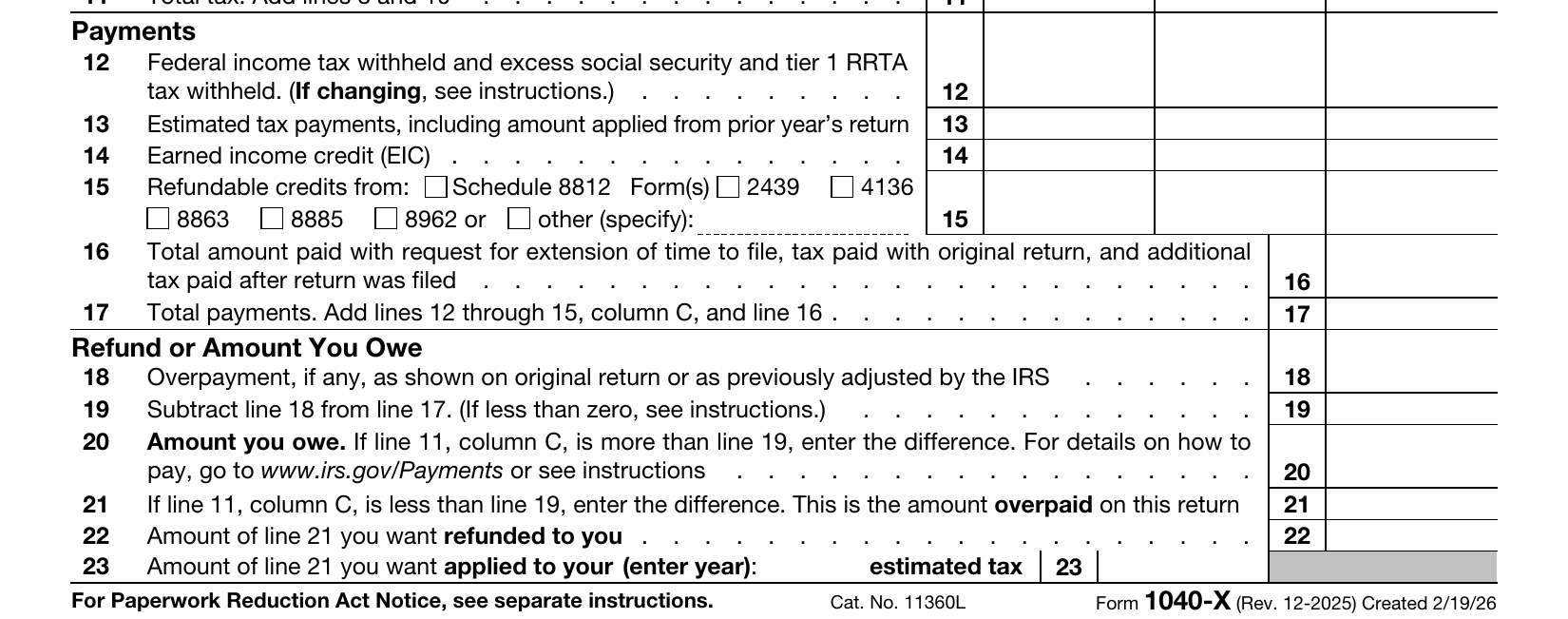
Form 1040-X, page 1: the payments block, lines 12–17 — line 13, estimated tax payments, and line 16, total amount paid with an extension request, with the original return, and after the return was filed — and the refund or amount you owe block, lines 18–23, with line 20, amount you owe. Per Form 1040-X (Rev. December 2025), final; checked on 2026-10-16.
The refund side runs lines 18–23. Line 18 is the overpayment shown on the original return (plus any additional overpayment from an IRS adjustment — not including interest received on a refund). Line 19 is line 17 minus line 18; the instructions print the awkward case too — if line 18 is larger, line 19 is negative, and the filer treats it as positive and adds it to line 11 on the way to line 20. Line 20 is the amount owed, when line 11, column C exceeds line 19; the instructions point to paying electronically, and an e-filed amendment can authorize a direct debit with the filing. Line 21 is the overpayment when the comparison runs the other way; line 22 is the part of it to be refunded — sent separately from any refund on the original return, with the instructions' sentence standing as the whole interest rule on this side: "We will figure any interest and include it in your refund." A refund from a paper-filed amendment cannot be direct-deposited — it arrives as a check; direct deposit exists only on the e-filed form (Step 7). Line 23 applies part of the overpayment to a stated year's estimated tax, under a printed CAUTION pair: no interest is paid on that amount, and the election, once made, cannot be changed — and an original return's election to apply its overpayment forward cannot be reversed on the amended return. Overpayments can also be offset against past-due federal and state debts and other obligations, with notice to the filer.
Interest and penalties themselves never get a line. The Purpose of Form prints the rule as an instruction to the filer: don't include any interest or penalties on Form 1040-X; they will be adjusted accordingly — Topic 308 prints the same sentence. What the instructions do print ("Interest and Penalties," p. 3) is the charging framework, reported here and computed for no one: interest runs on tax not paid by its due date even if the filer had an extension, and on the listed penalties from the return's due date including extensions. The late-payment penalty, if additional tax is not paid within 21 calendar days of notice and demand (10 business days when the amount is $100,000 or more), is generally ½ of 1% per month or part of a month, up to 25%, in addition to interest — with reasonable cause as the printed relief. Two caution figures close the section: an erroneous claim for a refund or credit carries a penalty of 20% of the disallowed amount, and a frivolous return carries $5,000. Those are the form's whole vocabulary on the subject; the underpayment computation that produces interest in the first place is the estimated-tax machinery of Articles 1, 4, and 11, and it is not re-opened here.
§8Step 7: filing it, and watching it move
The amendment itself can be e-filed, inside a printed window. The IRS's Amended Return FAQ page (checked 2026-10-16) states it: a Form 1040, 1040-SR, 1040-NR, 1040-SS (or, before 2023, 1040-PR) for the current or two prior tax periods can be amended electronically using available tax software. Outside that window, paper is mandatory — and paper is also mandatory when amending a prior-year return that was originally filed on paper during the current processing year. Up to three e-filed amended returns are accepted per tax year; a third accepted filing closes the door. An e-filed amendment is not the 1040-X alone: it requires submission of all the forms and schedules the original required, as if it were the original submission, in addition to the attached Form 1040-X. The e-filed form is also where direct deposit lives — available for amendments since February 2023, for tax year 2021 and later, on lines the paper form does not carry.
Tracking is its own tool. Where's My Amended Return is described identically in three IRS texts this article rests on. The instructions ("Tracking Your Amended Return," p. 5) give the processing frame — generally 8 to 12 weeks, up to 16 weeks in some cases — and the tool can take up to 3 weeks from mailing to show the return at all. The filer enters Social Security number (TIN), date of birth, and ZIP code; Topic 308 adds the phone route, 866-464-2050, the same three-weeks-after-filing start, English and Spanish, and a reach of the current tax year and up to three prior years. The FAQ page names the three stages the tool reports — Received → Adjusted → Completed — and lists what it cannot show: carryback applications and claims, injured-spouse claims, a Form 1040 itself marked as amended or corrected, returns with a foreign address, business returns, and returns being processed by specialized units such as Examination or Bankruptcy. An amendment inside one of those exclusions is not lost; it is simply not on the tracker, and the article prints the list so a blank tracker is read correctly.
§9Three filing dates, three deadlines — what "whichever is later" does
Step 2 prints the clock as two rules — three years after filing, or two years after paying, whichever is later — plus the two filing-date fictions and the lookback that limits the refund. This block runs those rules on three filing dates, as of 2026-10-26. The dates are hypothetical, not a prediction and not your dates. No figure here is a Tax Table value and no tax is computed; the block decides timeliness only, and the tax itself is refigured on the updated return underneath, as Step 5 shows.
| Filing date, as the instructions deem it | Three-year deadline | Two-year-after-payment deadline | Later of the two | Claim filed | Timely? |
|---|---|---|---|---|---|
| Filed early, March 1, 2026 — deemed filed April 15, 2026; tax deemed paid April 15, 2026 | April 15, 2029 | April 15, 2028 | April 15, 2029 | February 10, 2029 | Yes — inside the three-year rule. Lookback: the claim is filed within three years of filing, so the lookback is three years plus no extension period, back to February 10, 2026, which covers the April 15, 2026 payment. |
| Filed under extension, received July 1, 2026 — deemed filed July 1, 2026, not October 15; tax paid July 1, 2026 | July 1, 2029 | July 1, 2028 | July 1, 2029 | August 20, 2029 | No — past the later deadline, and past the two-year deadline too. The extension to October 15 does not move the filing date. |
| Filed April 15, 2024; additional tax paid June 30, 2026 | April 15, 2027 | June 30, 2028 | June 30, 2028 | May 12, 2028 | Yes — under the two-year rule, although past the three-year deadline. Lookback: the claim is filed more than three years after filing, so the lookback is the two years immediately before the claim, May 12, 2026 to May 12, 2028, which covers the June 30, 2026 payment. |
The third row is the reason the rule says "whichever is later": a claim that is late under one clock can still be timely under the other, and the lookback then decides how much of the tax paid can actually be refunded — the two tests are separate, and passing the deadline test does not by itself pass the lookback test. The extension mechanics behind the second row are Article 39; the estimated payments inside the first row's paid date are Article 1; and the self-employment tax a Schedule C amendment carries through Schedule 2 is Article 2. How each date above was checked is described on How we verify.
Frequently asked questions
1 questionReal questions first-time filers asked in public forums — answered only from the lines read in this article.
I filed my return, but I just realized I forgot to report some self-employment income. It was already accepted. Can I amend it?
Yes, that is what Form 1040-X is for. The original return is not edited: the correction files on its own form, Form 1040-X, and a change in income is exactly the case Topic No. 308 names as calling for the form. The form is filed only after the original return has been filed, and generally, for a credit or refund, within 3 years (including extensions) after the date the original return was filed, or within 2 years after the date the tax was paid, whichever is later. A return filed early is considered filed on the due date, generally April 15.
Sources
21 claimsEvery claim above traces to a document, a tax year, a line, and the date it was checked.
-
1
Lines 1–23 run in three columns — A "Original amount reported or as previously adjusted," B "Net change," C "Correct amount"; Part II, Explanation of Changes, must be completed; the header instruction to attach a completed Form 1040 with the changes
- DOC
- Form 1040-X
- YEAR
- Rev. December 2025
- LINE
- Lines 1–23; Part II; form header
- CHECKED
- 2026-10-16
-
2
Form 1040-X and its instructions were converted from an annual revision to continuous use in tax year 2021; the underlying figures use the forms and instructions for the year being amended; a completed, updated Form 1040 must be attached to a paper-filed Form 1040-X (What's New)
- DOC
- Instructions for Form 1040-X
- YEAR
- Rev. December 2025
- LINE
- Reminders; What's New
- CHECKED
- 2026-10-16
-
3
File only after the original return; generally within 3 years (including extensions) after filing or 2 years after paying, whichever is later; an early return is considered filed on the due date; a return received July 1 under an extension to October 15 is considered filed July 1; more than one timely amendment is allowed
- DOC
- Instructions for Form 1040-X
- YEAR
- Rev. December 2025
- LINE
- "When To File," p. 3
- CHECKED
- 2026-10-16
-
4
The refund is limited to tax paid within the lookback period — 3 years plus any extension period when the claim is filed within 3 years of filing, otherwise 2 years; withheld and estimated tax are considered paid on the due date; longer windows (7-year bad debt / worthless security; 10-year foreign tax credit) and the financial-disability suspension are printed in the same section. The 7-year window's statute was read 2026-11-04: 26 U.S.C. §6511(d)(1) sets the 7-year period for a claim relating to a debt deductible under §166 or §832(c) or a loss from worthlessness of a security under §165(g), named in (d)(1)(A); §165(g) itself sets the loss treatment (treated as a sale or exchange on the last day of the taxable year) and contains no period, so it is not cited alone as the period's source
- DOC
- Instructions for Form 1040-X; 26 U.S.C. §6511(d)(1)
- YEAR
- Rev. December 2025; U.S. Code
- LINE
- "Filing limits due to lookback period," p. 3; §6511(d)(1)
- CHECKED
- 2026-10-16; §6511(d)(1) read 2026-11-04
-
5
The IRS may correct certain errors and accept returns without required forms, so there is no need to amend in those instances; amend for a change in filing status, income, deductions, credits, or tax liability; the superseding rule — owe additional tax before the due date, file Form 1040-X or a corrected Form 1040 and pay by the due date and the corrected return replaces the original; withholding is deemed paid on the due date
- DOC
- Topic No. 308
- YEAR
- As posted
- LINE
- Opening; "When to file"; "Balance due"
- CHECKED
- 2026-10-16
-
6
Column A takes amounts as previously adjusted if the IRS or a prior amendment changed them (the instructions' example: IRS-added $10,000 of income making taxable income $100,000 is the column A figure); column B is the net increase or (decrease), each change explained in Part II with its schedule attached; unchanged lines repeat A in C
- DOC
- Instructions for Form 1040-X
- YEAR
- Rev. December 2025
- LINE
- "Columns A Through C," pp. 6–7
- CHECKED
- 2026-10-16
-
7
Which lines to complete: income → lines 1–23; QBID / Schedule 1-A deductions → 4a–23; tax before credits → 5–23; nonrefundable credits or other taxes → 6–23; payments and refundable credits → 11–23
- DOC
- Instructions for Form 1040-X
- YEAR
- Rev. December 2025
- LINE
- "Lines 1 Through 30 — Which Lines To Complete," p. 7
- CHECKED
- 2026-10-16
-
8
Any change to income or adjustments is reflected on line 1; an AGI change can require AGI-limited credits and deductions to be refigured, with the supporting forms attached
- DOC
- Instructions for Form 1040-X
- YEAR
- Rev. December 2025
- LINE
- "Line 1 — Adjusted Gross Income," p. 7
- CHECKED
- 2026-10-16
-
9
Assembly: the updated Form 1040 behind the 1040-X, changed schedules in Attachment Sequence No. order, supporting statements last, W-2 / W-2c / 2439 copies in front; do not attach the original return unless required; attach all appropriate forms and schedules or the amendment will be returned; a separate Form 1040-X for each year
- DOC
- Instructions for Form 1040-X
- YEAR
- Rev. December 2025
- LINE
- "Assembling Your Return," p. 11; Special Situations, p. 4; Purpose of Form, p. 2
- CHECKED
- 2026-10-16
-
10
Line 10, column A takes the total other taxes amount from Schedule 2 for the year amended; changing lines 1–6 may require refiguring the other taxes in that same Schedule 2 section (the section self-employment tax sits in)
- DOC
- Instructions for Form 1040-X
- YEAR
- Rev. December 2025
- LINE
- "Line 10 — Other Taxes," p. 9
- CHECKED
- 2026-10-16
-
11
Payments: line 13 is the estimated payments claimed on the original return plus any prior-year overpayment elected in; line 16 takes extension payments, tax paid with the original return, and additional tax paid after filing — never payments of interest or penalties (the $1,500 check covering $1,400 tax and a $100 penalty enters as $1,400); line 17 totals lines 12–15 column C plus line 16; changing line 12 withholding attaches the W-2 copies to the front
- DOC
- Instructions for Form 1040-X
- YEAR
- Rev. December 2025
- LINE
- Lines 12–17 instructions, pp. 9–10
- CHECKED
- 2026-10-16
-
12
Refund or amount owed: line 18 excludes interest received on a refund; the negative-line-19 case is treated as positive and added to line 11 for line 20; the line 22 refund is sent separately and "We will figure any interest and include it in your refund"; a paper-filed amendment's refund cannot be direct-deposited; the line 23 election pays no interest and cannot be changed once made, and an original return's election to apply an overpayment forward cannot be reversed; overpayments may be offset against past-due debts
- DOC
- Instructions for Form 1040-X
- YEAR
- Rev. December 2025
- LINE
- "Refund or Amount You Owe," pp. 9–10; Line 20 CAUTION
- CHECKED
- 2026-10-16
-
13
Interest is charged on tax not paid by its due date even with an extension; don't include any interest or penalties on Form 1040-X — they will be adjusted accordingly; late-payment penalty generally ½ of 1% per month to 25% if not paid within 21 calendar days of notice and demand (10 business days at $100,000 or more), reasonable cause excepted; erroneous refund/credit claim penalty 20%; frivolous return $5,000
- DOC
- Instructions for Form 1040-X
- YEAR
- Rev. December 2025
- LINE
- "Interest and Penalties," p. 3; Purpose of Form, p. 2
- CHECKED
- 2026-10-16
-
14
Don't file Form 1040-X only for a refund of penalties or interest or an addition to tax already paid (Form 843), or for an injured-spouse share (Form 8379, which may accompany an e-filed 1040-X); don't file another original return for the same year after the due date
- DOC
- Instructions for Form 1040-X
- YEAR
- Rev. December 2025
- LINE
- Purpose of Form / CAUTIONs, pp. 2–3
- CHECKED
- 2026-10-16
-
15
Many math errors are corrected by the IRS in processing; respond to a notice requesting forms instead of amending; a notice proposing a change may allow agreement without amending; if a refund check already arrived for a return that needs amending, file promptly and return the check voided, with a letter of explanation
- DOC
- Amended returns & Form 1040X — FAQ (irs.gov)
- YEAR
- As posted
- LINE
- FAQ page
- CHECKED
- 2026-10-16
-
16
E-file: the current or two prior tax periods can be amended electronically; paper is mandatory for older years and for a prior-year return originally filed on paper during the current processing year; up to three e-filed amended returns per tax year; an e-filed amendment submits all required forms as an original submission plus the Form 1040-X; direct deposit for e-filed amendments since February 2023 (TY2021+)
- DOC
- Amended Return Frequently Asked Questions (irs.gov)
- YEAR
- As posted (items updated May 28, 2025 and January 2, 2024)
- LINE
- FAQ page
- CHECKED
- 2026-10-16
-
17
Where's My Amended Return: allow 8 to 12 weeks, up to 16; the tool may take up to 3 weeks to show the return; TIN, date of birth, and ZIP; phone 866-464-2050; current year plus up to three prior years; stages Received → Adjusted → Completed; the printed list of what the tool cannot show
- DOC
- Instructions for Form 1040-X; Topic No. 308; Amended Return FAQ
- YEAR
- Rev. December 2025 / as posted
- LINE
- "Tracking Your Amended Return," p. 5; "Amended return status"; FAQ page
- CHECKED
- 2026-10-16
-
18
The worked example's standard deduction: $15,750 for a single filer
- DOC
- Instructions for Form 1040
- YEAR
- 2025 final
- LINE
- Line 12 instructions — standard deduction amounts
- CHECKED
- 2026-10-16
-
19
The worked example's income tax: Tax Table row $19,650–$19,700, single = $2,123; row $25,100–$25,150, single = $2,777 — both rows read in the table itself for this build
- DOC
- Instructions for Form 1040
- YEAR
- 2025 final
- LINE
- 2025 Tax Table (p. 68 and following)
- CHECKED
- 2026-10-16
-
20
The worked example's self-employment tax run: net earnings are 92.35 percent of Schedule C net profit; the tax is figured at 12.4 percent (Social Security, under the wage ceiling) plus 2.9 percent (Medicare) and lands at line 12; half of it is deducted at line 13, onto Schedule 1, line 15
- YEAR
- 2025 final
- LINE
- Lines 4a–13
- CHECKED
- 2026-10-06
-
21
Clock arithmetic for three filing dates (this block): early filing deemed April 15, 2026 with claim February 10, 2029; extension filing deemed July 1, 2026 with claim August 20, 2029; April 15, 2024 filing with tax paid June 30, 2026 and claim May 12, 2028 — deadlines and lookback windows computed 2026-10-26
- DOC
- Instructions for Form 1040-X
- YEAR
- Rev. December 2025
- LINE
- "When To File," p. 3; "Filing limits due to lookback period," p. 3
- CHECKED
- 2026-10-26
Update log
Changes are dated and kept. Old figures are never silently overwritten.
- Same form Form 1040-X
- Next form Short Sales and Taxes in 2026
- Tool Schedule SE Estimator
Free one-page sheet: The $1,000 Line reads the $1,000 test on the 2026 Estimated Tax Worksheet.