Filing Extension 2026: Form 4868 Moves the Return, Not the Payment
This is education, not tax advice. I'm not a CPA or EA. State taxes are not covered.
The mechanics in this article are read in Form 4868 (2025) — the form and its instructions in one document — which is the current posted edition as of the check date; Form 4868 (2026) has not yet been posted. The dates the 2025 edition prints are the 2025 tax year's dates. The 2026 tax year's dates in this article — April 15, 2027, June 15, 2027, and October 15, 2027 — are derived, not printed: they are worked out from the form's printed rule (six months past the April 15 calendar-year due date) and the 2027 calendar, in which none of the three dates falls on a weekend, and each is marked "(derived)" where it appears. When Form 4868 (2026) posts, its printed dates replace the derived ones — that re-read is this page's first correction trigger. The minimum late-filing penalty figure is likewise the 2025 edition's, and is labeled with its edition where it appears. Topic No. 304 is read as posted. If a line changes, this page is updated in place with a dated note at the foot of the article.
- Last checked
- Tax year
- 2026
- Core line
- Form 4868, line 4 — the estimate of total tax liability, and the payments worksheet it stands on
- Changes
- Update log (5)
Filing Form 4868 gives you six more months to file — to October 15, 2027 for a 2026 return, a date derived from the form's printed rule, since the 2026 edition of the form has not yet posted. It does not move the day the tax is due: interest runs on tax unpaid after the original due date, and the form's late-payment penalty description still applies. In this article's example, an estimated liability of $9,340 against $4,978 already paid leaves a $4,362 balance on line 6; paying $3,260 of it on line 7 gets the extension anyway — payment is not a condition of it — and the $3,260 comes back on Schedule 3, line 10 when the return is filed.
This article is for you if a filing deadline is close, your return is not ready, and you are thinking of buying time with Form 4868.
§1The form that moves one deadline and leaves the other standing
This article is for you if a filing deadline is close, the return is not ready, and you are thinking of buying time with Form 4868, the Application for Automatic Extension of Time To File. The form grants that time — six more months of it — and this article reads the whole of the small document it is printed in: what qualifies a filer for the extension, the four-line worksheet at its center, the one condition that can void the extension after the fact, and the dates the extension does not move.
Three boundaries stand at the door. The article never decides whether a particular reader should extend — it prints the form's mechanics and the form's own cautions, and the decision stays the reader's. It never computes a reader's interest or penalty: the instructions' printed sentences about both are reported exactly as printed, and run on no one's numbers. And the estimated-tax underpayment computation — the machinery that prices a missed installment — belongs to Article 1, Article 4, and Article 11; this article meets that machinery at exactly one printed carve-out, named where it occurs below.
§2Step 1: the thesis, in the form's own caution
The form states its own limit before it states anything else, in a CAUTION on its first page: "Although you aren't required to make a payment of the tax you estimate as due, Form 4868 doesn't extend the time to pay taxes. If you don't pay the amount due by the due date, you'll owe interest. You may also be charged penalties." The IRS's topic page for the form prints the same rule in bold: an extension of time to file is not an extension of time to pay.
What the form does move is stated in its purpose line: "Use Form 4868 to apply for 6 more months (4 if 'out of the country' — Step 8) to file Form 1040, 1040-SR, 1040-NR, or 1040-SS." For a calendar-year filer, the printed rule lands the extended due date six months past April 15 — October 15 of the following fall, as the 2025 edition prints it for its own year. For the 2026 tax year that rule derives October 15, 2027 (derived) as the extended due date, from an original due date of April 15, 2027 (derived) — derived, both of them, under the form-status note above, until the 2026 edition of the form prints them. The instructions also close the far end: "Generally, we can't extend the due date of your return for more than 6 months." The Privacy Act notice on the form's last page grounds the whole mechanism in section 6081 — the extension is a statutory one, and the form is its printed door.
§3Step 2: how you get it — three steps, three routes, no reason required
Qualifying is three printed steps and nothing else (p. 1): "1. Properly estimate your tax liability using the information available to you, 2. Enter your total tax liability on line 4 of Form 4868, and 3. File Form 4868 by the due date of your return." The same page prints the sentence filers most often doubt: "You don't have to explain why you're asking for the extension." Two printed exclusions stand beside the steps: do not file Form 4868 if you want the IRS to figure your tax, or if you are under a court order to file your return by the due date. Disaster-affected filers may have additional time to file the 4868 itself — the form prints a pointer to www.irs.gov/DisasterRelief and nothing more, and this article prints the pointer and nothing more.
The form prints three routes to the same extension. Pay electronically and indicate the payment is for an extension — Direct Pay, an online account, EFTPS, a debit or credit card, a digital wallet, or cash: "You don't need to file Form 4868 if you make a payment using our electronic payment options. The IRS will automatically process an extension of time to file when you pay part or all of your estimated income tax electronically." The form itself is still to be completed as a worksheet on that route — the lines of Step 3 are the worksheet. E-file Form 4868 through tax software or a tax professional; Free File offers free e-filing of the form. Or file the paper form, with a payment of the estimate enclosed or not, as Step 3 explains. One printed limit: fiscal-year taxpayers must file a paper Form 4868.
What proof each route leaves is also printed, and it is thinner than most filers expect. The extension is automatic on a qualifying filing; there is no approval letter. Page 1: "We'll contact you only if your request is denied." An e-filed form returns an electronic acknowledgment — "Keep it with your records. Don't mail in Form 4868 if you file electronically, unless you're making a payment with a check or money order." An electronic payment returns a confirmation number to keep the same way. Topic No. 304 adds the e-file identity step: have a copy of the prior year's return at hand — the prior year's AGI is asked for as verification. And one verified negative belongs in print, because a filer looking for more will not find it: no IRS tracking tool for an extension request is named in the form, its instructions, or Topic 304 — the acknowledgment and the confirmation number are the whole printed proof system. A second negative stands with it: the paper Form 4868 carries no signature block and no perjury statement anywhere in its four pages — nothing on the form is signed; what the routes verify is identity, not a signature.
§4Step 3: the worksheet — lines 4 through 7
The form's Part II is four lines, and they are a small accounting of the year: what the tax is expected to be, what has already been paid toward it, what is left, and what is being paid now.
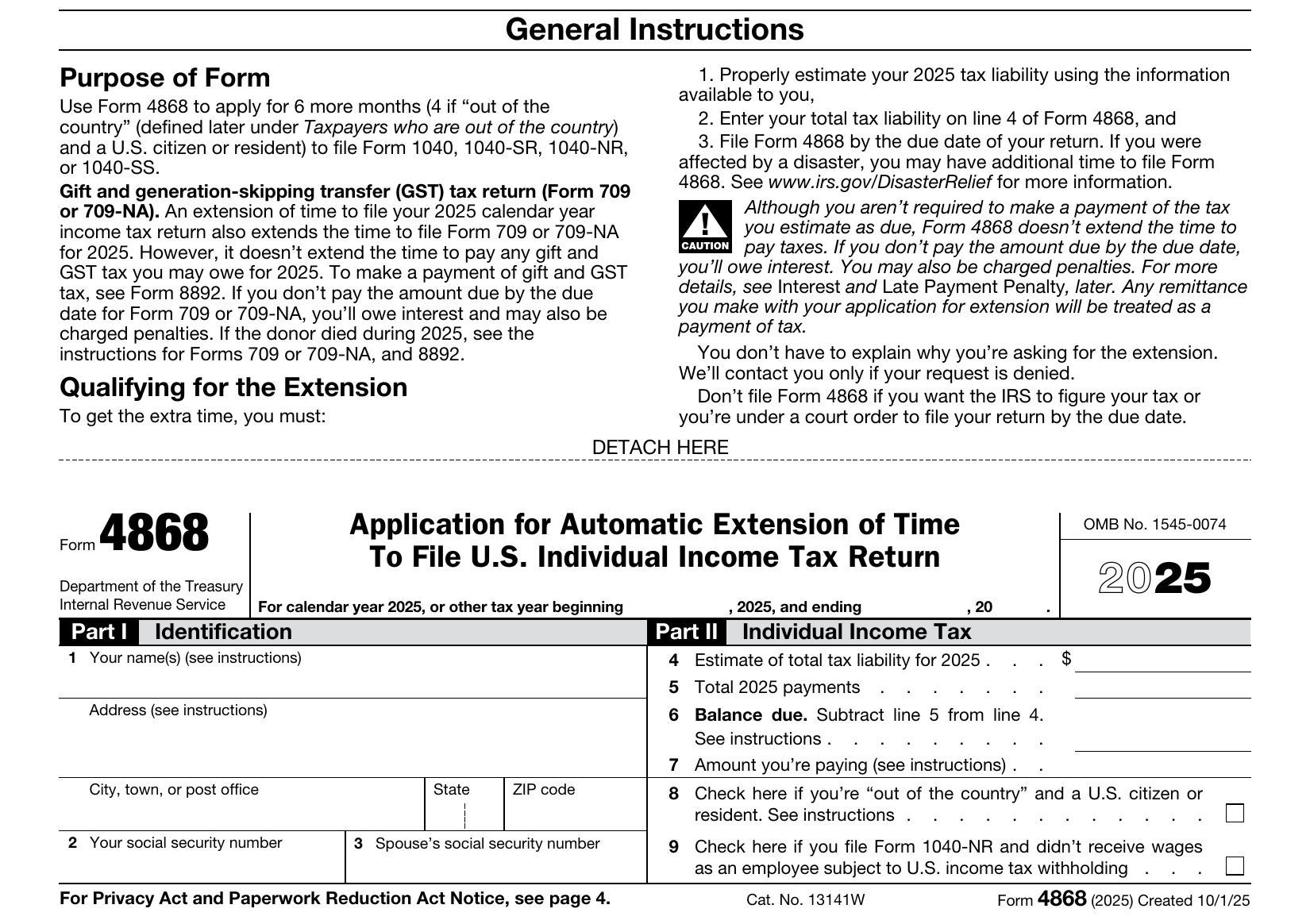
Form 4868 (2025), page 1: the General Instructions — Purpose of Form, the three qualifying steps, and the CAUTION that the form doesn't extend the time to pay taxes — above the form itself, whose Part II holds the worksheet: line 4, estimate of total tax liability; line 5, total payments; line 6, balance due; line 7, amount you're paying. Per Form 4868 (2025), final; checked on 2026-10-16.
Line 4 — Estimate of Total Tax Liability. Enter the total tax liability you expect to report on Form 1040, line 24. "If you expect this amount to be zero, enter -0-." For a Schedule C filer this is the whole expected bill — income tax and self-employment tax together, as the return will eventually state it — estimated before the return exists. Step 4 reads the condition this line carries; it is the article's load-bearing caution.
Line 5 — Total Payments. Enter the total payments you expect to report on Form 1040, line 33 — excluding Schedule 3, line 10. That is withholding, estimated tax payments, and the other payments and refundable credits that land on line 33, counted without anything paid with the extension request itself. The instruction carries its own CAUTION, printed in capitals in the form: "Don't include on line 5 the amount you're paying with this Form 4868." The carve-out has a mechanical reason, and Step 7 shows it: Schedule 3, line 10 is where a payment made with Form 4868 is later claimed on the return, so counting it here as well would count it twice. The money paid with the form has its own line — line 7.
Line 6 — Balance Due. "Subtract line 5 from line 4. If line 5 is more than line 4, enter -0-." The balance cannot go below zero on this form.
Line 7 — Amount You're Paying. What is actually sent with the request — and the form prints, in plain words, that it does not have to be the whole of line 6: "If you find you can't pay the amount shown on line 6, you can still get the extension. But you should pay as much as you can to limit the amount of interest you'll owe. Also, you may be charged a late payment penalty on the unpaid tax from the due date of your return." Payment, in other words, is not a condition of the extension: the first page's CAUTION (Step 1) says a filer "aren't required to make a payment of the tax you estimate as due," and any remittance made with the application "will be treated as a payment of tax." The extension stands on the estimate and the timely filing; the payment stands on its own line, priced by the printed sentences of Step 5.
§5Step 4: the condition — a reasonable estimate, or the extension is void
Line 4's instruction is one sentence of method and one sentence of consequence, and both are the form's: "Make your estimate as accurate as you can with the information you have. If we later find that the estimate wasn't reasonable, the extension will be null and void." That is the whole printed condition. The form builds no test around it — no factors, no threshold, no safe percentage — and this article builds none either: the sentence is quoted from the Line 4 instructions, attributed to them, and left at the strength the form gives it. What a court has done with the underlying condition is a matter of record, and the record is this article's one case.
The condition has been litigated once at full length, on harder facts than any example here. One case, stated as fact:
In the early 1980s, a married couple requested and received the automatic extensions of that era for their 1981 and 1982 returns — two months for 1981 and four for 1982 under the regulation then in force, not the six months today's form grants; the length has changed since, and what carries forward is the estimate condition, which the current form prints in its own words. Both returns carried Schedule C professional income — his day work for oil companies — alongside large interest and dividend income. On the 1981 Form 4868 they estimated their tax liability at $12,000 and paid $2,000 with it; the 1981 return they eventually filed computed $41,559.08, and the court found the true liability had been underestimated by approximately $58,000. On the 1982 form they estimated $22,000 and paid $20,403.24; the filed 1982 liability was $36,214.32, an underestimate of approximately $27,000. The IRS took the position that the Forms 4868 were invalid and the extensions void from the start for failure to properly estimate, so the returns were late, and the failure-to-file additions applied — $8,329.33 for 1981 and $5,261.97 for 1982, as noticed.
The Tax Court held that an estimate is proper when it is a bona fide and reasonable estimate based on the information available at the time, and that a taxpayer must make a bona fide attempt to locate, gather, and consult the information that would enable a proper estimate; underestimation alone does not void an extension. But these taxpayers had lost or misplaced many of their Forms 1099, never tried to replace them, never chased information held by others, and never clarified their reimbursed expenses — they had made no bona fide attempt to consult information within their possession or readily available to them. Their estimates were therefore improper, the IRS could properly void the extensions, the returns were untimely, and reliance on the voided extensions was not reasonable cause. The additions were sustained; the opinion ends with the decision to be entered under Rule 155, so it prints the noticed figures above and no final computed totals.
— Crocker v. Commissioner, 92 T.C. 899 (1989) · Tax years at issue: 1981 and 1982
Hold the case at the distance the form keeps it. The sentence a filer files under is the Line 4 instruction's own — as accurate as you can, on the information you have, or the extension is null and void. The case shows the condition enforced once, at its far end, against estimates made without consulting the information at hand; it is printed here as that record, not as a set of criteria for any reader's estimate.
§6Step 5: what does not move
Interest. The instructions' paragraph is short and closes its own exits: "You'll owe interest on any tax not paid by the due date of your return, even if you qualify for the 2-month extension because you were out of the country. The interest runs until you pay the tax. Even if you had a good reason for not paying on time, you will still owe interest." Reasonable cause, which the next penalty admits, does not stop interest — the asymmetry is printed, and this article reports it without softening it. No interest figure is computed anywhere in this article; interest is the IRS's figure, charged on the unpaid tax from the due date the extension leaves standing.
The late payment penalty, as the instructions print it. It is "usually ½ of 1% of any tax (other than estimated tax) not paid by the due date of your return," charged "for each month or part of a month the tax is unpaid," with a maximum of 25%. Two reliefs are printed. A filer may show reasonable cause for not paying on time, by a statement attached to the return — "Don't attach the statement to Form 4868." And the instructions print a deemed-reasonable-cause rule for the extension period, both halves of which must hold: at least 90% of the total tax shown on the return was paid on or before the due date — through withholding, estimated payments, or payments made with Form 4868 — and the remaining balance is paid with the return. Those sentences are reported here as the form prints them; they are applied to no reader's numbers. The parenthetical in the rate sentence does its own fence work: the penalty is figured on tax "other than estimated tax" — a shortfall in the estimated installments themselves is priced by a different machine, the underpayment computation of Articles 1, 4, and 11, and nothing in this article opens it.
The late filing penalty, as the instructions print it — the one penalty the extension actually holds off, because it is measured from the due date and the extension is what moves that date. It is "usually 5% of the amount due for each month or part of a month your return is late. The maximum penalty is 25%. If your return is more than 60 days late, the minimum penalty is $525 (adjusted for inflation) or the balance of the tax due on your return, whichever is smaller." The $525 figure is the 2025 edition's — the form adjusts it for inflation annually, and this article carries the edition it cites until the 2026 form prints its own. Relief for a reasonable explanation is printed the same way as above: a statement attached to the return, not to Form 4868.
The fourth estimated-tax date. Form 1040-ES (2026), on its own payment schedule (p. 4), prints the 2026 installments on their own dates — and the fourth is January 15, 2027. Nothing in Form 4868 or Topic No. 304 touches that date: the extension runs from the return's due date, the installments run on their printed schedule, and a filer who extends the 2026 return to October 2027 still meets the January installment on January's date. The schedule's printed footnote rides with the date and is Article 1's ground, named here and not re-taught: the January payment does not have to be made if the 2026 return is filed by February 1, 2027 and the entire balance is paid with it.
§7Step 6: worked example — an estimate, a partial payment, and an extension that holds anyway
One worked example, with numbers used only in this article. These are hypothetical figures, not a prediction and not your numbers. The dates in it are the derived 2026-tax-year dates of the form-status note.
The filer. A first-year self-employed filer, single. He left a W-2 job in February 2026 and has worked for himself since; 2026 is his first year with a Schedule C. By April 2027 his books are not closed — two client ledgers are unreconciled — but his records support an estimate, and he files Form 4868 by April 15, 2027 (derived), the original due date.
The worksheet, as he completes it:
| Form 4868 line | What goes on it | Amount |
|---|---|---|
| 4 — Estimate of total tax liability | The total tax he expects the 2026 return to show — income tax and self-employment tax together | $9,340 |
| 5 — Total payments | Estimated payments made during the year: three payments of $1,450 = $4,350, plus $628 of withholding from the part-year W-2 job. The amount he is about to pay with this form is not in this line — the line 5 caution of Step 3 | $4,978 |
| 6 — Balance due | Line 4 minus line 5: $9,340 − $4,978 | $4,362 |
| 7 — Amount you're paying | What he sends with the request — less than line 6, because that is what he can send | $3,260 |
What the printed rules do with those figures. The extension is granted on the estimate and the timely filing; line 7's shortfall does not defeat it — "you can still get the extension." His time to file now runs to October 15, 2027 (derived). The $1,102 of the balance he did not pay ($4,362 − $3,260) stands unpaid from the original due date: the form's printed sentences of Step 5 govern it — interest runs on it until it is paid, and the late payment penalty as printed may be charged on it — and this example computes neither, because the form computes neither on this page either. What he controls is the size of the unpaid figure, which is why line 7's instruction says to pay as much as you can.
The payment's return trip. He files the return in September 2027, inside the extension. The $3,260 he paid with Form 4868 is entered on the return at Schedule 3 (Form 1040), line 10 — the landing Step 7 reads — where it stands as a payment against the tax the return actually computes. The example's figures end there: what the finished return's tax turns out to be is the return's own arithmetic, and whether his $9,340 estimate was reasonable is judged, if it is ever judged, under Step 4's printed sentence — on the information he had, which in this example was unreconciled but real.
§8Step 7: filing the return later — and claiming the payment
The extension buys time, not a schedule: the instructions print that "You can file your tax return any time before the extension expires." One attachment rule travels with the return, and it surprises filers who saved the form carefully: "Don't attach a copy of Form 4868 to your return." The 4868 has done its work by the time the return is filed.
The payment made with it has not. The instructions' "How To Claim Credit for Payment Made With This Form" (p. 2) prints the landing: when the return is filed, the amount paid with Form 4868 is entered on Schedule 3 (Form 1040), line 10. That single landing explains the worksheet's shape two steps back — line 5 of Form 4868 counts the payments that land on Form 1040, line 33 excluding Schedule 3, line 10, because the extension payment is not one of them; it arrives on the return by its own line, and the form's caution keeps it from being counted in both places. One household edge is printed in the same passage: spouses who each filed a separate Form 4868 and later file a joint return enter the total of both payments on line 10.
§9Step 8: out of the country — the printed two months
The form's second timing rule is not an extension at all, and it is printed under its own heading (p. 2). If, on the due date of your return, you are out of the country — as the form defines it — and a U.S. citizen or resident, "you're allowed 2 extra months to file your return and pay any amount due without requesting an extension." For a calendar-year filer that lands on June 15 — June 15, 2027 (derived) for the 2026 tax year. The two months move the filing date and the penalty date; they do not move the interest clock, and the form says so inside the same passage: "Interest will still be charged, however, on payments made after the due date, without regard to the extension."
The printed definition has exactly two prongs: (1) you live outside the United States and Puerto Rico and your main place of work is outside the United States and Puerto Rico, or (2) you are in military or naval service on duty outside the United States and Puerto Rico. One printed edge widens it slightly: a filer may qualify even if physically present in the United States or Puerto Rico on the due date. Topic No. 304 adds one requirement the form's passage does not print, and it is attributed to the topic page where it stands: using the automatic two months requires attaching a statement to the return explaining which of the situations qualifies you.
If the two months are not enough, the door back to Form 4868 is printed in the same passage: by the June date, file the return and pay — or file Form 4868 and check the box on line 8 (the "out of the country" checkbox in Part II) — for an additional 4 months, to the same October 15 the form's six months reach: October 15, 2027 (derived). That is the whole of the form's "4 if out of the country" arithmetic from Step 1: two automatic months plus four more by the form, and Topic 304 prints that the additional four months are not an extension of time to pay. Beyond this, the form points and this article follows: filers who do not expect to meet the bona fide residence or physical presence tests by the due date are pointed to Form 2350, and the whole subject to Publication 54 — both pointers only here. Form 1040-NR filers who received no wages subject to U.S. income tax withholding have their own June 15 due date and the line 9 checkbox in Part II. Combat-zone and disaster postponements live outside this form's text — the form prints only its disaster pointer (Step 2) — and are not summarized here.
§10Step 9: the edges — two clocks this form does not touch
The article closes with its two permitted contacts, each one line long, because each belongs to another article's ground. One clock the extension does not stretch: if a mistake in an already-filed return is caught before the original due date, the window in which a corrected return supersedes the original is measured without regard to any extension — it closes at the original due date, extension or no extension; Article 38 reads that window. And the extended due date this form produces is the same "due date, including extensions" that Article 13's retirement-plan set-up and funding clocks run on — the plan mechanics are that article's, and none are re-taught here.
Everything else the form leaves where it found it. Form 4868 is the individual filer's form — it extends the time to file Form 1040 and its variants, and it does not decide, for any reader, whether extending is wise. It moves one date, prints the price of leaving the other date unmet in its own sentences, and stands or falls on an estimate made as accurately as the information at hand allows. That is the whole of the document, and it is enough to file on.
§11The 90% line, priced on the worked example's own figures
Step 5 prints the deemed-reasonable-cause rule as two halves that must both hold: at least 90% of the total tax shown on the return paid on or before the due date — through withholding, estimated payments, or payments made with Form 4868 — and the remaining balance paid with the return. This block prices the first half only, on the worked example's own figures, as of 2026-10-27. The figures are the example's hypothetical figures, not a prediction and not your numbers, and the test itself runs on the return's finished total, not on the estimate — so the block runs it on the estimate as if it were the finished total, and then states how the line moves when the finished total differs. This block computes no interest and no penalty, and it decides no reader's penalty, relief, or extension: the extension in Step 6 stands on the estimate and the timely filing, and this 90% line is about late-payment-penalty relief for the extension period, a separate question Step 5 prints separately.
| Piece | Computation | Amount |
|---|---|---|
| Paid on or before the due date — line 5 total payments | $4,350 estimated payments + $628 withholding | $4,978 |
| Paid with the request — line 7 | Sent with Form 4868 by the original due date | $3,260 |
| Total paid by the due date | $4,978 + $3,260 | $8,238 |
| 90% line if the finished return showed $9,340 | $9,340 × 90% | $8,406 |
| Gap on that hypothetical finished total | $8,406 − $8,238 | $168 short |
On that hypothetical — a finished total exactly equal to the $9,340 estimate — the first half is not met: $8,238 paid by the due date sits $168 below the $8,406 line, so the deemed-cause route would fail on its first half even if the remaining balance were paid with the return. That says nothing about the separate reasonable-cause-by-statement route Step 5 prints, which is not decided here, and nothing about interest, which Step 5 says runs regardless. And the line moves with the finished total, not the estimate: every $100 the finished total falls below $9,340 lowers the 90% line by $90, and every $100 it rises above $9,340 raises it by $90 — so the $168 gap above is a property of the hypothetical finished total chosen, not a property of the estimate itself.
The estimated payments inside line 5 are Article 1's ground; the self-employment tax inside the finished total is Article 2's ground; and the part-year W-2 withholding inside line 5 is Article 42's ground. How each figure above was checked is described on How we verify.
Frequently asked questions
1 questionReal questions first-time filers asked in public forums — answered only from the lines read in this article.
Can I file Form 4868 and pay nothing with it — put 0 on line 7?
Payment is not a condition of the extension. Line 7 is the amount actually sent with the request, and the form prints that if you find you can't pay the amount shown on line 6, you can still get the extension — and the first page's caution says a filer isn't required to make a payment of the tax estimated as due. What the extension does not move is the payment date: the form's caution is that it doesn't extend the time to pay taxes, so any balance left unpaid stands from the original due date, with interest running on it until it is paid and a late payment penalty that may be charged on it. That is why line 7's instruction says to pay as much as you can.
Sources
18 claimsEvery claim above traces to a document, a tax year, a line, and the date it was checked.
-
1
Form 4868 applies for 6 more months (4 if "out of the country") to file Form 1040, 1040-SR, 1040-NR, or 1040-SS; the CAUTION — a payment is not required, but the form doesn't extend the time to pay taxes, and unpaid amounts owe interest and may be charged penalties; any remittance with the application is treated as a payment of tax; the mechanism is grounded in section 6081 (Privacy Act notice)
- DOC
- Form 4868
- YEAR
- 2025
- LINE
- Purpose of Form and CAUTION, p. 1; Privacy Act notice, p. 4
- CHECKED
- 2026-10-16
-
2
Qualifying is three steps — properly estimate the liability on the information available, enter it on line 4, file by the due date; no explanation for the request is required; don't file if you want the IRS to figure your tax or are under a court order to file by the due date; disaster-affected filers are pointed to www.irs.gov/DisasterRelief for additional time to file the form itself
- DOC
- Form 4868
- YEAR
- 2025
- LINE
- "Qualifying for an Extension," p. 1
- CHECKED
- 2026-10-16
-
3
File Form 4868 by the due date of the return — April 15, 2026 as printed for a 2025 calendar-year return; generally the due date can't be extended more than 6 months — October 15, 2026 as printed for most calendar-year taxpayers
- DOC
- Form 4868
- YEAR
- 2025
- LINE
- "When To File" and "Total Time Allowed," p. 2
- CHECKED
- 2026-10-16
-
4
The 2026 tax year's dates — original due date April 15, 2027, out-of-country date June 15, 2027, extended due date October 15, 2027 — are DERIVED from the printed rule above (six months past the April 15 calendar-year due date) and the 2027 calendar: April 15, 2027 is a Thursday, June 15, 2027 a Tuesday, October 15, 2027 a Friday, so no weekend shift arises, and the District's Emancipation Day (April 16, 2027, a Friday) is observed on its own day; they are marked "(derived)" wherever this article prints them and are replaced by the 2026 form's printed dates when that edition posts
- DOC
- Form 4868 (printed rule) + 2027 calendar
- YEAR
- 2025 edition's rule; derivation run 2026-10-16
- LINE
- p. 2 rule; weekday check
- CHECKED
- 2026-10-16
-
5
Line 4 takes the total tax liability expected on Form 1040, line 24 (enter -0- if zero expected); "Make your estimate as accurate as you can with the information you have. If we later find that the estimate wasn't reasonable, the extension will be null and void."
- DOC
- Form 4868
- YEAR
- 2025
- LINE
- Specific Instructions, Line 4, p. 3
- CHECKED
- 2026-10-16
-
6
Line 5 takes the total payments expected on Form 1040, line 33, excluding Schedule 3, line 10 — CAUTION: "Don't include on line 5 the amount you're paying with this Form 4868"; line 6 is line 4 minus line 5, entered as -0- if line 5 is more; line 7 — a filer who can't pay line 6 in full "can still get the extension" and should pay as much as possible to limit interest
- DOC
- Form 4868
- YEAR
- 2025
- LINE
- Specific Instructions, Lines 5–7, p. 3
- CHECKED
- 2026-10-16
-
7
Interest is owed on any tax not paid by the due date of the return, even under the out-of-the-country 2-month extension; it runs until the tax is paid; a good reason for paying late does not stop it
- DOC
- Form 4868
- YEAR
- 2025
- LINE
- "Interest," p. 2
- CHECKED
- 2026-10-16
-
8
Late payment penalty as printed: usually ½ of 1% of any tax (other than estimated tax) not paid by the due date, per month or part of a month, maximum 25%; reasonable cause shown by a statement attached to the return (not to Form 4868); deemed reasonable cause for the extension period when at least 90% of the tax on the return was paid by the due date (withholding, estimated payments, or payments with Form 4868) and the balance is paid with the return
- DOC
- Form 4868
- YEAR
- 2025
- LINE
- "Late Payment Penalty," p. 2
- CHECKED
- 2026-10-16
-
9
Late filing penalty as printed: usually 5% of the amount due per month or part of a month late, maximum 25%; if the return is more than 60 days late, the minimum penalty is $525 (adjusted for inflation) or the balance of tax due, whichever is smaller — the $525 is the 2025 edition's figure; reasonable-explanation relief by statement attached to the return
- DOC
- Form 4868
- YEAR
- 2025
- LINE
- "Late Filing Penalty," p. 2
- CHECKED
- 2026-10-16
-
10
The return may be filed any time before the extension expires; don't attach a copy of Form 4868 to the return; the amount paid with Form 4868 is claimed on Schedule 3 (Form 1040), line 10; spouses who filed separate Forms 4868 and later file jointly enter the total of both
- DOC
- Form 4868
- YEAR
- 2025
- LINE
- "How To Claim Credit for Payment Made With This Form," p. 2
- CHECKED
- 2026-10-16
-
11
Three routes: pay electronically and indicate the payment is for an extension (no Form 4868 needed; the IRS automatically processes the extension; the form is still completed as a worksheet); e-file Form 4868 (Free File offers it free); or file the paper form — fiscal-year taxpayers must file on paper; "We'll contact you only if your request is denied"; e-filing returns an electronic acknowledgment and electronic payments a confirmation number; no tracking tool for an extension request is named in the form, its instructions, or Topic 304
- DOC
- Form 4868; Topic No. 304
- YEAR
- 2025 / as posted
- LINE
- Form p. 1; Topic 304, routes and e-file sections
- CHECKED
- 2026-10-16
-
12
The paper Form 4868 carries no signature block and no perjury statement anywhere in its four pages (verified negative — the whole document was read); e-file identity verification asks for the prior year's AGI
- DOC
- Form 4868; Topic No. 304
- YEAR
- 2025 / as posted
- LINE
- Whole form, pp. 1–4; Topic 304, e-file section
- CHECKED
- 2026-10-16
-
13
Out of the country: a U.S. citizen or resident who is out of the country on the due date gets 2 extra months to file and pay without requesting an extension, with interest still charged on payments after the due date; the definition's two prongs (live and work outside the U.S. and Puerto Rico, or military/naval service on duty outside them); qualification can hold even if physically present in the U.S. or Puerto Rico on the due date; by June 15 (June 15, 2026 as printed) file and pay, or file Form 4868 with the line 8 box checked, for 4 additional months; Form 2350 and Publication 54 are the printed pointers; Form 1040-NR filers without withholding wages use the line 9 checkbox
- DOC
- Form 4868
- YEAR
- 2025
- LINE
- "Taxpayers who are out of the country," p. 2; form face, lines 8–9, p. 1
- CHECKED
- 2026-10-16
-
14
An extension of time to file is not an extension of time to pay (printed in bold); using the automatic 2 months requires a statement attached to the return explaining the qualifying situation; the additional 4-month period is not an extension of time to pay; no material divergence from the form's instructions was found
- DOC
- Topic No. 304, "Extensions of time to file your tax return"
- YEAR
- As posted
- LINE
- Whole page
- CHECKED
- 2026-10-16
-
15
The 2026 estimated-tax installments print on their own schedule — 1st April 15, 2026; 2nd June 15, 2026; 3rd September 15, 2026; 4th January 15, 2027 — with the footnote that the January payment need not be made if the 2026 return is filed by February 1, 2027 and the entire balance is paid with the return; nothing in Form 4868 moves the January date
- DOC
- Form 1040-ES
- YEAR
- 2026
- LINE
- Payment schedule and Record of Estimated Tax Payments, p. 4
- CHECKED
- 2026-10-16
-
16
Case (one factual passage only): automatic extensions for 1981 (2 months) and 1982 (4 months) under the regulation then in force; estimates of $12,000 (1981, $2,000 paid with the form) and $22,000 (1982, $20,403.24 paid) against filed liabilities of $41,559.08 and $36,214.32 — underestimates of approximately $58,000 and $27,000; the court held an estimate proper when it is a bona fide and reasonable estimate based on the information available at the time, underestimation alone does not void an extension, but these taxpayers made no bona fide attempt to locate, gather, and consult available information, so the IRS could void the extensions and the noticed failure-to-file additions ($8,329.33 and $5,261.97) were sustained; decision to be entered under Rule 155 — no final totals printed in the opinion
- DOC
- Crocker v. Commissioner, 92 T.C. 899 — full text read in the Harvard CAP scan of the printed Tax Court Reports, vol. 92
- YEAR
- Opinion filed May 8, 1989 (tax years at issue: 1981, 1982)
- LINE
- Whole opinion, pp. 899–920
- CHECKED
- 2026-10-16
-
17
The IRS's consumer "Get an extension" page lists the same three routes; its opening phrasing — an extension until October 15 "without penalties" — is looser than the form and is NOT followed in this article; the form's interest and penalty sentences govern
- DOC
- "Get an extension to file your tax return" (irs.gov)
- YEAR
- As posted
- LINE
- Opening and routes list
- CHECKED
- 2026-10-16
-
18
Deemed-reasonable-cause first-half arithmetic on the worked example's own figures (new section, 2026-10-27): line 5 total payments $4,978 plus line 7 paid with the request $3,260 equals $8,238 paid by the due date; 90% of a $9,340 finished total equals $8,406; the gap on that hypothetical finished total is $168 short — the rule itself is the form's printed rule, the arithmetic is this article's own example figures, and no interest or penalty is computed
- DOC
- Form 4868
- YEAR
- 2025
- LINE
- "Late Payment Penalty," p. 2
- CHECKED
- 2026-10-27
Update log
Changes are dated and kept. Old figures are never silently overwritten.
- Same form Form 4868
- Next form Amended Return 2026: Form 1040-X for a Schedule C Mistake
- Tool Form Finder
Free one-page sheet: The $1,000 Line reads the $1,000 test on the 2026 Estimated Tax Worksheet.