Wrong 1099 Amount 2026: Line 1 Reports What You Received, Not What the Form Shows
This is education, not tax advice. I'm not a CPA or EA. State taxes are not covered.
Forms 1099-MISC and 1099-K are read in their Rev. December 2026 editions — final 2026 revisions, posted when checked. The Schedule C line-1 passage at the center of this article is read in the current (2025) Instructions for Schedule C; the final 2026 edition of those instructions had not posted when checked, and re-reading the line-1 passage in it is this page's first correction trigger. The General Instructions for Certain Information Returns are read in their 2025 edition, the latest posted when checked. The IRS's Form 1099-K web pages are living text, read as posted. Every passage in this article is cited as the edition it comes from, and no figure is stated here as belonging to an edition it does not come from. If a line changes, this page is updated in place with a dated note at the foot of the article.
- Last checked
- Tax year
- 2026
- Core line
- Schedule C, line 1 — the amount actually received, with the attached statement when the form's total is more
- Changes
- Update log (3)
A 1099 that shows more than you received is not the number you report. Form 1099-MISC's own back prints the first move — contact the payer; if it cannot be corrected, attach an explanation and report your information correctly — and for a 1099-NEC the Schedule C instructions print the landing: line 1 takes what you actually received, and when the box-1 total is more than line 1, a statement explaining the difference rides with the return. In this article's example, reporting the actual $47,300 instead of the form's $52,300 keeps $706.48 of self-employment tax off $5,000 that was never received.
This article is for you if a Form 1099-NEC, 1099-MISC, or 1099-K you received shows an amount that does not match your own records.
§1The form says more than you received
This article is for you if a form arrived — a Form 1099-NEC, a Form 1099-MISC, or a Form 1099-K — and the amount on it is not the amount you received. The payer counted an invoice twice, carried a fee back into the total, duplicated the form, or sent it for money that was never yours. Your own records say one number; the form the IRS also holds says a larger one. The fear underneath is plain: that the larger number is now your income unless you can prove otherwise.
The documents do not leave that fear standing. Each of the three forms has a printed recipient route, but the routes are not stored in the same place, and finding them is most of the work. The MISC carries its route on its own back, in two sentences. The NEC carries no amount route on its back at all — its route is printed in the Schedule C instructions, at line 1. The K prints a name to contact and sends you onward to the IRS's own 1099-K pages, which print the rest. This article walks the three routes in that order, then the correction machine behind all of them, then a worked example that prices the difference.
One boundary stands at the door. This article opens only when a form exists and is wrong. A year in which no form arrived at all is a different case — Article 3 reads it — and the two cases share only the underlying duty, printed in the Part I introduction of the Schedule C instructions: "Be sure to report all income attributable to your trade or business from all sources."
§2Step 1: the MISC carries its route on its own back
Form 1099-MISC (Rev. December 2026) is the only one of the three forms that prints the whole first move in its own Instructions for Recipient, under its own heading:

"Form 1099-MISC incorrect? If this form is incorrect or has been issued in error, contact the payer. If you cannot get this form corrected, attach an explanation to your tax return and report your information correctly."
Two steps, in the form's own order. First, contact the payer — the correction starts with the party that issued the number. Second, if the form cannot be corrected, the return itself carries the fix: an explanation attached, and your information reported correctly — your amount, not the form's. The same form's Copy B prints the word the recipient watches for when a replacement arrives: "CORRECTED (if checked)" — the corrected copy announces itself on its face, which Step 2 reads closely.
§3Step 2: the corrected copy — what arrives, and the $100 election
Behind the payer's correction sits a machine the recipient never operates but should be able to recognize. It is printed in the General Instructions for Certain Information Returns (2025), Part H. A payer that filed a form and later discovers an error must "Correct it as soon as possible" and "Furnish statements to recipients showing the correction." What reaches you is therefore a new form, never a hand-amended original: an "X" goes in the CORRECTED checkbox "only when correcting a form previously filed with the IRS or furnished to the recipient," and the payer "may enter a date next to the 'CORRECTED' checkbox. This will help the recipient in the case of multiple corrections." Part I prints the matching negative: an "X" in the VOID box does not correct a previously filed return — it only voids a form before submission. A VOID copy is not a correction.
The General Instructions sort errors into two types, and a wrong amount is the simpler one. Error Type 1 — "Incorrect money amount(s), code, or checkbox" — is corrected with one new return: the CORRECTED box checked, the correct money amounts, everything else as on the original. Error Type 2 — a wrong or missing payee TIN, a wrong payee name, or the wrong type of return — takes two returns. This article's case is an amount, so it is Error Type 1 whenever the payer runs it.
One printed lever belongs to the recipient, and it is easy to miss. The de minimis safe harbor in the same instructions treats a form as correct when a dollar amount on it is wrong by no more than $100 (no more than $25 for tax withheld) — no correction is required. But the harbor has an election printed into it, verbatim: "This safe harbor provision shall not apply if a recipient to whom a statement is required to be furnished elects to receive a corrected statement. In that case, a corrected return must be filed with the IRS and a corrected payee statement furnished to the recipient." A small overstatement does not strand the recipient: even an error of $100 or less can be forced into a corrected statement by the recipient's own election. (The worked example's error is $5,000, far outside the harbor — no election is needed there; the harbor never shelters it.)
How a payer issues and corrects its own outbound forms, and what a payer owes when it does not, is the payer's side of this machine — Article 18 reads it. This article stays in the recipient's chair.
§4Step 3: the NEC route — line 1 and the attached statement
Form 1099-NEC prints no passage like the MISC's. That was verified in both current revisions of the form — the Rev. April 2025 revision recipients hold for tax year 2025, and the Rev. December 2026 revision — and the word "incorrect" appears in neither revision's recipient text. Nothing is missing from your copy; the passage is not there. For a wrong NEC, the printed route lives one document over, in the Instructions for Schedule C (2025), at line 1 — the line the NEC's business income lands on:
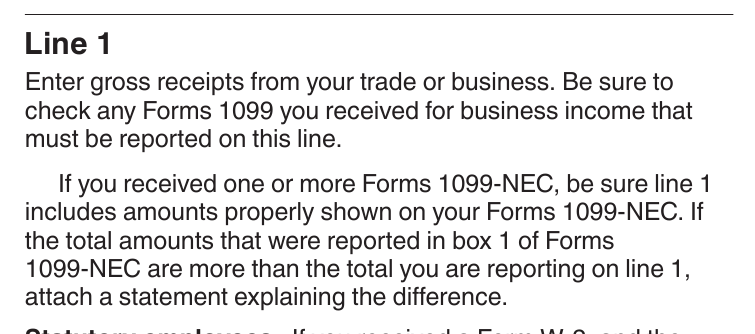
"Enter gross receipts from your trade or business. Be sure to check any Forms 1099 you received for business income that must be reported on this line. If you received one or more Forms 1099-NEC, be sure line 1 includes amounts properly shown on your Forms 1099-NEC. If the total amounts that were reported in box 1 of Forms 1099-NEC are more than the total you are reporting on line 1, attach a statement explaining the difference."
Read it as the landing it is. Line 1 takes the filer's actual gross receipts — the amount received. Publication 334 (2025) prints the same boundary from its side, in its "Nonemployee compensation" passage: business income includes amounts received "that were properly shown on Forms 1099-NEC." When the box-1 total exceeds the line 1 total, the instructions do not send the filer hunting for an adjustment line; they print exactly one reconciliation, and it is the attached statement explaining the difference. That statement is the whole of the printed fix on Schedule C. The sequence for a wrong NEC is therefore: ask the payer for the correction (Step 2's machine — a wrong amount is Error Type 1), and if no corrected copy arrives by filing time, report the actual amount on line 1 with the statement attached. The example below runs exactly that sequence.
One passage on the NEC's back begins with a belief about the form — "If you believe you are an employee and cannot get the payer to correct this form…" — and ends at Form 8919. That is a worker-classification route, not an amount route. It is named here so a reader who finds it does not mistake it for this article's topic, and it is not walked: this site never decides a classification.
§5Step 4: the K route — ask, don't wait, and the zero-out
Form 1099-K (Rev. December 2026) prints no "incorrect?" passage either. Its Instructions for Payee name the contact instead: "If you have questions about the amounts reported on this form, contact the FILER whose information is shown in the upper-left corner on the front of this form" — and, if the filer is not recognized, the PSE whose name and phone number sit in the lower-left corner. The form then points to the IRS's 1099-K pages, and those pages print the route.
First, a check the K's own box prints before any error is alleged. Box 1a is a gross figure by design: "The gross amount is the total dollar amount of total reportable payment transactions without regard to any adjustments for credits, cash equivalents, discount amounts, fees, refunded amounts, shipping amounts, or any other amounts." The what-to-do page prints the consequence for the business filer: fees, credits, refunds, shipping, cash equivalents, and discounts "are not taxable income. You can deduct them from the gross amount. Check your records." A K that is larger than your receipts because it carries your fees and refunds inside it is not an incorrect K; it is the form working as printed, and the difference comes out in your own figures, from your records.
When the K should not have reached you at all — the page's printed cases are personal payments from family or friends, a form that doesn't belong to you, and a duplicate of a K already received — the page's instructions run: "Contact the issuer immediately" and "Ask for a corrected Form 1099-K that shows a zero amount." Keep the original form and all correspondence. And, in the page's bold: "Don't wait to file your taxes. File even if you can't get a corrected Form 1099-K." For incorrect information — a wrong TIN or a wrong gross amount — the page prints the same ask ("Request a corrected form from the issuer"), the same recordkeeping, and one boundary stated flatly: "Don't contact the IRS. We can't correct your Form 1099-K." For a wrong gross amount it prints the filing instruction in its own words: "Report the amount from your incorrect Form 1099-K in the entry space at the top of Schedule 1 (Form 1040)."
The Form 1099-K FAQs (as updated by Fact Sheet 2025-08) print the Schedule 1 mechanic with the IRS's own example. A filer received a Form 1099-K for $11,000 a roommate sent for their share of rent — not income. The FAQ's entries: on Schedule 1 (Form 1040), enter the error on Part I, line 8z, Other income: "Form 1099-K received in error, $11,000"; adjust it on Part II, line 24z, Other adjustments: "Form 1099-K received in error, $11,000." "These 2 entries note the error and result in a $0 net effect on your adjusted gross income (AGI)." The FAQ's framing sentence is the whole rule: "If you can't get a corrected Form 1099-K, don't wait to file your return. You can zero out the error when you file your return." The same pages print the personal-item branch: an item sold at a loss is not deductible, but the reported gross can be zeroed out the same way — the payment reported at the top of Schedule 1, or on Form 8949 into Schedule D; an item sold at a gain goes on Form 8949 and Schedule D as a gain. Place a 1099-K amount with the 1099-K box-to-line mapper.
Hold the fence around this step: the Schedule 1 route is printed for Form 1099-K. It is not printed for a wrong 1099-NEC or 1099-MISC amount, and this article does not carry it across — those forms' printed routes are Steps 1 and 3.
§6Step 5: when the money was never yours — the nominee route
A wrong amount on your own income is one case; a form for money that belongs to someone else is another, and the General Instructions (2025) print its route in Part A. "If you receive a Form 1099 for amounts that actually belong to another person, you are considered a nominee recipient." The nominee must file a Form 1099 with the IRS — the same type of form received — for each of the other owners, showing the amounts allocable to each, furnish a Form 1099 to each other owner, and file the new forms with Form 1096, listing yourself as the "payer" and the other owner as the "recipient." Two printed edges: "A spouse is not required to file a nominee return to show amounts owned by the other spouse," and "The nominee, not the original payer, is responsible for filing the subsequent Forms 1099 to show the amount allocable to each owner." The original payer is out of this branch entirely; the correction runs through the person who received the form.
§7The worked example
One worked example, with numbers used only in this article. These are hypothetical figures, not a prediction and not your numbers.
A freelance designer — a sole proprietor, filing for the first time — was paid across the year by one large client, a small retailer. Her invoices and her bank deposits agree: she actually received $47,300. The client's Form 1099-NEC shows $52,300 in box 1a — the client's bookkeeping counted one $5,000 invoice twice, and the second $5,000 was never paid or received. The overstatement is $5,000.
- Step 1 — ask for the correction (Step 2's machine). She asks the client for a corrected 1099-NEC. A wrong money amount is Error Type 1, so the payer's correction is one new return with the CORRECTED box checked, showing $47,300. The $100 safe harbor cannot shelter a $5,000 error — and had the error been $100 or less, her election alone would still have forced a corrected statement.
- Step 2 — no corrected copy by filing time (Step 3's landing). She reports line 1 = $47,300 — what she received. Because the box-1 total ($52,300) is more than line 1, she attaches the statement the instructions print: the payer's form double-counted a $5,000 invoice; $47,300 was received.
- Step 3 — the Schedule C result. Expenses of $13,900 → line 31 = $47,300 − $13,900 = $33,400.
- Step 4 — the self-employment tax. This is her only self-employment income; she has no W-2 Social Security wages, and the amount stands far below the 2026 wage cap of $184,500, so the full rate applies. Schedule SE line 4c = $33,400 × 92.35% = $30,844.90. Line 12, the self-employment tax, = $30,844.90 × 15.3% = $4,719.27, entered on Schedule 2, line 4. Line 13, the one-half deduction, = $4,719.27 × 50% = $2,359.64, entered on Schedule 1, line 15.
The stakes — what the form's number would have cost. Had she reported the form's $52,300 instead: line 31 = $38,400 → × 92.35% = $35,462.40 → self-employment tax of $5,425.75. The difference is $706.48 — self-employment tax on $5,000 she never received. (Cross-check: $5,000 × 92.35% × 15.3% = $706.48.) Reporting the actual amount, with the statement attached, is what keeps that $706.48 off the return.
§8Step 6: found it after filing — and the fences
The printed routes above all run before filing. For the error discovered after the return is filed — or a corrected copy that arrives after you already reported the actual amount — no document read for this article prints a recipient-side instruction. That absence is recorded here rather than filled in from practice: what the pages do print is the recordkeeping line — keep the original form, the corrected form, and all correspondence with the payer or issuer. Changing a return that is already filed is the amend route, and Article 38 reads Form 1040-X; this article prints no amend steps of its own.
The fences, collected. No form at all is Article 3, not this article. Issuing or correcting a form as a payer is Article 18, not this article. The already-filed case is Article 38, by pointer only. And the Form 8919 passage on the NEC's back is a classification route, named in Step 3 and not walked. This article reads the printed recipient routes and adjudicates no reader's dispute with any payer: whether a specific payer must correct a specific form in a specific disagreement is a question the documents' rules frame but this page does not decide.
§9Two payers, one statement
The worked example has one payer and one doubled invoice. The ledger below is a second illustration, as of 2026-10-26, with two payers — because the line 1 rule runs on totals, and a filer with more than one Form 1099-NEC reconciles the whole stack, not one form at a time. Payer A is correct; Payer B counted one invoice twice. No expense or self-employment-tax figure is recomputed here: this block is the line 1 reconciliation only.
| Payer | Form box 1 total | Actually received | Difference |
|---|---|---|---|
| Payer A (correct) | $23,410 | $23,410 | $0 |
| Payer B (one invoice counted twice) | $29,860 | $27,215 | $2,645 |
| Totals | $53,270 | $50,625 | $2,645 |
Line 1 reports $50,625 — what was actually received. Because the box 1 total of $53,270 is more than line 1, the attached statement explains the whole difference in one sentence: the payer's forms total $53,270; $50,625 was received; the $2,645 difference is Payer B's invoice counted twice. One statement carries the full gap; the instructions print no per-payer statement and no second reconciliation. And the $100 safe harbor does not touch this ledger: at $2,645 the error stands far outside it, so no recipient election is needed to force a corrected statement — the correction is asked for, and the statement is attached, on the same route the worked example walks.
The year with no form at all is Article 3; the payer's side of the correction machine is Article 18; and the error found after filing is Article 38, by pointer only. How each figure above was checked is described on How we verify.
Sources
15 claimsEvery claim above traces to a document, a tax year, a line, and the date it was checked.
-
1
"Form 1099-MISC incorrect? If this form is incorrect or has been issued in error, contact the payer. If you cannot get this form corrected, attach an explanation to your tax return and report your information correctly"; Copy B prints "CORRECTED (if checked)"
- DOC
- Form 1099-MISC
- YEAR
- Rev. December 2026
- LINE
- Instructions for Recipient; Copy B
- CHECKED
- 2026-10-18
-
2
"Enter gross receipts from your trade or business… If the total amounts that were reported in box 1 of Forms 1099-NEC are more than the total you are reporting on line 1, attach a statement explaining the difference"; Part I introduction: "Be sure to report all income attributable to your trade or business from all sources"
- YEAR
- 2025
- LINE
- "Line 1," p. 5; Part I introduction, p. 5
- CHECKED
- 2026-10-18
-
3
Business income includes amounts received "that were properly shown on Forms 1099-NEC"; a filer must report all business income, "including income not reported to you on a Form 1099 filed by the payor." Pub. 334 prints no recipient steps for an incorrect form — no "ask the payer" or "contact the payer" passage exists in it, and "corrected" appears only in a forms list (Form W-2c)
- YEAR
- 2025
- LINE
- Ch. 5, "Nonemployee compensation," p. 21; Ch. 5 introduction, p. 21
- CHECKED
- 2026-10-18
-
4
Form 1099-NEC's recipient instructions print no incorrect-amount passage in either current revision; the only "correct"-family passages are the Form 8919 classification route ("If you believe you are an employee…") and the not-SE-income pointer to Schedule 1
- YEAR
- Rev. April 2025; Rev. December 2026
- LINE
- Instructions for Recipient (both revisions)
- CHECKED
- 2026-10-18
-
5
A payer that discovers an error must "Correct it as soon as possible" and "Furnish statements to recipients showing the correction"; an "X" in the CORRECTED checkbox goes "only when correcting a form previously filed with the IRS or furnished to the recipient"; a date may be entered next to the checkbox to help the recipient with multiple corrections; an "X" in the VOID box does not correct a previously filed return
- DOC
- General Instructions for Certain Information Returns
- YEAR
- 2025
- LINE
- Part H, "Corrected Returns on Paper Forms"; Part I (VOID)
- CHECKED
- 2026-10-18
-
6
Error Type 1 = "Incorrect money amount(s), code, or checkbox" → one new return, CORRECTED checked, correct amounts, new Form 1096. Error Type 2 = no or incorrect payee TIN, incorrect payee name, or wrong type of return → two returns (a -0- CORRECTED return, then a fresh original; one Form 1096 marked "Filed To Correct TIN." / "Name." / "Return.")
- DOC
- General Instructions for Certain Information Returns
- YEAR
- 2025
- LINE
- Part H, error charts
- CHECKED
- 2026-10-18
-
7
De minimis safe harbor: an amount incorrect by no more than $100 (tax withheld: no more than $25) needs no correction and is treated as correct — but "This safe harbor provision shall not apply if a recipient to whom a statement is required to be furnished elects to receive a corrected statement. In that case, a corrected return must be filed with the IRS and a corrected payee statement furnished to the recipient."
- DOC
- General Instructions for Certain Information Returns
- YEAR
- 2025
- LINE
- De minimis safe harbor (§§6721(c)(3)/6722(c)(3), T.D. 9984)
- CHECKED
- 2026-10-18
-
8
Nominee recipient: a person who receives a Form 1099 for amounts that belong to another person must file the same type of Form 1099 for each other owner (themselves as "payer," the other owner as "recipient"), with Form 1096, and furnish copies to each owner; a spouse is not required to file a nominee return for the other spouse; "The nominee, not the original payer, is responsible"
- DOC
- General Instructions for Certain Information Returns
- YEAR
- 2025
- LINE
- Part A, nominee/middleman
- CHECKED
- 2026-10-18
-
9
Form 1099-K payee text: questions go to the FILER (upper-left corner); an unrecognized filer means contacting the PSE (lower-left corner); box 1a is "the total dollar amount of total reportable payment transactions without regard to any adjustments for credits, cash equivalents, discount amounts, fees, refunded amounts, shipping amounts, or any other amounts." The K prints no "incorrect? attach an explanation" passage
- DOC
- Form 1099-K
- YEAR
- Rev. December 2026
- LINE
- Instructions for Payee; box 1a note
- CHECKED
- 2026-10-18
-
10
Form received when it shouldn't have (personal payments; doesn't belong to you; duplicate): "Contact the issuer immediately"; "Ask for a corrected Form 1099-K that shows a zero amount"; keep the original and all correspondence; "Don't wait to file your taxes. File even if you can't get a corrected Form 1099-K." Incorrect information: request a corrected form; "Don't contact the IRS. We can't correct your Form 1099-K"; wrong gross amount: "Report the amount from your incorrect Form 1099-K in the entry space at the top of Schedule 1 (Form 1040)." Gross by design: fees, credits, refunds, shipping, cash equivalents, discounts "are not taxable income. You can deduct them from the gross amount. Check your records." Personal item sold at a loss: the loss is not deductible, but the gross can be zeroed out — at the top of Schedule 1, or on Form 8949 into Schedule D; sold at a gain: Form 8949 + Schedule D
- YEAR
- Living web text, read 2026-10-18
- LINE
- Whole page
- CHECKED
- 2026-10-18
-
11
The zero-out mechanic with the IRS's example: a $11,000 Form 1099-K for a roommate's rent share — Schedule 1, Part I, line 8z: "Form 1099-K received in error, $11,000"; Part II, line 24z: "Form 1099-K received in error, $11,000"; a "$0 net effect" on AGI. "If you can't get a corrected Form 1099-K, don't wait to file your return. You can zero out the error when you file your return."
- YEAR
- As updated by Fact Sheet 2025-08 (Oct. 23, 2025)
- LINE
- A4
- CHECKED
- 2026-10-18
-
12
Timing gap (verified): no document read for this article prints a recipient-side instruction for an error found after filing, or for a corrected form arriving after the actual amount was reported; the printed recordkeeping lines (keep the original form, the corrected form, and all correspondence) are the only post-filing text
- DOC
- All documents above
- YEAR
- Editions as cited
- LINE
- Whole documents
- CHECKED
- 2026-10-18
-
13
Case check (verified negative): CourtListener searches restricted to the Tax Court corpus — "erroneous" + "1099," "1099-MISC" + "did not receive," "information return" + "overstated," "1099" + "not income," "Form 1099-K" + "error" — return no case; the only unfiltered hits were a bankruptcy case and a Minnesota state case, neither a Tax Court case on a recipient reporting actual income against a wrong 1099 amount. No case block is printed in this article
- DOC
- CourtListener Tax Court corpus
- YEAR
- Searched 2026-10-18
- LINE
- Whole corpus
- CHECKED
- 2026-10-18
-
14
Worked-example arithmetic (computed 2026-10-18): $47,300 − $13,900 = $33,400; $33,400 × 92.35% = $30,844.90; $30,844.90 × 15.3% = $4,719.27; $4,719.27 × 50% = $2,359.64; wrong path: $52,300 − $13,900 = $38,400; $38,400 × 92.35% = $35,462.40; $35,462.40 × 15.3% = $5,425.75; difference $5,425.75 − $4,719.27 = $706.48; cross-check $5,000 × 92.35% × 15.3% = $706.48
- DOC
- Computed from the example's stated figures
- YEAR
- 2026
- LINE
- —
- CHECKED
- 2026-10-18
-
15
The two-payer ledger arithmetic: $23,410 + $29,860 = $53,270 of box 1 total; $23,410 + $27,215 = $50,625 actually received; $53,270 − $50,625 = $2,645 explained by the attached statement
- YEAR
- 2025
- LINE
- "Line 1," p. 5 (attach a statement explaining the difference)
- CHECKED
- 2026-10-26
Update log
Changes are dated and kept. Old figures are never silently overwritten.
Browse the Schedule C hub — its lines, articles, and tools.
- Same form Do I Have to Report Income Without a 1099? (2026)
- Next form Self-Employment Tax 2026, Line by Line: Where It Is Figured — Schedule SE, Line 12
- Tool Schedule SE Estimator
Free one-page sheet: The $1,000 Line reads the $1,000 test on the 2026 Estimated Tax Worksheet.